
Pollination Efficiency of Indigenous Insects on Major Nigerian Crops: A Case Study of Cocoa, Cashew, and Oil Palm Farms
-
Moses Adondua Abah


Department of Biochemistry, Faculty of Biosciences, Federal University Wukari, Wukari, Taraba State, Nigeria
Micheal Abimbola OladosuDepartment of Biochemistry, Faculty of Basic Medical Sciences, University of Lagos, Idi-Araba, Lagos Nigeria
Sarah Oluwaseun JuliusDepartment of Microbiology, Faculty of Science, University of Ibadan, Ibadan, Oyo State, Nigeria
Silas Verwiyeh TatahDepartment of Biochemistry, Faculty of Biosciences, Federal University Wukari, Wukari, Taraba State, Nigeria
Abah Sarah OnyeocheDepartment of Nursing, College of Health Sciences, Benue State University, Makurdi, Benue State, Nigeria
| Received 01 May, 2025 |
Accepted 10 Sep, 2025 |
Published 30 Sep, 2025 |
The pollination activities of indigenous species are crucial for sustaining food production and enhancing the yield of cocoa (Theobroma cacao), cashew (Anacardium occidentale), and oil palm (Elaeis guineensis) in Nigeria. Native pollinators especially stingless bees, flies, and beetles significantly improve pollination efficiency, resulting in better fruit yield, seed quality, and crop resilience. Their role as providers of vital ecosystem services directly influences crop productivity and agricultural sustainability. However, their effectiveness is increasingly threatened by seasonal fluctuations, land-use changes, and climate variability. Unlike introduced species, indigenous pollinators are better adapted to local environments, making them more effective and resilient. Beyond pollination, native species contribute to soil health, biodiversity, and ecosystem balance, key elements of sustainable agriculture. Conservation strategies such as preserving natural habitats, protecting floral resources, practicing agroecology and agroforestry, intercropping, and reducing chemical pesticide use are vital. These efforts help maintain consistent food sources and safe habitats for pollinators. Integrating scientific knowledge with traditional practices can inform locally appropriate conservation solutions. Despite their importance, native pollinators face threats from habitat loss, pesticides, and environmental degradation. There is an urgent need for integrated policies to protect these species while improving agricultural productivity. Supporting indigenous pollinators is essential for food security and promoting sustainable farming systems in Nigeria.
| Copyright © 2025 Abah et al. This is an open-access article distributed under the Creative Commons Attribution License, which permits unrestricted use, distribution, and reproduction in any medium, provided the original work is properly cited. |
INTRODUCTION
The success of global food production depends heavily on pollination, with over 75% of leading food crops requiring animal pollinators for reproduction1. In tropical regions, effective pollination enables crops to reach maximum yields while supporting biodiversity and ecosystem stability2. Enhancing pollination services offers a sustainable solution to boost food production without expanding farmland, addressing growing food insecurity in developing nations3. In Nigeria, crops such as mango, citrus, cocoa, cashew, and oil palm rely heavily on pollination4. A decline in pollination leads to poor fruit development, reduced yields, and economic losses, especially for smallholder farmers. Practices like agroforestry, planting flowering cover crops, and reducing pesticide use can significantly improve pollination efficiency5.
Crop sustainability in tropical systems relies largely on indigenous pollinators like stingless bees, carpenter bees, butterflies, and beetles. Indigenous pollinators outperform European honeybees in tropical habitats due to their natural adaptations and resilience to environmental stresses6. Smallholder farmers, native pollinators are vital, enhancing both fruit yield and quality in cashew, cocoa, and oil palm farming. However, their populations face major threats from pesticide use, deforestation, expanding monocultures, and climate change7. Conservation efforts such as farmer education, habitat restoration, and agri-environmental schemes are critical for improving crop yields while preserving tropical ecosystems sustainably8.
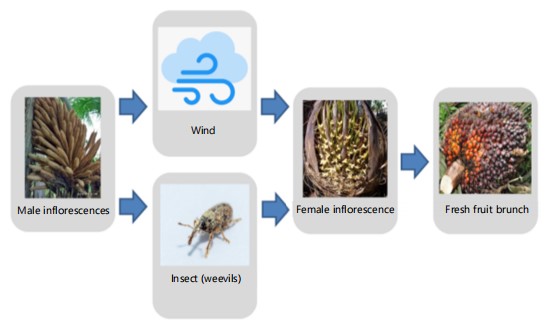
This review underscores the vital role of insect pollinators in supporting key Nigerian crops like cocoa, cashew, and oil palm, crucial for food security and exports. Despite threats like habitat loss, pesticides, and climate change, agricultural policies often neglect pollinators. Highlighting their ecological and economic value is key to promoting sustainable farming. Figure 1 shows oil palm pollination by insects like weevils, essential for fruit production.
OVERVIEW OF MAJOR NIGERIAN CROPS AND THEIR POLLINATION BIOLOGY
Numerous districts throughout Nigeria support the cultivation of cocoa and cashew, and oil palm because these tree crops advance both economic performance and sustainable rural development10. The pollination processes of these crops affect their fruit production and yield potential individually. The pollination of cocoa (Theobroma cacao) in Southwestern States relies on Forcipomyia spp., midges, but ineffective natural pollination occurs because these pollinators are infrequently active11. Each Central and Southeastern State, together with Kogi and Oyo, maintains cashew (Anacardium occidentale) as its main agricultural product because bees, ants, flies, and wasps serve as the primary pollinators. Thanks to these insects, the process of cross-pollination develops nuts better and increases total agricultural12. Crop productivity, together with sustainable agricultural practices, depends heavily on proper pollination management in these plant systems.
|
Pollination mechanisms in cocoa (Theobroma cacao): The majority of cocoa (Theobroma cacao) pollination results from insect cross-pollination managed mostly by midges (Ceratopogonidae) per13. Flowers on the cocoa plant are both male and female, but they cannot produce healthy offspring from their pollen; therefore, they need cross-pollination from different plants. The flower fragrance draws pollinating midges because these flies seek nectar during foraging. The flying insects move from one cocoa flower to another as they gather pollen from anthers until they feed the collected material onto the female stigma of separate11. Too few pollinators anywhere along with unwelcoming natural conditions and inadequate flower quantity, affect the efficiency of cross-pollination12. The floral structure impedes extensive wind-driven pollen movement, so this wind mechanism contributes only minimally to pollination. Artificial pollination combined with habitat conservation represents two important methods to support pollinator effectiveness while improving cocoa production13.
Floral biology and pollination of cashew (Anacardium occidentale): All flowers of the Anacardium occidentale cashew plant present as and romonoecious types with both bisexual and male flowers located together on each inflorescence. The plant displays small scented flowers that grow in groups at the tip of each branch and bloom during the dry season when pollinators reach their most active state15. The bisexual flowers act as a reproductive system for fruit development, but male flowers enhance pollination availability and attract pollinators. The main pollinators for cashew flowers are bees known as Apismellifera, together with ants, flies, and wasps. Insects are attracted to cashew flower nectar and scents so they will naturally carry male pollen between the anthers to the female stigma during their foraging activities. The cross-pollination process leads to improved cashew nuts by promoting development and better yield and quality results14-16.
Reproductive strategy and pollination in oil palm (Elaeis guineensis): Elaeis guineensis adopts dichogamy in combination with monoecism to achieve cross-pollination by delaying the production times of male and female inflorescences on each plant17. Male inflorescences of the oil palm plant dominate by providing abundant pollen during their first emergence period before female inflorescences reach their receptive stage for fertilization. A single inflorescence contains hundreds to thousands of flowers combined in a compact spike form that enables mass pollination events18. Researchers have revealed wind-pollination was incorrectly perceived for oil palm after demonstrating that the insects, specifically Elaeidobius kamerunicus small weevils, function as the primary pollinators throughouNt various oil palm cultivation areas19. These sensitive insects detect the scent profiles from both male and female flowers through released volatile organic compounds that duplicate one another20. The feeding and breeding habits of weevils supply pollen between male flowers and female flowers to accomplish fertilization between the sexes.
Indigenous insect pollinators in Nigerian agroecosystems: The agricultural industry benefits extensively from insect involvement, since insects facilitate crop pollination in particular. Household insects play an essential role in achieving successful pollination of cocoa, cashew, and oil palm, which serve as important cash crops in Nigerian agroecosystems. The combination of pollinators that encompasses stingless bees and hoverflies, and beetles functions as a key force to increase crop production and biodiversity21. Determining the distinct insect species alongside their foraging actions and environmental functions enables better agricultural sustainability on oil palm and cocoa, and cashew farms. Table 1 provides details about flower characteristics along with pollination methods of cocoa, cashew, and oil palm.
Common indigenous insect pollinators: Farmers in Nigerian agricultural areas commonly encounter stingless bees of the Meliponini genus alongside hoverflies from Syrphidae as well as sweat bees from Halictidae, combined with carpenter bees from Xylocopa spp., and beetle species from Coleoptera. These insects serve essential functions by pollinating three important crops: Cocoa (Theobroma cacao), cashew (Anacardium occidentale), and oil palm (Elaeisg uineensis). The pollinators responsible for cocoa production are mainly midges (Forcipomyia spp.), while bees and fly species attract cashew pollination, and weevils (Elaeidobius kamerunicus) support oil palm reproduction22.
| Table 1: | Floral traits and pollination requirements of cocoa, cashew, and oil palm | |||
| Crop | Floral traits | Pollination requirements |
| Cocoa (T. cacao) | Small, hermaphroditic flowers; pale pink/white; cauliflorous (on trunk/branches); complex hooded morphology; short-lived (24-48h); early anthesis |
Requires cross-pollination by midges (Forcipomyia spp.); needs humid, shaded environments; natural fruit set is very low |
| Cashew (A. occidentale) | Andromonoecious (male+bisexual flowers); small creamy/yellowish flowers in panicles; open early in the day; short-lived |
Pollination by bees, ants, flies, and both self- and cross-pollination requires adequate pollinator presence |
| Oil palm (E. guineensis) | Monoecious (separate male and female inflorescences); large, cream/yellow flowers in dense clusters; anthesis during day; female flowers long-lived |
Cross-pollinated by weevils (Elaeidobius kamerunicus); minimal wind role; high success with insect pollinators |
Habitat, behavior, and foraging patterns: The agroecosystems contain pollinators that mainly thrive in forest borders, domestic gardens, and shaded farmland areas. The Hiving behavior of stingless bees involves using tree hollows for their nests, yet carpenter bees construct their homes in woody stems. The decomposition products where flies and beetles reside are typically moist or damp areas. These pollinators display various foraging patterns by visiting cocoa together with cashew and oil palm flowers through early mornings and late afternoons21. These pollinators have an essential role in improving crop yields because they can successfully pollinate different flowering plants within the agroecosystems.
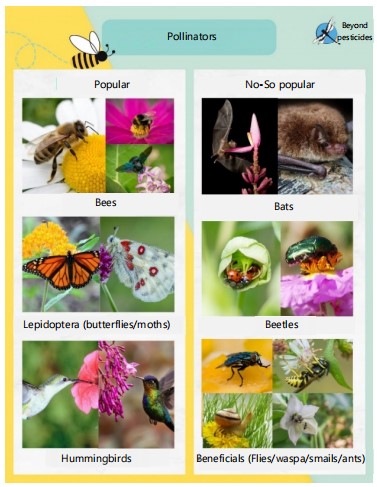
Ecological roles beyond pollination: Indigenous pollinators play several ecological roles beyond pollination. For example, hoverflies are effective natural pest controllers, and beetles contribute to soil aeration and decomposition, enriching soil health. These roles are essential not only for enhancing crop production in cocoa, cashew, and oil palm farms but also for maintaining ecosystem resilience and biodiversity23. The conservation of these insect populations ensures a sustainable agroecosystem, which is vital for long-term agricultural productivity. Figure 2 shows both popular and lesser-known pollinators. Popular pollinators like bees, butterflies, and hummingbirds are well recognized, while bats, beetles, and other beneficial insects (flies, wasps, snails, and ants) are less known but equally important. Together, they all play vital roles in pollination and maintaining healthy ecosystems.
Table 2, highlights the main insect pollinators for cocoa, cashew, and oil palm crops. Cocoa is mostly pollinated by Forcipomyia midges, with other flies and stingless bees occasionally contributing. Cashew depends largely on the African honeybee, which supports both self- and cross-pollination, while stingless bees, sweat bees, and some flies play secondary roles. For oil palm, the oil palm weevil is the principal pollinator, with other beetles and carpenter bees providing occasional support. This shows how different insect groups play varying roles in pollination, which is vital for crop production.
Pollination efficiency of indigenous insects: The service of pollination through insects plays an essential role in agriculture because it regulates food production and stability and enhances biodiversity. Native insect pollinators remain unrecognized for their crucial contribution to sustaining the major crops of cocoa, cashew, and oil palm in Nigeria’s agricultural systems3. The local climates, as well as the vegetation and floral structures, match better with indigenous pollinators compared to managed and introduced species. Researchers need to understand pollination efficiency because it gives them fundamental knowledge to develop agricultural solutions based on nature, which work better under ecological changes and growing land use problems25.
Measurement of pollination efficiency: The evaluation of pollination efficiency usually involves measuring fruit set percentages together with fruit dimensions and seed numbers per fruit, and total yield numbers. Studies indicate that native midges (Forcipomyia spp.) boost cocoa fruit set only when their species exists abundance in natural habitats25. Stingless bees alongside sweat bees benefit cashew flower pollination because they contribute to superior seed quality, together with increased nut sizes7. Under favorable conditions Elaeidobius kamerunicus weevils enhance the fruit bunch weight and oil yield in oil palm while providing effective pollination services.
|
| Table 2: | Indigenous insect species associated with cocoa, cashew, and oil palm | |||
| Crop | Insect pollinator species | Pollinator group | Pollination role |
| Cocoa (T. cacao) | Forcipomyia spp. (biting midges) Stomoxys spp., Clogmia albipunctata Meliponula spp., (stingless bees) |
Diptera (Ceratopogonidae) Diptera (Varied families) Hymenoptera (Apidae) |
Primary pollinators Supplementary pollinators Occasional flower visitors |
| Cashew (A. occidentale) | Apis mellifera adansonii (African honeybee) Trigona spp., (stingless bees), Halictus spp., (sweat bees) Musca domestica, Calliphora spp., (house and blow flies) |
Hymenoptera (Apidae) Hymenoptera (Apidae/Halictidae) Diptera |
Main pollinator; facilitates both self and cross-pollination Secondary pollinators Occasional pollinators |
| Oil palm (E. guineensis) | Elaeidobius kamerunicus (oil palm weevil) Microporum spp., Prosoestus spp. Xylocopa spp., (carpenter bees) |
Coleoptera (Curculionidae) Coleoptera (Nitidulidae) Hymenoptera (Apidae) |
Principal pollinator Supplementary pollinators Occasional visitors (limited pollination role) |
COMPARATIVE EFFICIENCY BETWEEN INDIGENOUS AND INTRODUCED POLLINATORS
Pollinators that originate from local regions demonstrate superior abilities to thrive in their native crops, together with environmental factors in relation to foreign species, according to comparative research. The African honeybee (Apis mellifera adansonii) shows success in cashew pollination, yet native stingless bees demonstrate superior constant floral behavior along with enhanced stress tolerance that enables better pollination quality than honeybees26. Research reveals that the oil palm pollination weevil E. kamerunicus became a dominant pollinator after naturalizing in Nigeria, even though it initially entered Nigeria from Cameroon27.
|
| Table 3: | Yield comparisons in farms with high vs. low pollinator diversity | |||
| Crop | Pollinator diversity | Average yield | Observed benefits |
| Cocoa | High | 650-800 kg/ha | Higher fruit set, better pod development |
| Low | 350-500 kg/ha | Misshapen pods, lower bean count | |
| Cashew | High | 900-1200 kg/ha (nuts) | Improved nut size, seed quality, and uniformity |
| Low | 500-750 kg/ha | Poor nut fill, increased abortion rate | |
| Oil palm | High | 18-22 tons/ha (FFB) | More uniform fruit ripening, increased bunch weight |
| Low | 12-15 tons/ha | Smaller bunch size, incomplete fertilization | |
| FFB: Fresh fruit bunch | |||
SEASONAL AND ENVIRONMENTAL FACTORS AFFECTING POLLINATION
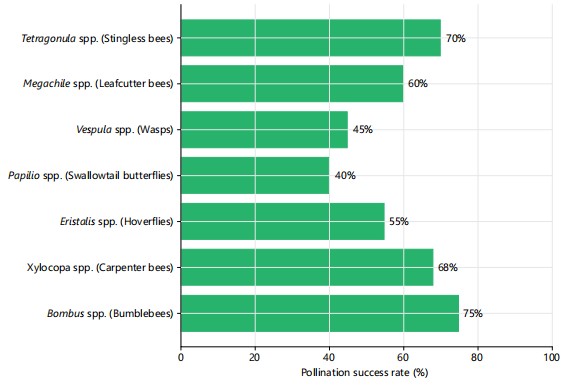
The effectiveness of pollination depends on seasonal factors that consist of rainfall amounts together with temperature conditions, and the timing of plant flowers (Fig. 3). Overall, pollinators that originate from indigenous backgrounds, including stingless bees and midges, show fresh activity schedules throughout early morning and late afternoon hours of dry season periods, according to20. Excessive rainfall at the time of cocoa flower reproduction can render midges inactive, thus resulting in decreased fruit yield. Pollination services suffer because habitat destruction and pesticide usage, and nesting habitat reduction impact the indigenous insect populations in negative ways.
Table 3 shows how different kinds of pollinators play a role in the yields and quality of crops on cocoa, cashew, and oil palm farms. Having a wide range of pollinators on a farm leads to more and better-harvested crops. For example, cocoa plants on farms with many pollinators can produce around 650-800 kg/ha, but those places with little diversity do not do as well and often see deformed pods. Just like bees in watermelons, high activity by pollinators in cashews causes the cashews to grow larger and be better filled, but a lack of pollinator types causes the nuts to ripen unevenly and leads to more becoming aborted. Oil palm produces more and more even fresh fruit bunches the more pollinators are present in the field. The research evidence highlights the key role played by pollinators in increasing the value and quality of crops grown in tropical agriculture.
FACTORS AFFECTING INDIGENOUS POLLINATORS
The pollination services of native bee colonies together with beetles and midges, and the native fly populations, boost the yields of cocoa and cashew and oil palm tree crops. Multiple environmental and anthropogenic stresses endanger these native pollinators and their population levels, together with their pollination capabilities. Agroecological strategies must be developed with full knowledge of these environmental factors29.
Land-use change and habitat fragmentation: The loss of essential natural habitat spaces for nesting and foraging activities occurs because of agricultural expansion, together with logging operations, as well as development projects that lead to ecosystem fragmentation. Fragmentation of land produces pollinator population isolation that causes reduced genetic diversity and diminished resistance within these populations30.
Pesticide use and agricultural intensification: Industrial chemicals utilized throughout cashew and oil palm plantations create detrimental effects on insect pollinator condition as well as behavior patterns. Sub-lethal pesticide exposure creates adverse effects on foraging capacity and navigation, and reproduction abilities in Halictid bees and Meliponula spp. Plants become more isolated from one another when farmers plant only one crop type because it eliminates the seasonal variety of blooming flowers7.
Climate change and seasonal variability: Formal climate variations such as temperature escalation, together with changed rainfall patterns and abnormal weather patterns, create disharmony between pollen availability and pollinator movement schedules. The activity of midges decreases when heavy rainfall occurs during cocoa flowering season, thereby causing poor fruit set according to25, cashew farms have been shown to face challenges to both nesting and foraging activities of stingless bees and sweat bees because of dry seasonal conditions31.
Conservation and sustainable pollination strategies: Conservation and sustainable pollination strategies are vital for maintaining healthy ecosystems and ensuring consistent yields of pollinator-dependent crops such as cocoa, cashew, and oil palm. These strategies involve protecting natural habitats15, promoting agroecological practices25 and integrating indigenous knowledge with scientific approaches. Together, they help sustain pollinator populations, enhance biodiversity, and support more resilient and productive farming systems.
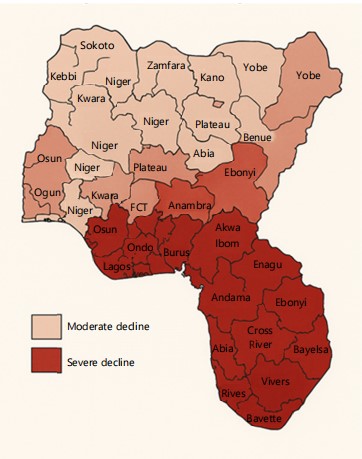
Protecting natural habitats and floral resources: Protecting natural habitats and maintaining diverse floral resources are crucial for sustaining healthy pollinator populations, particularly in agricultural landscapes where crops like cocoa, cashew, and oil palm depend on insect pollination32. Natural habitats such as forests, wildflower meadows, and riparian zones serve as nesting sites and foraging grounds for bees, midges, and weevils that pollinate these crops33. Conservation efforts that preserve or restore these habitats can significantly improve pollination services and contribute to sustainable agricultural production. The map in Fig. 4, illustrates farming areas in Nigeria where the populations of pollinators are decreasing.
Promoting agroecological farming practices: Agroecological farming practices enhance pollinator diversity and abundance by creating more hospitable environments within agricultural landscapes32. Techniques such as intercropping, agroforestry, cover cropping, and reduced pesticide use support natural pollinators by providing continuous floral resources, shelter, and safe nesting areas33. For pollinator-dependent crops like cocoa, cashew, and oil palm, agroecological methods such as shade-grown systems and diversified planting improve microclimatic conditions and habitat structure, which in turn boost pollination efficiency and crop yields34 control, and climate resilience, making them a key strategy in sustainable agricultural development.
|
| Table 4: | Conservation strategies and their impacts on pollinator abundance3 | |||
| Conservation strategy | Description | Impact on pollinators | Example (cocoa, cashew, oil palm) |
| Protection of natural habitats |
Preserving forests, buffer zones, and wild vegetation near farms |
Increases nesting and foraging sites; supports diverse pollinator species |
Forest patches around cocoa and and cashew farms support bees and midges |
| Agroecological farming practices |
Use of shade trees intercropping, minimal pesticide application |
Enhances floral diversity, reduces chemical exposure, and promotes habitat complexity |
Shade-grown cocoa and cashew agroforestry systems enhance pollinator activity |
| Floral resource management |
Planting native flowering plants or hedgerows |
Provides year-round nectar/ pollen; sustains pollinators during crop off-seasons |
Wildflower strips near oil palm and cashew plantations |
| Reduced chemical use | Limiting pesticides and herbicides through IPM or organic practices |
Protects pollinator health and boosts population resilience |
Integrated pest management in in cocoa and oil palm farms |
| Integration of indigenous knowledge |
Utilizing local knowledge of pollinators and traditional land-use practices |
Improves local adaptation of pollinator-friendly practices and ecosystem management |
Indigenous timing of cocoa flowering and planting supports midge activity |
| Scientific monitoring & education |
Training farmers and using data to manage pollination and biodiversity |
Helps maintain optimal conditions for pollinators through informed decision-making |
Training cashew farmers in bee- friendly farming and pollination tracking |
INTEGRATING INDIGENOUS KNOWLEDGE WITH SCIENTIFIC APPROACHES
Combining indigenous knowledge with scientific approaches enhances sustainable pollination strategies by aligning traditional ecological understanding with modern agricultural science35. Indigenous communities often have deep-rooted knowledge of local ecosystems, including the behavior of pollinators, flowering cycles, and natural pest control. In cocoa, cashew, and oil palm farming, this knowledge can guide decisions on planting patterns, habitat conservation, and seasonal management practices that support pollinator health. When integrated with scientific research, such as pollinator behavior studies or biodiversity monitoring, it results in more context-specific, culturally appropriate, and ecologically sound farming systems. This synergy not only strengthens pollination services but also empowers local communities and promotes long-term sustainability.
Table 4 highlights key conservation strategies that support pollinator abundance, demonstrating how the integration of indigenous knowledge with scientific approaches enhances their effectiveness. Traditional practices, such as preserving forest patches or timing planting with flowering cycles, complement scientific methods like integrated pest management and biodiversity monitoring. Together, they promote sustainable farming systems in cocoa, cashew, and oil palm cultivation36.
CONCLUSION
Key findings show that diverse pollinator populations enhance fruit set, yield quality, and crop resilience. Natural habitats near farms support wild pollinators, such as bees, midges, and weevils, which are vital for cocoa and oil palm production. Agroecological practices and traditional knowledge further improve pollination services, boosting crop yields, quality, and reducing chemical input reliance. These strategies promote long-term sustainability by increasing biodiversity, improving soil health, and strengthening farm resilience to climate change. Future research should focus on quantifying pollinator contributions in various farming systems and identifying optimal habitat configurations for conservation, while policies prioritize habitat protection, promote agroecological farming, and support research that integrates indigenous knowledge. Strengthening education on pollination ecology will be key to scaling sustainable practices, ultimately ensuring pollinator protection, food security, and ecological balance in agriculture.
SIGNIFICANCE STATEMENT
This study explores how native insects contribute to pollinating key Nigerian crops, i.e. cocoa, cashew, and oil palm, which are vital for the country’s economy and food security. By measuring pollination efficiency, insects that are most effective in boosting crop yields are identified. These findings highlight the important role of indigenous pollinators, emphasizing the need to protect their habitats for sustainable agriculture. Understanding their contribution can help farmers improve crop productivity naturally, reducing reliance on costly or harmful alternatives. This research also encourages further studies on conserving pollinator diversity and developing farming practices that support these beneficial insects
ACKNOWLEDGMENT
We sincerely acknowledge all authors for their contributions that make this work a success.
REFERENCES
- Gintoron, C.S., M.A. Mohammed, S.N. Sazali, E.Q. Deka, K.H. Ong, I.H. Shamsi and P.J.H. King, 2023. Factors affecting pollination and pollinators in oil palm plantations: A review with an emphasis on the Elaeidobius kamerunicus weevil (Coleoptera: Curculionidae). Insects, 14.
- Wahyuni, M., Wagino and H. Manurung, 2020. The effect of palm oil planting material characteristics on the population of weevil pollinator (Elaeidobius kamerunicus). J. Phys. Conf. Ser., 1542.
- Klein, A.M., B.E. Vaissiere, J.H. Cane, I. Steffan-Dewenter, S.A. Cunningham, C. Kremen and T. Tscharntke, 2007. Importance of pollinators in changing landscapes for world crops. Proc. R. Soc. B: Biol. Sci., 274: 303-313.
- Kouakou, M., N. Hala, A. Akpesse, Y. Tuo, M. Dagnogo, K. Konan and H.K. Koua, 2014. Comparative efficacy of Elaeidobius kamerunicus, E. plagiatus, E. subvittatus (Coleoptera: Curculionidae) and Microporum spp. (Coleoptera: Nitidulidae) in the pollination of oil palm (Elaeis guineensis). J. Exp. Biol. Agric. Sci., 2: 538-545.
- Ollerton, J., R. Winfree and S. Tarrant, 2011. How many flowering plants are pollinated by animals? OIKOS, 120: 321-326.
- Meléndez, M.R. and W.P. Ponce, 2016. Pollination in the oil palms Elaeis guineensis, E. oleifera and their hybrids (OxG), in tropical America. Pesqui. Agropecu. Trop., 46: 102-110.
- Auffray, T., B. Frérot, R. Poveda, C. Louise and L. Beaudoin-Ollivier, 2017. Diel patterns of activity for insect pollinators of two oil palm species (Arecales: Arecaceae). J. Insect Sci., 17.
- Apriyanto, A. and van Basten Tambunan, 2020. The complete mitochondrial genome of oil palm pollinating weevil, Elaeidobius kamerunicus Faust. (Coleoptera: Curculionidae). Mitochondrial DNA Part B, 5: 3432-3434.
- Bentrup, G., J. Hopwood, N.L. Adamson and M. Vaughan, 2019. Temperate agroforestry systems and insect pollinators: A review. Forests, 10.
- Potts, S.G., J.C. Biesmeijer, C. Kremen, P. Neumann, O. Schweiger and W.E. Kunin, 2010. Global pollinator declines: Trends, impacts and drivers. Trends Ecol. E, 25: 345-353.
- Marja, R., D. Kleijn, T. Tscharntke, A.M. Klein, T. Frank and P. Batáry, 2019. Effectiveness of agri-environmental management on pollinators is moderated more by ecological contrast than by landscape structure or land-use intensity. Ecol. Lett., 22: 1493-1500.
- Wongnaa, C.A., A.B. Kyei, I.A. Apike, D. Awunyo-Vitor and R.K. Dziwornu, 2022. Perception and adoption of artificial pollination technology in cocoa production: Evidence from Ghana. Afr. J. Sci. Innovation Dev., 14: 1642-1654.
- Khalifa, S.A.M., E.H. Elshafiey, A.A. Shetaia, A.A. Abd El-Wahed and A.F. Algethami et al., 2021. Overview of bee pollination and its economic value for crop production. Insects, 12.
- Corley, R.H.V. and P.B.H. Tinker, 2016. The Oil Palm. 5th Edn., John Wiley and Sons, United States, ISBN: 9781118953297, Pages: 680.
- Kovács-Hostyánszki, A., A. Espíndola, A.J. Vanbergen, J. Settele, C. Kremen and L.V. Dicks, 2017. Ecological intensification to mitigate impacts of conventional intensive land use on pollinators and pollination. Ecol. Lett., 20: 673-689.
- Reuben, A., E.M. Manczak, L.Y. Cabrera, M. Alegria and M.L. Bucher et al., 2022. The interplay of environmental exposures and mental health: Setting an Agenda. Environ. Health Perspect., 130.
- Olawumi, T.O., D.W.M. Chan, A.P.C. Chan and J.K.W. Wong, 2020. Development of a building sustainability assessment method (BSAM) for developing countries in Sub-Saharan Africa. J. Cleaner Prod., 263.
- Bazurto, L.G.M., L.Á. Sánchez, F. Prada, E.S. Daza, A.E. Bustillo and H.M. Romero, 2018. Relationships between inflorescences and pollinators and their effects on bunch components in Elaeis guineensis, in Colombia. J. Entomol. Sci., 53: 554-568.
- Anning, A.K., A. Ofori-Yeboah, F. Baffour-Ata and G. Owusu, 2022. Climate change manifestations and adaptations in cocoa farms: Perspectives of smallholder farmers in the Adansi South District, Ghana. Curr. Res. Environ. Sustainability, 4.
- Ekerenam, O.O., A.I. Ikeuba, C.N. Njoku, D.I. Njoku and W. Emori et al., 2025. Advancements in corrosion studies and protective measures for copper and copper-based alloys in varied environmental conditions. Results Eng., 26.
- Theodorou, P., 2022. The effects of urbanisation on ecological interactions. Curr. Opin. Insect Sci., 52.
- Ballantyne, G., K.C.R. Baldock, L. Rendell and P.G. Willmer, 2017. Pollinator importance networks illustrate the crucial value of bees in a highly speciose plant community. Sci. Rep., 7.
- Perma, A.D., R.E. Putra, A. Susanto and A.S. Leks, 2021. Elaeidobius kamerunicus (Coleoptera: Curculionoidea): Activity on oil palm flower in Central Kalimantan, Indonesia. Pak. J. Biol. Sci., 24: 1209-1216.
- Vijay, V., S.L. Pimm, C.N. Jenkins and S.J. Smith, 2016. The impacts of oil palm on recent deforestation and biodiversity loss. PLoS ONE, 11.
- Bodeker, G. and K. Kariippanon, 2020. Traditional medicine and indigenous health in indigenous hands. Global Public Health.
- FAO, 2008. Pollination Services for Sustainable Agriculture. 1st Edn., Food and Agriculture Organization of the United Nations, Rome, Italy, Pages: 13.
- Ogunbode, A.M., M.O. Owolabi, O.O. Ogunbode, L.A. Adebusoye and A. Ogunniyi, 2022. Predictors of weight reduction in a Nigerian family practice setting. Ghana Med. J., 56: 206-214.
- Syed, R.A., 1979. Studies on oil palm pollination by insects. Bull. Entomol. Res., 69: 213-224.
- Toledo-Hernández, M., T.C. Wanger and T. Tscharntke, 2017. Neglected pollinators: Can enhanced pollination services improve cocoa yields? A review. Agric. Ecosyst. Environ., 247: 137-148.
- Fernández-Llamazares, Á., J.E. Fa, D. Brockington, E.S. Brondízio and J. Cariño et al., 2024. No basis for claim that 80% of biodiversity is found in indigenous territories. Nature, 633: 32-35.
- Garibaldi, L.A., I. Steffan-Dewenter, R. Winfree, M.A. Aizen and R. Bommarco et al., 2013. Wild pollinators enhance fruit set of crops regardless of honey bee abundance. Science, 339: 1608-1611.
- Li, K., T. Tscharntke, B. Saintes, D. Buchori and I. Grass, 2019. Critical factors limiting pollination success in oil palm: A systematic review. Agric. Ecosyst. Environ., 280: 152-160.
- Anggraeni, T., S. Rahayu, I. Ahmad, R.R. Esyanti and R.E. Putra, 2013. Resources partitioning and different foraging behavior is the basis for the coexistence of Thrips hawaiiensis (Thysanoptera: Tripidae) and Elaeidobius kamerunicus (Coleoptera: Curculionidae) on oil palm (Elaeis guineensis Jacq) flower. J. Entomol. Nematol., 5: 59-63.
- Afolayan, M.A., I. Olatayo, O.M. Abimbola, M.A. Abah and M.C. Endurance et al., 2025. The impact of agricultural extension services in promoting food security in Nigeria. Agric. Res. Technol.: Open Access J., 29.
- Silas, T.V., E.C. Stephen, M.A. Abah, A.S. Michael, U.J. Isaac and R.Y. Emochone, 2023. Growth indices of seeds (maize and cowpea) grown in heavy metal contaminated soil treated with ginger extract. Toxicol. Adv., 5.
- Otitoju, O., M.A. Adondua, O.P. Emmanuel and O.T. Grace, 2022. Risk assessment of pesticide residues in some samples of carrots (Daucus carota). Int. J. Adv. Biochem. Res., 6: 42-48.
How to Cite this paper?
APA-7 Style
Abah,
M.A., Oladosu,
M.A., Julius,
S.O., Tatah,
S.V., Onyeoche,
A.S. (2025). Pollination Efficiency of Indigenous Insects on Major Nigerian Crops: A Case Study of Cocoa, Cashew, and Oil Palm Farms. Trends in Biological Sciences, 1(2), 110-120. https://doi.org/10.21124/tbs.2025.110.120
ACS Style
Abah,
M.A.; Oladosu,
M.A.; Julius,
S.O.; Tatah,
S.V.; Onyeoche,
A.S. Pollination Efficiency of Indigenous Insects on Major Nigerian Crops: A Case Study of Cocoa, Cashew, and Oil Palm Farms. Trends Biol. Sci 2025, 1, 110-120. https://doi.org/10.21124/tbs.2025.110.120
AMA Style
Abah
MA, Oladosu
MA, Julius
SO, Tatah
SV, Onyeoche
AS. Pollination Efficiency of Indigenous Insects on Major Nigerian Crops: A Case Study of Cocoa, Cashew, and Oil Palm Farms. Trends in Biological Sciences. 2025; 1(2): 110-120. https://doi.org/10.21124/tbs.2025.110.120
Chicago/Turabian Style
Abah, Moses, Adondua, Micheal Abimbola Oladosu, Sarah Oluwaseun Julius, Silas Verwiyeh Tatah, and Abah Sarah Onyeoche.
2025. "Pollination Efficiency of Indigenous Insects on Major Nigerian Crops: A Case Study of Cocoa, Cashew, and Oil Palm Farms" Trends in Biological Sciences 1, no. 2: 110-120. https://doi.org/10.21124/tbs.2025.110.120

This work is licensed under a Creative Commons Attribution 4.0 International License.