
Molecular Characterization and Impact of Fungi Associated with Leather
-
Nnebechukwu, Ijeoma Adaku
Department of Plant Science and Biotechnology, University of Jos, Jos, Nigeria
Augustine, MeritDepartment of Plant Science and Biotechnology, Faculty of Science, University of Port Harcourt, Port Harcourt 500001, Rivers State, Nigeria
Ikechi–Nwogu, Chinyerum Gloria

Department of Plant Science and Biotechnology, Faculty of Science, University of Port Harcourt, Port Harcourt 500001, Rivers State, Nigeria
| Received 16 Apr, 2025 |
Accepted 16 Sep, 2025 |
Published 30 Sep, 2025 |
Background and Objective: Leather has a substantial economic impact because of its numerous uses in a wide range of industries, including fashion and apparel, footwear, furniture and upholstery, automotive, accessories (car seat covers), sporting goods, and economic diversification. The aim of the study is to identify the common fungal pathogens causing leather degeneration. Materials and Methods: Fungal pathogens were isolated from leather samples from shoes and car seat covers using a standard blotter method. The most common isolate was coded (RCBBR_P14). The fungal DNA was obtained and analysed using the Nanodrop 2000c spectrophotometer. The DNA sequence was attained from the IITA Bioscience Centre Ibadan, Oy, State Nigeria Ib for amplification and sequencing. Results: The morphological results indicated that the RCBBR_P14 isolate was an Aspergillus tamarii. Based on sequence similarity, the DNA sequence of the isolate was 100% identical to Aspergillus tamarii. Aspergillus tamarii is identified as a primary fungal species responsible for leather deterioration. Conclusion: Aspergillus tamarii is the primary fungal species associated with leather deterioration. This study provides valuable insights into the fungal species responsible for leather degradation, informing strategies for prevention and control.
| Copyright © 2025 Adaku et al. This is an open-access article distributed under the Creative Commons Attribution License, which permits unrestricted use, distribution, and reproduction in any medium, provided the original work is properly cited. |
INTRODUCTION
Hides and skins are regarded as a useful byproduct or co-product in animal agriculture1. They are chemically treated to prevent deterioration. According to Gillan and Murray2, they are used to produce leather, a robust, pliable, and long-lasting substance. Cattle, sheep, goats, horses, buffalo, pigs, hogs, ostriches, and aquatic creatures like seals and alligators are the most common sources of leather Based on reports of Gillan and Murray2, they are used locally for the manufacture of goods including shoes, clothes, bags, belts, hats, upholstery, interior decorating, horse tack, and harnesses.
Throughout the years, investigations have been carried out to comprehend the elements influencing the quality and longevity of leather materials. It has been found that fungal attacks on leather and leather products diminish their qualities, longevity, and value. Various types of finished leather are very susceptible to fungal attack. Hence, the biodeterioration of finished leather has become a problem of interest in recent times. According to Boahin et al.3, the harmful impact of moulds on leather has led to diminished taste among enthusiasts of indigenous leather items, threatening the industry’s future development.
These fungi pathogens have been identified using several traditional techniques; however, these techniques can occasionally be laborious, time-consuming, and inaccurate. Since some of these fungal pathogens can produce mycotoxins that could be ingested and pose major health risks, it is important to properly identify these fungal pathogens. The molecular characterization technique has been used to authenticate the identification of the fungal pathogens to accurately identify these pathogens4,5. Therefore, the purpose of this study was to identify the fungal pathogens linked to deteriorated leather and to validate the identification using a molecular characterization technique.
MATERIALS AND METHODS
Source of leather materials: Leather samples used for this study were obtained in September, 2023 from different shoes and car seat covers. The shoe leather samples were kept in the open air (under cold conditions) for 2 months (from September to October, 2023) to be exposed to microorganisms. Car leather samples used were sourced from the Upholstery Shop situated in the Mechanic Workshop opposite Olobo Comprehensive School, along East-West Road Choba, Port Harcourt Nigeria.
Isolation of fungi from leathers: The fungi associated with leather were isolated at the University of Port Harcourt, Nigeria Faculty of Science Pathology/Mycology Laboratory of the Department of Plant Science and Biotechnology in September 2023, using the modified traditional blotter method6 to examine the most common fungi isolate.
Molecular characterization using the internal transcribed spacer (ITS) marker and identification of fungi associated with leather: The Biological DNA of the isolate GN-01 was obtained following the procedure of the Quick-DNATM Fungal/Bacterial Miniprep Kit (Zymo Research Group, California, USA) as explained by the producer, with changes at the Regional Centre for Biotechnology and Bioresources (RCBB), University of Port Harcourt, Rivers State, Nigeria7. The GN-01 isolate DNA quantity and concentration were determined using the Nanodrop 2000c spectrophotometer (Thermo fisher Scientific Inc. Wilmington, Delaware, USA). The DNA purity was calculated as a ratio of absorbance at 280 (nm) to that of 260 (nm). The quality of the DNA of the isolate GN-01 was further evaluated using the Agarose gel electrophoresis executed according to the modified method of Saghai-Maroof et al.8. The DNA sample of the GN-01 isolate was shipped to the International Institute of Tropical Agriculture (IITA) Bioscience Centre, Ibadan, Nigeria, for amplification and sequencing. The primers used to amplify pieces of the nuclear ribosomal DNA (rDNA) of the GN-01 isolate were the internal transcribed spacer 1 (ITS-1) with the sequence TCCGTAGGTGAACCTGCGG and ITS-4 with the sequence TCCTCCGCTTATTGATATGC. The amplicons were sequenced employing the ABI 3500 capillary electrophoresis sequencer. The DNA sequence file was stored in the BioEdit file with an extension. The sequence was analyzed using the molecular evolutionary genetics analysis (MEGA) version 7.0.26 software and aligned using the Basic Local Alignment Search Tool for nucleotide (BLASTN) 2.8.0 version of the National Centre for Biotechnology Information (NCBI) database.
RESULTS
Isolation, morphological, and microscopic identification of fungi associated with leather: The result of the fungal isolation is presented in Fig. 1. The isolated fungi from sample RCBBR_P14m were found to be associated with leather. The fungal isolate RCBBR_P14 developed a whitish mass of mycelia which turned grey with age. From the photomicrograph, the isolates were identified as an Aspergillus species.

|
|
|
| Table 1: | NanoDrop spectrometry characteristics of the DNA from the isolates of deteriorating leather RCBBR_P14 | |||
| Isolate code | A260 | A280 | Purity |
DNA concentration (ng/μL) |
| RCBBR_P14 | 1.087 | 0.543 | 2 | 54.4 |
| Table 2: | GenBank closest matches and percentage similarity of the fungal isolate | |||
| Strain | Organism | Closest GenBank match | Similarity (100%) | Accessionn no. |
| RCBBR_P14 | Aspergillus tamarii | Aspergillus tamarii strain XAFAC3 | 100 | OQ568950.1 |
DNA extraction and concentration determination: The genomic DNA of the isolates RCBBR_P14 of deteriorated leather was successfully extracted. The NanoDrop results in Table 1 shows the concentration of the DNA 54.4 ng/μL of the isolates.
|
|
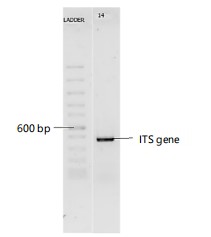
Polymerase chain reaction and gel electrophoresis: The result of the amplified DNA or PCR band of the isolates RCBBR_P14 is represented in Fig. 2 and 3. Amplified DNA showed a band on gel when observed under UV light. From the result, the ladder used indicated that the RCBBR_P14 isolate sequence had over 600 base pairs.
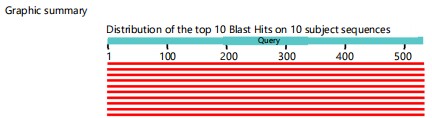
The alignment results are presented in Fig. 3 displayed in red lines; the scores were greater than 200.
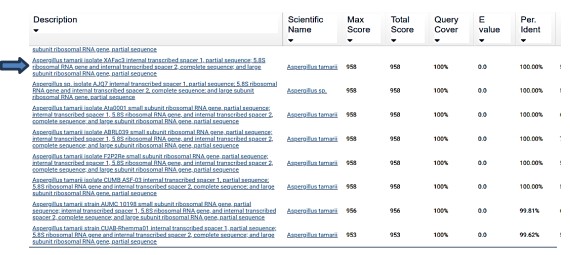
The strain RCBBR_P14 was identified as Aspergillus tamarii, matching Aspergillus tamarii strain XAFAC3 with 100% similarity. Its GenBank accession number is OQ568950.1, shown in Table 2.
Sequence alignment using BLAST: Figure 4 indicated that the RCBBR_P14 isolate sequence aligned with 100 sequences deposited in the composite biological database of National Center Biotechnology sequence was 100% identical to Aspergillus tamarii (blue arrow) as shown in Table 2.
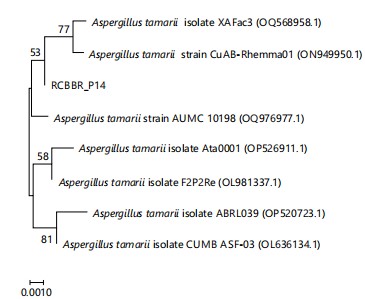
The phylogenetic tree constructed showed the relationship between the isolates from this study and other fungal isolates on GenBank. The phylogenetic analysis showed that Aspergillus tamarii is closely related to fungi obtained from deteriorating leather, as represented in Fig. 5.
DISCUSSION
This study was to detect fungus linked to leather deterioration by morphological and molecular means. Since molecular approaches enable the comparison of DNA sequence information across known and unknown fungus species, they are more reliable than older methods. Many isolates have been falsified as a result of the traditional techniques frequently utilized for fungal identification. A fungus isolated from leather was successfully characterized owing to the molecular approaches used in this study for fungal identification.
According to a study by Orlita9, leather is a biological product and a very appropriate environment for the growth of microorganisms due to the presence of protein and lipids in the form of glycerides. Fungi are common contaminants of leather, making them less useful and dangerous to humans when they come into contact with it. Leather materials are vulnerable to fungi attack due to heavy microbial infection during storage and user conditions.
Habib et al.10 also support these trials by showing how seriously the growing moulds harm things. Their study looked at fungus linked with heavy animal leather (cows and buffalos) and light animal leather (sheep and goats) at different phases of processing, identifying 10 genera and 25 species, including Alternaria, Aspergillus, and Penicillium.
This study revealed the identity of the isolated organisms from leather to be Aspergillus tamarii. This result is supported by research carried out by Rathore et al.11 on leather, who recorded different fungi associated with finished leather, including Aspergillus tamarii.
To bolster the notion that leather materials are susceptible to fungal attack, Amobonye et al.12 isolated and recorded a range of fungi from deteriorated leather. They discovered that the most prevalent fungi in leather deterioration were Aspergillus and Penicillium species.
This finding is consistent with that of Linder and Neuber13, who claimed that the primary causes of leather deterioration include Aspergillus species, Mucor species, Paecilomyces variotii, Penicillium species, Rhizopus nigricans, and Trichoderma viride. Additionally, Shahazizyan et al.14 research revealed that Aspergillus flavus is one of the most common infections that deteriorate leather.
This outcome is comparable to that of Ghosh et al.15, who demonstrated in their study that A. tamarii is effective in eliminating color and Cr from dye solutions used to make leather.
This study provides valuable information on the types of micro fungi that can infest leather, causing deterioration in quality (change in color, texture) and the conditions that promote their growth. This knowledge can be used to develop preventive measures to protect leather items from fungal infections, particularly in humid environments.
Aspergillus species can pose a health risk to humans when inhaled. Therefore, it is important to dispose of leather that has changed color or shows other signs of fungal infection, like peeling, as it may contain harmful toxins. This study also highlights the need for further research on fungal pathogens of leather and their potential health risks. In the meantime, users should be aware of the possible dangers of moldy leather and take appropriate precautions to protect themselves.
Aspergillus moulds, for example, can be toxic, allergic, and infective to humans. Some Aspergillus species can produce secondary metabolites or mycotoxins. Sick building syndrome is linked to inhaling high concentrations of mixed organic dusts, which contain mycotoxins, volatile organic compounds (VOCs), and allergens (glucans).
Studies have shown that finished leather, which is used to make a variety of everyday items, is highly susceptible to fungal infection. No type of leather is completely resistant to this infection by Rathore et al.11, and all leather items are at risk of infestation during storage and use.
In a previous study, Mansour et al.16 isolated Aspergillus tamarii among the six fungi isolated from the deteriorated pieces of leather used in their experiment. It was noted that they caused the breaking of fibers leather.
Another Experiment carried out by Adhikari et al.17, identified seven visually distinctive fungi colonies as Mucor and Aspergillus genera based on macroscopic appearances and microscopic morphology.
CONCLUSION
In this study, it was revealed that Aspergillus spp. is one of the causal fungal pathogens that cause deterioration of leather. The study successfully identified the common fungal pathogen causing leather degeneration as Aspergillus tamarii. The overall outcome of the study is the identification of Aspergillus tamarii as the primary fungal species responsible for leather deterioration. Understanding leather degeneration's root cause can aid the leather industry in preventing fungal growth, improving product quality and durability. Identifying Aspergillus tamarii can also aid in conservation and restoration efforts, addressing environmental and health concerns. Therefore, leather materials should be kept in good condition to avoid damage. Leather shoes worn harbour several fungi. These fungi affect both the shoes and the people who wear them. People should always dry and clean their shoes after wearing them because moisture encourages the growth of the dangerous fungi described in this study.
SIGNIFICANCE STATEMENT
The study reveals that one of the main fungal species causing leather degradation is Aspergillus tamarii. It advances molecular characterization techniques using ITS-1 markers and Blastn analysis, enhancing diagnostic tools. By identifying this key fungal species, this research lays the foundation for the development of targeted treatments and preservation methods, ultimately enhancing the quality, durability, and longevity of leather products. The research provides insights into leather degradation mechanisms, promoting prevention and mitigation strategies. It bridges the gap between mycology, materials science, and environmental studies, paving the way for future research.
REFERENCES
- Scanes, C.G., 2018. Animal Attributes Exploited by Humans (Nonfood Uses of Animals). In: Animals and Human Society, Scanes, C.G. and S.R. Toukhsati (Eds.), Elsevier, Amsterdam, Netherlands, ISBN: 978-0-12-805247-1, pp: 13-40.
- Gillan, K. and J. Murray, 2019. Comprehensive Guide to Leather Repair and Restoration: Leather Repair Training Manual. Advanced Leather Solutions, Inc., Anderson, CA, Pages: 370.
- Boahin, J.O.B., A. Kwabena and L. Adu-Gyamfi, 2013. Controlling fungus attack on indigenous Ghanaian vegetable tanned leathers. Arts Des. Stud., 14: 1-6.
- Gontia-Mishra, I., D. Deshmukh, N. Tripathi, K. Bardiya-Bhurat, K. Tantwai and S. Tiwari, 2013. Isolation, morphological and molecular characterization of phytate-hydrolysing fungi by 18S rDNA sequence analysis. Braz. J. Microbiol., 44: 317-323.
- Bechem, E.T. and Y.A. Afanga, 2017. Morphological and molecular identification of fungi associated with corm rot and blight symptoms on plantain (Musa paradisiaca) in macro-propagators. Int. J. Biol. Chem. Sci., 11: 2793-2808.
- Ikechi-Nwogu, C.G. and F.C. Okene, 2019. Molecular characterization of fungi associated with stored soybean (Glycine max L) seeds. Niger. J. Biotechnol., 36: 27-32.
- Samson, R.A., J. Houbraken, U. Thrane, J.C. Frisvad and B. Andersen, 2010. Food and Indoor Fungi. CBS-KNAW Fungal Biodiversity Centre, Utrecht, Netherlands, ISBN: 9789070351823, Pages: 390.
- Saghai-Maroof, M.A., K.M. Soliman, R.A. Jorgensen and R.W. Allard, 1984. Ribosomal DNA spacer-length polymorphisms in barly: Mendelian inheritance, chromosomal location, and population dynamics. Proc. Natl. Acad. Sci. U.S.A., 81: 8014-8018.
- Orlita, A., 2004. Microbial biodeterioration of leather and its control: A review. Int. Biodeterior. Biodegrad., 53: 157-163.
- Habib, K.A., E.F. Al-Jumaily and S.E. Kadhum, 2008. Isolation and identification of fungi which associated with animal's leather. Baghdad Sci. J., 5: 324-329.
- Rathore, D.S., N. Sharma and S. Chauhan, 2013. Isolation, screening and relative capacity of fungi which causes infestation of finished leather. Int. J. Curr. Microbiol. Appl. Sci., 2: 74-83.
- Amobonye, A., J. Lalung, M.K. Awasthi and S. Pillai, 2023. Fungal mycelium as leather alternative: A sustainable biogenic material for the fashion industry. Sustainable Mater. Technol., 38.
- Lindner, W. and H.U. Neuber, 1990. Preservation in the tannery. Int. Biodeterior., 26: 195-203.
- Shahazizyan, I.V., I.M. Eloyan, R.E. Matevosyan and S.G. Nanagulyan, 2021. Determination of fungi resistance of several samples of natural leather in conditions of Armenia. Proc. YSU B: Chem. Biol. Sci., 55: 172-180.
- Ghosh, A., M.G. Dastidar and T.R. Sreekrishnan, 2016. Bioremediation of a chromium complex dye using Aspergillus flavus and Aspergillus tamarii. Chem. Eng. Technol., 39: 1636-1644.
- Mansour, M., R. Hassan and M. Salem, 2017. Characterization of historical bookbinding leather by FTIR, SEM-EDX and investigation of fungal species isolated from the leather. Egypt. J. Archaeol. Restor. Stud., 7: 1-10.
- Adhikari, A., A. Changmai, K.S. Gupta and B.K. Dey, 2019. Fungal growth on leather surface and identification of their genera based on macroscopic appearances and microscopic morphology. J. Pharm. Sci. Innovation, 8: 105-108.
How to Cite this paper?
APA-7 Style
Adaku,
N.I., Merit,
A., Gloria,
I.C. (2025). Molecular Characterization and Impact of Fungi Associated with Leather. Trends in Biological Sciences, 1(2), 209-215. https://doi.org/10.21124/tbs.2025.209.215
ACS Style
Adaku,
N.I.; Merit,
A.; Gloria,
I.C. Molecular Characterization and Impact of Fungi Associated with Leather. Trends Biol. Sci 2025, 1, 209-215. https://doi.org/10.21124/tbs.2025.209.215
AMA Style
Adaku
NI, Merit
A, Gloria
IC. Molecular Characterization and Impact of Fungi Associated with Leather. Trends in Biological Sciences. 2025; 1(2): 209-215. https://doi.org/10.21124/tbs.2025.209.215
Chicago/Turabian Style
Adaku, Nnebechukwu,, Ijeoma, Augustine, Merit, and Ikechi–Nwogu, Chinyerum Gloria.
2025. "Molecular Characterization and Impact of Fungi Associated with Leather" Trends in Biological Sciences 1, no. 2: 209-215. https://doi.org/10.21124/tbs.2025.209.215

This work is licensed under a Creative Commons Attribution 4.0 International License.