
Prevalence of Anemia and Associated Factors among Chronic Kidney Disease Patients: A Cross-Sectional Study in Chattogram, Bangladesh
-
Md. E. Islam
Department of Biochemistry and Biotechnology, University of Science and Technology Chittagong, Chattogram-4202, Bangladesh
Noman P. ChowdhuryDepartment of Biochemistry and Biotechnology, University of Science and Technology Chittagong, Chattogram-4202, Bangladesh
Gazi W. Akbar

Department of Biochemistry and Biotechnology, University of Science and Technology Chittagong, Chattogram-4202, Bangladesh
Nurul AbsarDepartment of Biochemistry and Biotechnology, University of Science and Technology Chittagong, Chattogram-4202, Bangladesh
| Received 04 May, 2025 |
Accepted 14 Sep, 2025 |
Published 30 Sep, 2025 |
Background and Objective: Anemia is a prevalent and serious side effect that lowers quality of life and raises the risk of morbidity and death in people with Chronic Kidney Disease (CKD). Anemia in CKD is still underdiagnosed and poorly treated, despite advancements in our understanding of its pathogenesis and therapy. This study aimed to explore the prevalence of anemia and associated factors among CKD patients in Chattogram. Materials and Methods: In Chattogram, 313 individuals with anemia and Chronic Kidney Disease (CKD), aged 16 to 85, were included in a cross-sectional study from November, 2023 to January, 2024. The patients gave their agreement to take part in the study and were receiving routine follow-up care at the chosen nephrology clinic. This study also covered additional biochemical parameters, such as creatinine level, the relationship between Hb (%) and diabetic patients, and other hypertension factors. A standardized questionnaire comprising the patient’s data (name, age, sex, weight, cell phones number, etc.) was used to collect the clinical history. Results: In this study, 63.89% of patients were male and 36.11% were female, with a mean age of 50.5 years. Decreased hemoglobin levels were significantly associated with diabetes (p = 0.00001) and hypertension (p = 0.00009) in CKD patients. High creatinine was found in 159 males; 57 males and 39 females had a history of heart disease. Smoking and alcohol use were predominantly among males (36.5 and 29%, respectively), while almost no females reported these habits. Kidney stone history was noted in 35 males and 11 females. Anemia is highly prevalent among CKD patients, particularly in those with advanced disease stages. Conclusion: These findings emphasize the need for regular anemia screening and comprehensive management in CKD patients, especially those with additional risk factors. In resource-limited settings, early intervention and targeted health education can greatly improve outcomes and reduce CKD-related complications.
| Copyright © 2025 Islam et al. This is an open-access article distributed under the Creative Commons Attribution License, which permits unrestricted use, distribution, and reproduction in any medium, provided the original work is properly cited. |
INTRODUCTION
A common and crippling adverse effect that has a major influence on the health and well-being of people with Chronic Kidney Disease (CKD) is anemia. Anemia in Chronic Kidney Disease (CKD) is characterized by an inadequate supply of red blood cells or hemoglobin and results from a combination of causes such as the kidneys’ reduced ability to produce erythropoietin, iron metabolism issues, chronic inflammation, and the impact of uremic toxins. As CKD progresses, the prevalence and severity of anemia tend to increase, posing a substantial clinical challenge.
Depending on variables such as patient demographics, regional location, and CKD stage, the prevalence of anemia among CKD patients varies globally1. According to studies, anemia affects 20-50% of patients with mild to moderate Chronic Kidney Disease (CKD) and up to 80% of patients with End-Stage Renal Disease (ESRD) who require dialysis. The necessity for localized research to better understand regional patterns and optimize management tactics is highlighted by this considerable variety2.
Anemia in CKD has serious and complex repercussions. Anemia is linked to a higher risk of cardiovascular morbidity and mortality, cognitive decline, and a decreased overall survival probability, in addition to the common symptoms of weakness, exhaustion, and poor exercise tolerance. In addition to reducing patients’ quality of life, these issues place a heavy economic burden on healthcare systems3,4.
Understanding the causes of anemia in individuals with Chronic Kidney Disease (CKD) is essential to implementing therapeutic measures into practice and enhancing results. Inadequate iron stores, susceptibility to Erythropoiesis-Stimulating Agents (ESAs), underlying inflammatory diseases, nutritional inadequacies, and the existence of other comorbidities, including diabetes and hypertension, are important variables that affect anemia in CKD4. The occurrence and management of anemia in various geographic locations and healthcare systems are also impacted by differences in healthcare access and treatment practices.
A multidisciplinary strategy combining nephrology, hematology, nutrition, and patient-centered treatment is necessary to address the intricate interactions between these variables. by carrying out in-depth research to clarify the prevalence and contributing variables of anemia in CKD patients5, healthcare professionals can customize treatments to maximize ESA therapy, iron supplements, and other management techniques. These initiatives seek to improve overall clinical results and the health of CKD patients globally, in addition to lowering the burden of anemia6.
The study’s main aim was to explore the prevalence of anemia and associated factors among CKD patients in Chattogram. It also includes other objectives, such as:
| • | To determine the prevalence of anemia in patients with different stages of CKD | |
| • | To identify demographic factors associated with anemia in CKD patients | |
| • | To examine clinical factors associated with anemia in CKD patients | |
| • | To explore biochemical factors associated with anemia in CKD patients | |
| • | To compare the clinical outcomes of anemic and non-anemic CKD patients | |
| • | To provide recommendations for treating anemia in individuals with chronic kidney disease (CKD) in light of the study’s findings |
MATERIALS AND METHODS
Study area: A descriptive cross-sectional study was carried out to identify the prevalence of anemia and related variables among patients with chronic renal disease. A total of 313 samples were analyzed in this study, conducted between October, 2023 to January, 2024 at a tertiary hospital in Chattogram, Bangladesh.
The inclusion criteria for this study were patients diagnosed with CKD stages 1-5 based on eGFR criteria, who were within the age range greater than 18 years. The patients were receiving regular follow-up care at the selected nephrology clinic and had consented to participate in this study, Appendix 1, Informed Consent Form.
| Appendix 1: | Prevalence of anemia and associated factors among chronic kidney disease patients: A cross-sectional study in Chattogram, Bangladesh | |||
| Informed consent form |
| I am Mr./ Mrs …………………………………………….. hereby giving informed consent willingly to participate in the study to be conducted by Md. Ehasanul Islam without any prejudice. I am fully convinced that during my studies, I will not suffer from any serious physical or psychological problems. I am also informed that my participation will bring fruitful results that will be beneficial for health issues. I have the right to withdraw from this study at any time. I will not receive any financial benefit. I have understood that the personal information will be kept strictly confidential and will be used for research purpose only. |
| Signature/Thumb impression of respondents |
| Date: ……………………………………………………… |
| Name: ……………………………………………………… |
| Address: ……………………………………………………… |
| Signature of witness: ……………………………………………………… |
| Signature of investigator: ……………………………………………………… |
Patients with Acute Kidney Injury (AKI), pregnancy, known hematological disorders unrelated to CKD, and receiving treatment for active infections or malignancies were excluded from this study.
Based on their eGFR, recruited individuals were categorized into the relevant CKD stages 1-5. A standardized questionnaire, Appendix 2, that contained the individuals’ personal information (name, age, sex, weight, mobile number, etc.) was used to obtain the clinical history.
Chronic Kidney Disease (CKD) is defined as Abnormalities of kidney structure or function that last longer than three months and have an impact on health.
Anemia is a disorder where the blood’s ability to carry oxygen is diminished due to a Hemoglobin (Hb) concentration that is below the normal range. Hemoglobin concentration less than 13.0 g/dL (<130 g/L) in males and less than 12.0 4 g/dL (<120 g/L) in females.
Creatinine is a waste product generated from muscle metabolism and is excreted by the kidneys. In patients with Chronic Kidney Disease (CKD), the kidneys’ ability to filter and excrete creatinine is impaired, leading to elevated levels in the blood. In CKD, creatinine levels typically rise progressively with worsening kidney function. The level of creatinine correlates inversely with Glomerular Filtration Rate (GFR)-as creatinine increases, GFR decreases.
Sample collection: Six milliliters of venous blood were drawn from each patient’s antecubital fossa. Hemoglobin and creatinine samples were taken; 4 mL of blood for creatinine were taken in a plain red tube, and hemoglobin was taken into an EDTA (Ethylenediaminetetraacetic Acid) tube to measure the amount of hemoglobin.
Data analysis: The data was analyzed using Microsoft Excel 2010. Every question was considered a variable, and each research participant was assigned a code number. In the Microsoft Excel 2010 variable view, each of the questionnaire’s variables is described by its name, type, width, decimals, label, values, missing, column, alignment, and measure. The variables and subjects’ code numbers are indicated in the variable view’s list of values. These data were further computerized using the Statistical Package for Social Science (SPSS) version. An unpaired Student’s t-test, assuming a normal distribution, was used to compare continuous variables after calculating their means and standard deviations. A p<0.05 was considered statistically significant. Skewed data were compared and reported using the median and percentiles.
| Appendix 2: | Prevalence of anemia and associated factors among chronic kidney disease patients: A cross-sectional study in Chattogram, Bangladesh | |||
 |
|
| University of Science and Technology Chittagong (USTC) | |
| QUESTIONNAIRE | |
| SL No: | Date: |
| Name of the patients: | |
| Gender: | |
| Age: | |
| Weight: | |
| Phone number: | |
| How long have you been diagnosed as CKD patient? | |
| 6 months to 1 year | |
| 1 year to 3 year | |
| 3 year to 5 year | |
| More than 5 year | |
| Creatinine level | |
| Normal | |
| High | |
| Hemoglobin level | |
| Normal | |
| High | |
| Do you have diabetes? | |
| Yes | |
| No | |
| Do you have high blood pressure? | |
| Yes | |
| No | |
| Do you have heart disease or heart surgery? | |
| Yes | |
| No | |
| Do you have any kidney stone now or before? | |
| Yes | |
| No | |
| Do you drink alcohol sometimes? | |
| Yes | |
| No | |
| Do you smoke? | |
| Yes | |
| No | |
RESULTS
All 313 patients (100%) in this study were between 16 and 84. The information was gathered between October, 2023 and January, 2024.
According to the demographic study, 200 (63.89%) of the 313 patients were male, and 113 (36.11%) were female, as shown in Table 1. The Chi-square (χ²) statistic for the gender distribution is 24.18, with a p-value of approximately 8.76×10⁻⁷. This indicates a highly significant difference from an equal distribution between males and females.
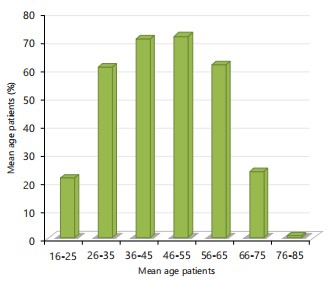
As shown in Fig. 1, the Age group distribution of the patients illustrates the distribution of respondents across different age groups, providing insights into the age demographics of the study population. This breakdown helps identify that of the 313 patients, 72 were found to be between the ages of 46 and 55.
|
| Table 1: | Distribution of the patients according to their gender | |||
| Gender | Number | Percentage (%) | χ2 | p-value |
| Male in number (n) | 200 | 63.89 | 24.18 | 8.76×10⁻⁷ |
| Female in number (n) | 113 | 36.11 | ||
| Total (n) | 313 | 100 | ||
| Table presents the distribution of patients based on gender, showing that out of a total of 313 patients, 200 (63.89%) were male and 113 (36.11%) were female and indicating a higher prevalence among male patients | ||||
| Table 2: | Prevalence of hemoglobin levels in different patients | |||
| Gender | Number | Normal Hb | Prevalence of normal Hb (%) |
Low Hb | Prevalence of low Hb (%) |
χ2 | p-value |
| Male | 200 | 110 | 55 | 90 | 45 | 5.34 | 0.021 |
| Female | 113 | 46 | 40.7 | 67 | 59.2 | ||
| Total patients | 313 | 156 | 49.84 | 157 | 50.1 | ||
| Table presents the prevalence of hemoglobin (Hb) levels among patients, categorized by gender and it shows the number and percentage of patients with normal and low Hb levels for both males and females | |||||||
The mean age of the patients was 50.5 years. The age group distribution of the patients is depicted graphically (Bar diagram) in Fig. 1, highlighting the number of people in each age range. The graph shows that most of the patients were in the age group 46-55 years.
Among the patients, the prevalence of low hemoglobin is 45.95% in males and 54.81% in females, while the prevalence of normal hemoglobin is 54.05% in males and 45.19% in females, as depicted in Table 2. Prevalence of hemoglobin levels in different patients. The correlation between Hemoglobin (Hb) levels and gender has a Chi-square (χ²) statistic of 5.34 and a p-value of approximately 0.021. This implies that the distribution of normal and low Hb levels in males and females differs significantly.
Table 3 association of Hb (%) with diabetic patients with CKD (n = 313), examines the association between hemoglobin percentage (Hb %) and diabetic patients with Chronic Kidney Disease (CKD) in a sample of 313 individuals. The table presents how Hb levels (normal vs low) are distributed among these diabetic CKD patients, clearly showing any trends or significant differences. This association is clinically important because anemia (low Hb %) is a common complication in CKD and may be exacerbated by diabetes. The Chi-square value (χ²) is 22.96, and the p-value is 0.00001, which is far below the standard significance level of 0.05. There is a highly significant association between diabetes status and hemoglobin levels in CKD patients.

|
| Table 3: | Association of Hb (%) with diabetic patients with CKD (n = 313) | |||
| Hb (%) | Diabetic | Non-diabetic | p-value |
| Low | 94 | 59 | χ2 = 22.96 |
| Normal | 55 | 105 | p = 0.00001 |
| Total | 149 | 164 | 313 |
| Table displays the distribution of Hemoglobin levels (Hb %) among diabetic and non-diabetic patients with Chronic Kidney Disease (CKD), and demonstrates that there was an association of decreased Hb (%) with diabetes in CKD patients | |||
In patients with Chronic Kidney Disease (CKD), kidney function gradually declines. As a result, the kidneys become less effective at clearing creatinine from the blood, leading to elevated serum creatinine levels. As shown in Table 4 level of serum creatinine in different patients, among the 313 patients, it is seen that 159 male patients had high creatinine levels and 100 female patients had high creatinine levels. The higher the creatinine level, the more severe the kidney impairment typically is. The results of the Chi-square test are 2.58, and the p-value is 0.108. Since the p-value (0.108) is greater than the common significance level of 0.05, there is no statistically significant association between gender and creatinine level in this sample.
In Table 5, Association of Hb (%) with hypertensive patients with CKD (n = 313), shows the relationship between hemoglobin levels (Hb%) and the presence of hypertension in patients diagnosed with Chronic Kidney Disease (CKD). Since both anemia (low Hb %) and hypertension are common and impactful complications in CKD.
As the results indicate that among hypertensive individuals, 101 had low hemoglobin, while 67 had normal hemoglobin, and among non-hypertensive individuals, only 55 had low hemoglobin, whereas 90 had normal hemoglobin. The Chi-square statistic (χ² = 15.33) and p-value (p = 0.00009) indicate a highly statistically significant association between hemoglobin level and hypertension status. In other words, low hemoglobin is significantly more common among hypertensive individuals.
In Fig. 2, a graphical representation of the data showing the number of male and female patients with a history of each condition (heart disease, smoking, kidney stones, and alcohol consumption), explores the distribution of comorbid medical conditions (such as cardiovascular disease, kidney stones) and lifestyle habits (such as smoking, alcohol use) among patients, analyzed by gender. About 96 patients had heart disease, and 217 did not. Heart disease was more commonly reported in males than in females in this study.
| Table 4: | Level of serum creatinine in different patients | |||
| Gender | Normal creatinine | High creatinine | χ2 | p-value |
| Male | 40 | 159 | 2.58 | 0.108 |
| Female | 14 | 100 | ||
| Total patients | 54 | 259 | ||
| Distribution of serum creatinine levels among different patient groups, illustrating variations in kidney function and potential indicators of renal impairment | ||||
| Table 5: | Association of Hb (%) with hypertensive patients with CKD (n = 313) | |||
| Hb (%) | Hypertensive | Non-hypertensive | p-value |
| Low | 101 | 55 | χ2 =15.33 |
| Normal | 67 | 90 | p = 0.00009 |
| Total | 168 | 145 | 313 |
| Table presents the relationship between Hemoglobin levels (Hb %) and hypertension status among 313 individuals, using a Chi-square test to evaluate statistical significance | |||
About 74 patients had a history of smoking, and 239 did not. And again, it was more prevalent among males. Female smoking rates were extremely low. Males were more likely than females to get kidney stones, where 35 males had a history of kidney stones and 11 females had kidney stones. In Fig. 2, alcohol consumption was only reported by men; no women reported using alcohol. About 29 males claimed having a history of alcohol use. In every lifestyle-related condition, rates are consistently higher in men. Particularly when it came to alcohol and smoking, the prevalence was significantly lower among women.
DISCUSSION
The present study highlights a high prevalence of anemia among Chronic Kidney Disease (CKD) patients in Chattogram, Bangladesh, with significant associations between reduced hemoglobin levels and comorbid conditions such as diabetes and hypertension. These findings align with existing literature from South Asia and other regions.
For example, a study in India found that 82.4% of patients with chronic kidney disease had anaemia, and that diabetes and hypertension were important contributory factors7. Anaemia was also shown to be more prevalent in CKD patients, especially in those who also had concomitant diabetes and hypertension, according to studies from Nepal. Our findings are supported by these studies, which highlight the necessity of comprehensive management approaches that target CKD and its associated comorbidities7.
The demographic trends observed in our study, including a predominance of male patients and a mean age of around 50 years, are consistent with other regional studies. For example, research from North India reported a higher prevalence of CKD and associated anemia among males in the middle-aged population. This similarity suggests potential gender-related factors influencing CKD progression and anemia development, warranting further investigation.
A considerable proportion of the male patients in our study also had high serum creatinine levels, which is a symptom of declining renal function. This finding is consistent with previous research that shows a correlation between deteriorating kidney function and a higher risk of anaemia as a result of decreased erythropoietin production. It is essential to comprehend this link to treat anemia in CKD patients and to intervene early8.
Lifestyle factors identified in our study, such as higher rates of smoking and alcohol consumption among male participants, mirror findings from other studies highlighting gender-based differences in health behaviors among CKD populations. These behaviors may contribute to the progression of CKD and the development of anemia, underscoring the importance of lifestyle modifications in disease management.
Despite these insights, our study has limitations. It was conducted in a single geographic location and limited to patients receiving follow-up at one nephrology clinic, which may affect the generalizability of the findings. Additionally, the cross-sectional design restricts the ability to infer causal relationships. Self-reported lifestyle data, such as smoking and alcohol consumption, may also be subject to reporting bias. Future studies with larger, more diverse samples and longitudinal designs are recommended to validate these findings and guide the development of targeted interventions for anemia management in CKD patients.
CONCLUSION
This study indicated that individuals with anemia and Chronic Kidney Disease (CKD) had significantly decreased physical abilities than those without anemia. According to the study, the leading causes of chronic kidney disease in our nation are diabetes mellitus and hypertension. Additionally, there are several factors, including kidney stones, smoking, alcohol, and heart disease. In the Chittagong Metropolitan Region, Chronic Kidney Disease (CKD) is a significant health concern. By identifying risk factors and screening at-risk groups, early diagnosis may lead got better modifiable risk factors for ESRD that can be treated, and CKD can be treated effectively.
SIGNIFICANCE STATEMENT
Anemia is a frequent and debilitating complication of Chronic Kidney Disease (CKD), contributing to increased morbidity, reduced quality of life, and accelerated disease progression. The prevalence and drivers of anemia in this population are still poorly understood, although the burden of CKD is increasing in resource-constrained areas like Chattogram, Bangladesh. This study provides critical insights into the magnitude of anemia among CKD patients and identifies key associated factors such as disease stage, cardiac disease, and comorbid conditions. The findings highlight the urgent need for routine anemia screening and targeted interventions in nephrology care. Addressing anemia in CKD improves clinical outcomes and supports health system planning and policy development to reduce the disease burden in underserved communities.
REFERENCES
- Kengne, A.P., S. Czernichow, M. Hamer, G.D. Batty and E. Stamatakis, 2012. Anaemia, haemoglobin level and cause-specific mortality in people with and without diabetes. PLoS ONE, 7.
- Angelousi, A. and E. Larger, 2014. Anaemia, a common but often unrecognized risk in diabetic patients: A review. Diabetes Metab., 41: 18-27.
- WHO, 2008. Worldwide Prevalence of Anaemia 1993-2005: WHO Global Database on Anaemia. WHO, Geneva, Switzerland, ISBN: 978-92-4-159665-7, Pages: 51.
- Feteh, V.F., S.P. Choukem, A.P. Kengne, D.N. Nebongo and M. Ngowe-Ngowe, 2016. Anemia in type 2 diabetic patients and correlation with kidney function in a tertiary care Sub-Saharan African Hospital: A cross-sectional study. BMC Nephrol., 17.
- Mancia, G., G. de Backer, A. Dominiczak, R. Cifkova and R. Fagard et al., 2007. 2007 Guidelines for the management of arterial hypertension: The task force for the management of arterial hypertension of the European Society of Hypertension (ESH) and of the European Society of Cardiology (ESC). Eur. Heart J., 28: 1462-1536.
- Gela, Y.Y., D.G. Belay, D. Chilot, A.A. Andualem and D.A. Bitew et al., 2023. Prevalence of anemia and associated factors among adult hypertensive patients in Referral Hospitals, Amhara Regional State. Sci. Rep., 13.
- Zaawari, A., K.L. Tejaswini, G.D. Davina and A. Singanaveni, 2022. Prevalence of anemia among chronic kidney disease patients in India: A single-centre study. Int. J. Basic Clin. Pharmacol., 11: 404-409.
- Portolés, J., L. Martín, J.J. Broseta and A. Cases, 2021. Anemia in chronic kidney disease: From pathophysiology and current treatments, to future agents. Front. Med., 8.
How to Cite this paper?
APA-7 Style
Islam,
M.E., Chowdhury,
N.P., Akbar,
G.W., Absar,
N. (2025). Prevalence of Anemia and Associated Factors among Chronic Kidney Disease Patients: A Cross-Sectional Study in Chattogram, Bangladesh. Trends in Biological Sciences, 1(2), 192-199. https://doi.org/10.21124/tbs.2025.192.199
ACS Style
Islam,
M.E.; Chowdhury,
N.P.; Akbar,
G.W.; Absar,
N. Prevalence of Anemia and Associated Factors among Chronic Kidney Disease Patients: A Cross-Sectional Study in Chattogram, Bangladesh. Trends Biol. Sci 2025, 1, 192-199. https://doi.org/10.21124/tbs.2025.192.199
AMA Style
Islam
ME, Chowdhury
NP, Akbar
GW, Absar
N. Prevalence of Anemia and Associated Factors among Chronic Kidney Disease Patients: A Cross-Sectional Study in Chattogram, Bangladesh. Trends in Biological Sciences. 2025; 1(2): 192-199. https://doi.org/10.21124/tbs.2025.192.199
Chicago/Turabian Style
Islam, Md., E., Noman P. Chowdhury, Gazi W. Akbar, and Nurul Absar.
2025. "Prevalence of Anemia and Associated Factors among Chronic Kidney Disease Patients: A Cross-Sectional Study in Chattogram, Bangladesh" Trends in Biological Sciences 1, no. 2: 192-199. https://doi.org/10.21124/tbs.2025.192.199

This work is licensed under a Creative Commons Attribution 4.0 International License.