
Metals Contamination Assessment in Sediment, Hydrophytes, and Water Samples to Evaluate Human Health Risk
-
Juliet Akudo Mbabie
Chemistry Advanced Research Centre, Sheda Science and Technology Complex, Abuja, Nigeria
Francis Olawale Abulude

Environmental and Sustainable Research Group, Science and Education Development Institute, Akure, Ondo, Nigeria
| Received 03 Jan, 2026 |
Accepted 20 May, 2026 |
Published 30 Sep, 2026 |
Background and Objective: Metal pollution from natural and anthropogenic sources is a growing global concern, affecting soil, groundwater, and aquatic plants, with potential human health risks. This study aimed to assess the concentrations of As, Cd, Cu, Cr, Co, and Fe in sediment, hydrophytes, and water, and to evaluate associated human health risks. Materials and Methods: Water, sediment, and hydrophyte samples were collected from the study area and prepared through filtration, acid digestion (HNO3), and dilution under controlled conditions. Heavy metals (As, Cd, Cr, Cu, Co, Fe) were quantified using atomic absorption spectrophotometry with appropriate calibration and quality control measures. Human exposure risk was evaluated by calculating the average daily dose (ADD) through ingestion, inhalation, and dermal pathways. Standard exposure parameters (e.g., body weight, exposure duration, and frequency) were applied for both adults and children to estimate health risks. Statistical analysis was performed using one-way ANOVA in SPSS (version 25.0), with significance determined at p<0.05. Results: Mean metal concentrations (mg/L) in the upper dam were Fe (0.300), Cu (0.251), Co (0.030), As (0.020), Cr (0.100), and Cd (ND), and in the lower dam Fe (0.335), Cu (0.263), Co (0.040), As (0.031), Cr (0.190), and Cd (ND). In water, the metals followed the order Fe>Cu>Cr>As>Co>Cd. All measured concentrations in water, sediment, and hydrophytes were below NESREA limits. Children had higher estimated doses for all metals than adults. Conclusion: Although current metal levels are within safe limits, continuous human exposure through water, sediment, and hydrophytes warrants monitoring, regulatory interventions, and future mitigation strategies.
| Copyright © 2026 Mbabie and Abulude. This is an open-access article distributed under the Creative Commons Attribution License, which permits unrestricted use, distribution, and reproduction in any medium, provided the original work is properly cited. |
INTRODUCTION
Weathering and pedogenic processes, including the disintegration of rocks due to the water-rock interaction1, are the primary natural sources of potentially toxic elements (PTEs) in soils2. Human-caused pollution of the soil from mining, industry, agriculture, and urbanization typically raises more environmental concerns3. Human-induced shifts in land use can be a significant contributor to PTE buildup in soils, which can impact several environmental compartments across multiple ecosystems. Setting leading values for these elements is crucial since these changes can result in multiple health hazards for humans due to exposure to PTEs, particularly in the Amazon, which has been experiencing significant anthropogenic alterations4.
Metals' inherent longevity, toxicity to living things, and capacity for bioaccumulation make them serious hazards to human well-being and the environment since they may pollute food chains. Therefore, it is essential to monitor and evaluate the concentrations of potentially hazardous metals and metalloids in local biodiversity and vulnerable natural areas5. Among the most hazardous metals and metalloids are nickel (Ni), chromium (Cr), copper (Cu), zinc (Zn), cadmium (Cd), lead (Pb), and arsenic (As). Even in little amounts, metal contamination of water damages aquatic life and significantly alters histology. Aquatic animals may be simultaneously exposed to several substances that interact either antagonistically, synergistically, or additively. For susceptible species, metal exposure and dosage may cause teratogenicity, cancer, or mutagenesis through complex pathways6. Regardless of the sediment matrix, a significant amount of metal accumulates in sediments by adsorption, even though a variety of naturally occurring factors, including discharge rates, temperature, pH, and organic matter, have a significant impact on the fluctuations in pollutants in the water and in the sediment.
Because of Nigeria’s fast urbanization, inadequate waste management, farming, and industrial operations, heavy metal poisoning of groundwater is becoming a bigger problem. Ojo et al.7 examined the possible degrees of pollution and the effects on public health and the cleanliness of water of the heavy metals found in hand-dug wells in Shasha Market, Southwestern Nigeria. In several Nigerian cities, well and borehole water has been found to contain elevated levels of Cd and Cr, above the National Environmental Standard and Regulation Enforcement Agency for Drinking Water Quality requirements8. Despite being necessary minerals, high levels of Fe and Mn can cause health problems such as oxidative stress and neurotoxicity, as well as aesthetic problems like color, taste, and stains. Thus, it is essential to compare the quality of sediments, water, and hydrophytes in order to comprehend pollution trends and any health hazards.
In addition to serving as a medium for plant development and waste disposal, soil also transmits a variety of pollutants to the atmosphere, groundwater, surface water, and food. Human health may be at risk from soil contamination due to its impact on air quality, as well as the hygienic condition of food and drinking water. In the past, soil degradation has received less attention than food9. The heavy metal contamination of land and aquatic ecosystems is becoming a possible worldwide issue, and urban areas often have large population densities and intense anthropogenic activity. Third-world nations like Nigeria may expose their citizens to heavy metal poisoning due to a lack of infrastructure and planning for the detection and monitoring of soil, stream sediments, and water quality. Like other metals, heavy metals are found naturally in stream sediments and soil. Additional human-caused sources of heavy metal pollution include landfills, industrial and agricultural operations, the burning of fossil fuels, and atmospheric deposition.
In Southwest Nigeria, the dam water used in this study is located at the Federal College of Agriculture (FECA), Akure, Ondo State. To provide drinking water, the water was connected to the local community’s pipes. The upper dam is utilized for fish farming and as a demonstration for college students' fishing practicals. The fish are typically cropped each year, while farming continues within the surroundings. In Ondo State, Nigeria, researchers have conducted a number of studies on the topic of water quality7. Since FECA water, sediment, and hydrophytes have not been investigated, there is a lack of data from the area, which makes this study unique.
This implies that it is essential to continuously validate the water quality. To address this gap, the current study uses AAS to measure concentrations of heavy metals (HMs) (Cd, Fe, and Fe) and toxic metals (TMs) (As, Cu, and Cr) in sediment, hydrophytes, and water samples taken from the FECA old dam. It also assesses the risk to human health for both adults and children.
MATERIALS AND METHODS
Study area: The samples were collected at the study area in August, 2025. FECA, Akure, Ondo State, Nigeria, was the site of the study. The town was served by a dam located at FECA (Latitude 7°16'12.824"N and Longitude 5°13'33.510"E). Farming and other small-scale cottage enterprises are well-known in Akure. The research area is 19 km² in size. In 2019, the city had 477,396 residents overall. The study area's average yearly temperature was 29.6°C; the hottest month, June, had a temperature of 39.0°C, while January had the lowest temperature, 6.0°C. The typical temperatures in April and October are 19-34 and 18-31°C, respectively, with average humidity levels of 50-69%. Agricultural products account for the majority of waste, with other anthropogenic activities contributing the remainder.
Water samples: Samples of water (0-40 cm depth) were taken in sterilized 100 mL polyethylene bottles after being filtered with 0.45 μm Whatman GF/F filters to eliminate suspended particles. The filtered sample was acidified with 5 mL of pure nitric acid (HNO3, 70%) and digested on a hotplate at 95°C until the quantity was decreased to roughly 20 mL for the total metal analysis. The digested material was combined with 100 mL of deionized water after cooling, and then it was filtered again.
Sediment samples: Following a period of air drying at ambient temperature in an uncontaminated setting, sediment samples were homogenized using a porcelain mortar and pestle. To get rid of coarse material, they were sieved through a 2 mm nylon mesh. A Teflon digestion tube containing 0.5 g of the sieved sediment was filled with 10 mL of 70% concentrated HNO3 and heated to 170°C for 2 hrs using a hot block digester. The digested samples were cooled, filtered using Whatman No. 42 filter paper, and diluted with 50 mL of deionized water before analysis.
Hydrophytes samples: Before being homogenized with a porcelain mortar and pestle, these samples (Raphia farinifera (Gaertn.) Hyl.., Laportea aestuans, Ficus lutea Vahl., Commelina erecta, Elaeis guineensis Jacq., Nephrolepis biserrata (Sw.) Schott, Hymenocallis littoralis (Jacq.), Ficus sur Forssk., Discoglypremna caloneura (Pax) Prain) were allowed to air dry at room temperature in a contaminant-free setting. A Teflon digestion tube containing 0.5 g of sieved sediment was filled with 10 mL of 70% concentrated HNO3 and heated to 170°C for 2 hrs using a hot block digester. The digested samples were cooled, filtered using Whatman No. 42 filter paper, and diluted with 50 mL of deionized water before analysis.
Heavy metal analysis by atomic absorption spectrophotometry: Atomic Absorption Spectrophotometer (AAS, Buck Scientific GVP 210, USA) was used to measure the concentrations of metals (As, Cd, Cr, Cu, Co, and Fe) in water, hydrophytes, and sediment extracts. Matrix-matched multi-element standards made with the same acid concentration as the samples were used to calibrate the instrument. Cadmium (Cd) and copper (Cu) were determined using an air-acetylene flame, while chromium (Cr) analysis needed a nitrous oxide-acetylene flame for increased sensitivity. For CD, background correction was used to reduce spectral interferences. To guarantee accurate data, quality assurance procedures were used throughout the investigation.
Human health risk assessment: Average daily dose (ADD) was used to estimate the risk of human exposure to TMs and HMs in sediment, hydrophytes, and water10 at average dosage per day (Table 1). The formula11 was used to calculate the ADD of metals (Cr, Co, Cu, As, Cd, and Fe) in mg/kg/day for the three exposure pathways of soil: Ingestion (ADDing), inhalation (ADDinh), and dermal contact (ADDderm).
| Table 1: | Health risk assessment parameters for heavy metals | |||
| Indicator | Parameter | Definition | Units | Adult | Children | Reference |
| Exposure factors | EF | Exposure frequency | days/year | 350 | 350 | Ferreira-Baptista and de Miguel26 |
| ED | Exposure duration | years | 30 | 6 | Ferreira-Baptista | |
| BW | Body weight | kg | 70 | 20 | and de Miguel26 | |
| Conversion factor | CF | Unit conversion | mg/kg | 1×10⁶ | 1×10⁶ | - |
| Metal concentration |
C | Concentration of heavy metals |
mg/kg or mg/L |
- | - | Present study |
| Ingestion | IRing | Ingestion rate of water | L/day | 2.5 | 0.78 | Ferreira-Baptista and de Miguel26 |
| IngR | Ingestion rate of soil/dust | mg/day | 100 | 200 | Ferreira-Baptista and de Miguel26, Zheng et al.27 |
|
| Inhalation | IRinh | Inhalation rate | m3/day | 20 | 10 | Li et al.28 |
| PEF | Particle emission factor | m3/kg | 1.36×10⁶ | 1.36×10⁶ | Ferreira-Baptista and de Miguel26 |
|
| Dermal contact | SA | Exposed skin surface area | cm2 | 5800 | 2100 | Ferreira-Baptista and de Miguel26 |
| AF | Skin adherence factor | mg/cm2 | 0.07 | 0.2 | Ferreira-Baptista and de Miguel26 |
|
| ABF | Dermal absorption factor | – | 0.001 (except As = 0.03) |
0.001 (except As = 0.03) |
Ferreira-Baptista and de Miguel26 |
|
| Averaging time | AT | Average time | days | 365×ED | 365×ED | Ferreira-Baptistaand de Miguel26 |
| EF: Exposure frequency, ED: Exposure duration, BW: Body weight, CF: Conversion factor, C: Metal concentration, IRing: Soil/dust ingestion rate, IRinh: Inhalation rate, PEF: Particle emission factor, SA: Exposed skin area, AF: Skin adherence factor, ABF: Dermal absorption factor, AT: Averaging time, USEPA: United States Environmental Protection Agency and units are standardized for consistency, all ingestion rates, inhalation rates, and dermal parameters match calculations in the text | ||||||
Average daily intake (ADI) (mg/kg/day) of heavy metals in dust media:
| (1) |
| (2) |
| (3) |
Where, ADDingestion, ADDinhalation, and ADDdermal are the average daily intake or amount of exposure to heavy metals (mg (kg/day)) via ingestion or oral intake, inhalation, and dermal contact, respectively.
The C (mean concentration of metal, mg/kg), IngR (ingestion rate of water is 2.2 L/day for adult and 1.5 L/day for children), EF (Exposure frequency, 365 days/year), ED (Exposure duration, 6 years for children and 24 years for adults), BW (the average body weight (child = 15 kg and adult = 70 kg), AT (the average time (365×ED), PEF (particle emission factor in m3/kg (1.36×10⁹ for both adult and children), InhR (ingestion rate in mg/day (IngR = 200 for children and 100 for adults), SA (5700 cm2), AF (the skin adherence factor for the soil in mg cm2–1 (0.2 for adult and 0.07 for children), ABF (dermal absorption factor (0.03 for As and 0.001 for other metals).
Statistical analysis: All data were analyzed using appropriate statistical methods to determine the significance of differences among metal concentrations and exposure pathways. One-way Analysis of Variance (ANOVA) was performed to compare mean values across different samples and exposure routes (ingestion, inhalation, and dermal). Where significant differences were observed, post hoc comparisons were conducted using Tukey’s test.
All statistical analyses were carried out using SPSS software (version 25.0, IBM Corp., Armonk, NY, USA). The level of statistical significance was set at p<0.05. Data are presented as Mean±Standard Deviation (SD).
RESULTS AND DISCUSSION
The element levels in water samples are displayed in Table 2. Comparing the following metals' amounts in water samples based on their average concentrations (mg/L): The lower dam contains Fe (0.335), Cu (0.263), Co (0.040), As (0.031), Cr (0.190), and Cd (ND), while the upper dam has Fe (0.300), Cu (0.251), Co (0.030), As (0.020), and Cr (0.100). Water samples' metal levels are as follows: Fe>Cu>Cr>As>Co>Cd. In contrast to the lower dam results, the lower dam had notably higher values. As, Cd, Cu, Cr, Co, and Fe concentrations did not differ substantially in the studied area. Similar to the amounts in the soil and hydrophyte samples, the mean concentration of Cr in water samples was determined to be below the NESREA standard limit (0.5). Since Cr is closely related to soil, its main source in this study region may be its migration into nearby soil during farming operations, as the majority of landfills contain chemical waste from pesticides. Cr pollution has a significant impact on the biological activities of soil; the toxic effects of Cr have a significant impact on the biota of chernozem and decrease its catalytic activity. In hydrophytes, the Cr concentrations varied as follows: Raphia farinifera>Elaeis guineensis>Ficus sur> Discoglypremna caloneura>Laportea aestuans>Nephrolepis biserrata>Commelina erecta. Since both metals are used in the production of fertilizer, farming and fishing equipment, and alloys that end up in the sediments and water samples, the concentrations of Co in the samples were found to be higher in both the sediments and the water samples at the site. Its abundance can be a sign of the movement of Co-rich leachate into the nearby sediments and soils.
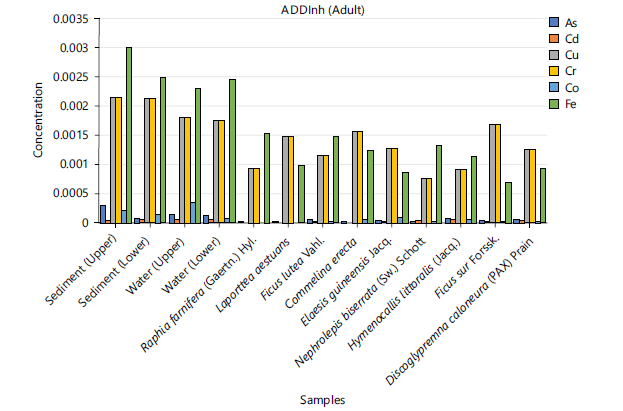
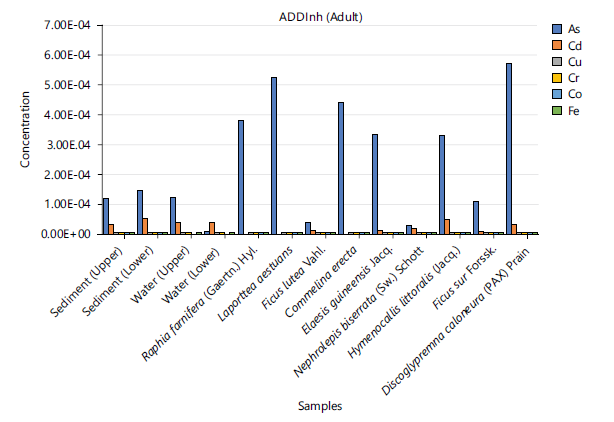
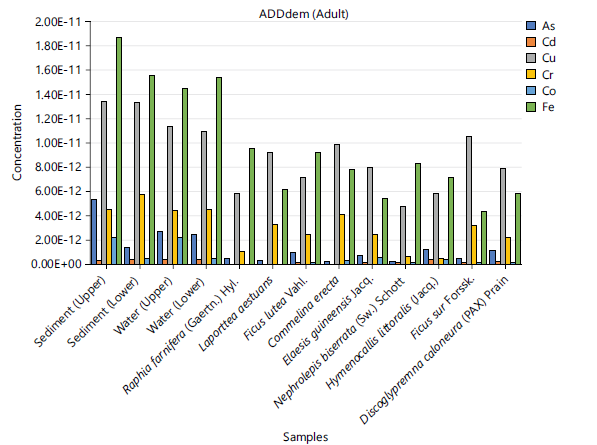
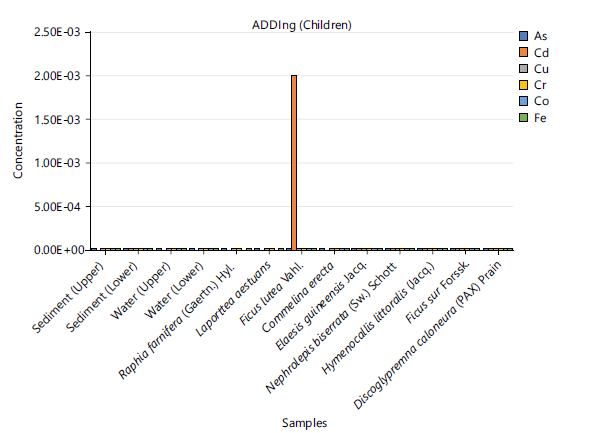
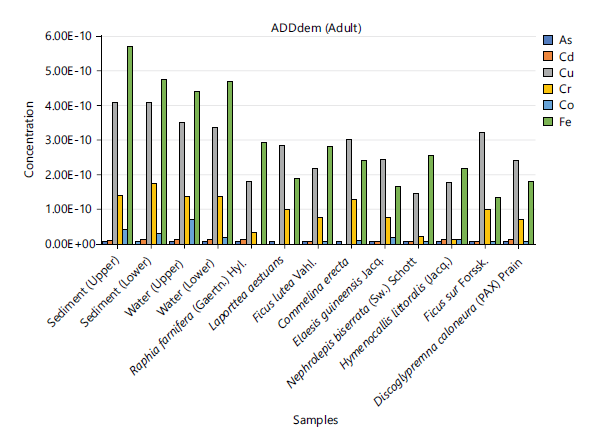
The results of the pathways are shown in Fig. 1-6. Figure 1 depicts the inhalation pathway in adults. The results are lower compared to those obtained for ingestion, showing that inhalation is less dominant exposure route of metals in adults. But, metals (Fe and Zn) depicted relatedly higher inhalation does in relationship to Pb and Ni, showing greater presence in airborne particulates. The variation between metals suggests differences in atmospheric mobility and concentration. Statistical analysis (p<0.05) indicates that the inhalation does differ significantly among metals. In Fig. 2, it is depicted that ingestion pathways (ADDing) in adults clearly shows the highest dose among the three exposure routes. Metals like Fe and Zn contribute the most in the ingestion exposure, while Pb and Ni depict low doses. The pattern in this graph suggest that ingestion of contaminated dust or soil is the primary exposure pathway in adults. The differences between metals are statistically significant (p<0.05), confirming variability in oral exposure risk. The derm pathway (ADDderm) in adults is presented in Fig. 3. The doses are higher than those of inhalation, but lower than those of the ingestion pathway. The highest dermal absorption is exhibited by Fe, while Pb is the lowest. There are differences in the trends of the skin adherence and absorption factors.
| Table 2: | Mean concentrations of metals in sediment, water, and plants | |||
| Sample | As | Cd | Cu | Cr | Co | Fe |
| Sediment (Upper) | 0.025 | ND | 0.3 | 0.115 | 0.018 | 0.384 |
| Sediment (Lower) | 0.031 | 0.001 | 0.322 | 0.098 | 0.025 | 0.399 |
| Water (Upper) | 0.02 | ND | 0.251 | 0.1 | 0.03 | 0.3 |
| Water Lower) | 0.031 | ND | 0.263 | 0.19 | 0.04 | 0.335 |
| Raphia farinifera (Gaertn.) Hyl.. | 0.003 | ND | 0.131 | 0.092 | ND | 0.175 |
| Laportea aestuans | 0.002 | ND | 0.208 | 0.054 | ND | 0.122 |
| Ficus lutea Vahl. | 0.007 | 0.002 | 0.16 | 0.012 | 0.002 | 0.187 |
| Commelina erecta | 0.001 | 0 | 0.221 | 0.009 | 0.006 | 0.161 |
| Elaeis guineensis Jacq. | 0.005 | 0.002 | 0.179 | 0.073 | 0.012 | 0.096 |
| Nephrolepis biserrata (Sw.) Schott | 0.001 | 0.003 | 0.107 | 0.05 | 0.001 | 0.131 |
| Hymenocallis littoralis (Jacq.) | 0.009 | 0.007 | 0.13 | 0.03 | 0.008 | 0.056 |
| Ficus sur Forssk. | 0.003 | 0.001 | 0.236 | 0.062 | 0.002 | 0.092 |
| Discoglypremna caloneura (Pax) Prain | 0.008 | 0.005 | 0.176 | 0.056 | 0.001 | 0.168 |
| National standard | ||||||
| NESREA-water (mg/L) | 0.05 | 0.003 | 1 | 0.5 | 0.3 | |
| NESREA-sediment and plant (mg/kg) | 0.05 | 0.003 | 1 | 0.5 | 0.3 | |
| Units: Sediment and plant samples-mg/kg, Water samples -mg/L, ND: Not detectable, ND: Not detected (metal concentration below detection limit), -: Not specified or not applicable in the national standard, mg/kg: Milligrams per kilogram (sediment and plant samples; dry weight basis), mg/L: Milligrams per liter (water samples), NESREA: National Environmental Standards and Regulations Enforcement Agency, As: Arsenic, Cd: Cadmium, Cu: Copper, Cr: Chromium, Co: Cobalt and Fe: Iron | ||||||
|
|
|
|
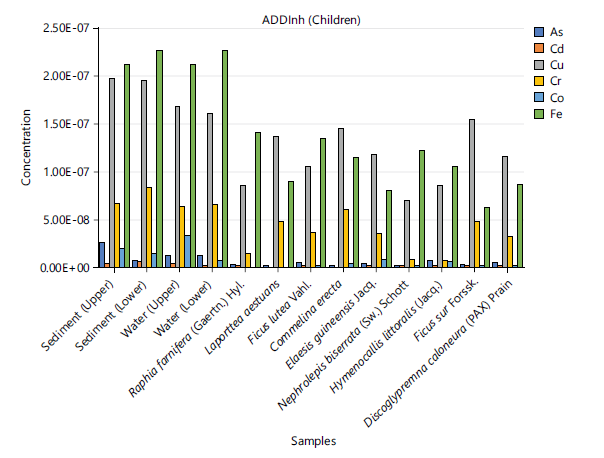
The statistical testing confirms significant differences in the metals (p<0.05), though overall dermal exposure remains secondary to ingestion. The inhalation pathway in children is illustrated in Fig. 4. From the results, it is observed that inhalation doses in children are higher than those observed in adults, indicating greater vulnerability due to lower body weight and higher breathing rates. The profile in
|
|
Fig. 4 is dominated by Fe and Zn. The differences are statistically significant (p<0.05), showing increased inhalation risk in children. Figure 5 shows the ingestion pathway in children and represents the highest exposure route overall. Ingestion doses are higher than in adults for all metals, confirming that children are more exposed. The Fe level of the dose is the greatest. The differences in between other metals are statistically significant (p<0.05). The ingestion pathway is the critical in children. Finally, Fig. 6 shows the dermal pathway in children. Similarly to that of the adults, dermal pathway exposure is lower than
ingestion, but higher than inhalation. The Fe and Zn show the highest dermal doses. The p<0.05 value shows significant variation between metals, depicting that children experience higher dermal exposure overall. In conclusion, ingestion has the highest dose, inhalation the lowest, and children consistently show higher ADD values than adults in all pathways.
The average As concentration in the soil and water samples was below the 0.05 mg/kg NESEREA-recommended level. According to the findings, the content of As in sediment and its transfer into hydrophytes may be linearly related. Cultivation in As-contaminated soil and water irrigation hurt growth and yield12. Although the average Cd concentration in the sediment, hydrophyte, and water samples was below the regulatory bodies' standard limit (0.003 mg/L), this sediment would not be appropriate for gardening or farming, but care must be given because high Cd concentrations are harmful. The main source of cadmium, which is linked to sediment and water in this research region, is the migration of landfill leachate into the surrounding area, where the majority of landfills include industrial waste.
The concentrations of Cu and Fe were found to be higher in hydrophytes, sediment, and water samples near dam sites. This is because both metals are used in the production of fertilizer, insecticides, pesticides, and other agricultural chemicals that end up in the dam through rainwater leaching or aerosol drift. Sediment, hydrophytes, and water all had mean concentrations of Cu and Fe below the NESREA threshold. The metabolism of certain metals may be disrupted by an excess of Cu and Fe in sediment, hydrophytes, and water4. The increased Fe content in soil/sediment has a significant impact on the carbon and nitrogen-containing microbial mass, which lowers the rate of nutrient cycling and degrades fertility13. Since there are fewer natural sources of iron than man-made ones, its high environmental concentration is seen to be a sign of pollution14.
A significant factor in the leaching of heavy metals into water, hydrophytes, and sediments is the breakdown of biodegradable materials in landfills. The aquifer matrix contains a significant amount of oxygen, an oxidant, which causes reducing conditions and disturbs the metals' current state in groundwater. The adsorption of these metals on the aquifer’s pore occurred as a result of the high concentrations of activated and non-activated colloids, as well as big and small dissolved particles, covering the heavy15. As a result of human activity, it has been discovered that Cr, As, Cd, and Pb contribute significantly to the potential risk of metal contamination in water, hydrophytes, and sediments.
As human carcinogens, they have been classified as priority metals that are critical to public health and have the potential to harm several organs16. Compared to earlier research, the current study’s reported As, Cd, Co, Cr, Cu, and Fe concentrations are lower17. These findings highlight how rare these harmful heavy metals are in FECA soils18. The dynamics of these elements are significantly influenced by the soil's size, grain distribution, natural acidity, heavy rainfall, and the rate at which organic matter breaks down. Due to the reduced ability of the soil colloids to retain metals, these factors contributed to the low metal levels2. In contrast to the primarily sand-rich soils of Akure, naturally high Cu concentrations are typically linked to soils rich in clay minerals or organic matter19.
In comparison of this study results with previous ones, it is found that Fe content results of Varol20, Enuneku et al.21 and Ayedun22 were far above, while that of Jolaosho et al.23, Ojo et al.7 and Oluwagbayide et al.18 favorably compared with it. Cd of the sediments reported by Tunde and Oluwagbenga24 and Olowojuni et al.25 are at par with this work. Jolaosho et al.23, Olowojuni et al.25, and Ojo et al.7 reported same Cr concentrations with the study. The differences in these results could be to the natural and anthropogenic activities around the sampling locations and the abilities of the hydrophytes to accumulate the metals.
CONCLUSION
Concentrations of metals in sediment, water, and hydrophytes of FECA dam were measured using AAS Sediment was found to have greater metal concentrations than hydrophytes and water. Average metal concentration in samples was below regulatory body’s limit of NESREA. According to these findings of risk assessments for human health, metals found in water, sediment, and hydrophytes present very little non-carcinogenic and carcinogenic risks to the adults and children residing in the research region. However, it is necessary to focus on and take steps to minimize and prevent heavy metal and toxic contamination in sediment, hydrophytes, and water by slowing down the movement of leachate. Current observations provide valuable information about the presence of heavy and hazardous metal contaminations in the dam area's sediment, hydrophytes, and water. All parties involved should work together to reduce the levels of these heavy and dangerous metals because they have the ability to bioaccumulate. This research is helpful in implementing preventative actions to preserve the urban environment. To stop toxic metals from leaking into sediment and water, government organizations should look into new technologies that have greater capacity for removing them from landfills. To stop these metals from leaking into the dam, vertical engineered barriers (VEB), tops, and liners should be built. Human exposure to water, sediment, and hydrophytes suggests that future interventions and legislative responses are required.
SIGNIFICANCE STATEMENT
This study provides baseline data on metal contamination in water, sediment, and hydrophytes from the FECA dam, a previously unassessed aquatic system. By integrating environmental monitoring with human health risk assessment, the findings highlight potential exposure risks, particularly for children, despite concentrations being within regulatory limits. The results support the need for continuous monitoring and informed management strategies to prevent future ecological and public health impacts.
REFERENCES
- Fuoco, I., L. Marini, R. de Rosa, A. Figoli, B. Gabriele and C. Apollaro, 2022. Use of reaction path modelling to investigate the evolution of water chemistry in shallow to deep crystalline aquifers with a special focus on fluoride. Sci. Total Environ., 830.
- Gonçalves, D.A.M., G.S.B. de Matos, A.R. Fernandes, K.R.M. Barros, D. do Socorro Nunes Campinas and C.B. do Amarante, 2016. Adsorption of cadmium and copper in representative soils of Eastern Amazonia, Brazil. Semina Ciênc. Agrár., 37: 3005-3016.
- Cachada, A., T. Rocha-Santos and A.C. Duarte, 2018. Soil and Pollution. In: Soil Pollution: From Monitoring to Remediation, Duarte, A.C., A. Cachada and T. Rocha-Santos (Eds.), Elsevier, Amsterdam, Netherlands, ISBN: 978-0-12-849873-6, pp: 1-28.
- de Almeida Jr., A.B., C.W.A. do Nascimento, C.M. Biondi, A.P. de Souza and F.M. do Rêgo Barros, 2016. Background and reference values of metals in soils from Paraíba State, Brazil. Rev. Bras. Ciênc. Solo, 40.
- Rawat, K.S., S.K. Singh and S.K. Gautam, 2018. Assessment of groundwater quality for irrigation use: A peninsular case study. Appl. Water Sci., 8.
- Ali, H., E. Khan and I. Ilahi, 2019. Environmental chemistry and ecotoxicology of hazardous heavy metals: Environmental persistence, toxicity and bioaccumulation. J. Chem., 2019.
- Ojo, O.M., O.A. Obiora-Okeke and D.O. Adeniran, 2025. Comparative assessment of heavy metals in well and borehole water in Akure, Ondo State, Nigeria. J. Civil Eng. Urbanism, 15: 1-8.
- Subramani, T. and S.N. Priya, 2023. Assessment of groundwater quality for irrigation purpose in river basin, Dindigul, Tamil Nadu. Int. J. Environ. Anal. Chem., 103: 6757-6773.
- Odukoya, A.M., 2015. Contamination assessment of toxic elements in the soil within and around two dumpsites in Lagos, Nigeria. Ife J. Sci., 17: 351-361.
- Mohammadi, A.A., A. Zarei, M. Esmaeilzadeh, M. Taghavi and M. Yousefi et al., 2020. Assessment of heavy metal pollution and human health risks assessment in soils around an industrial zone in Neyshabur, Iran. Biol. Trace Elem. Res., 195: 343-352.
- Karimi, A., A. Naghizadeh, H. Biglari, R. Peirovi, A. Ghasemi and A. Zarei, 2020. Assessment of human health risks and pollution index for heavy metals in farmlands irrigated by effluents of stabilization ponds. Environ. Sci. Pollut. Res., 27: 10317-10327.
- Waseem, A., J. Arshad, F. Iqbal, A. Sajjad, Z. Mehmood and G. Murtaza, 2014. Pollution status of Pakistan: A retrospective review on heavy metal contamination of water, soil and vegetables. BioMed Res. Int., 2014.
- de Souza, E.S., A.R. Fernandes, A.M. de Souza Braz, F.J. de Oliveira, L.R.F. Alleoni and M.C.C. Campos, 2018. Physical, chemical, and mineralogical attributes of a representative group of soils from the eastern Amazon Region in Brazil. Soil, 4: 195-212.
- Konhauser, K.O., W.S. Fyfe, W. Zang, M.I. Bird and B.I. Kronberg, 1995. Advances in Amazonian Biogeochemistry. In: Chemistry of the Amazon: Biodiversity, Natural Products, and Environmental Issues, Seidl, P.R., O.R. Gottlieb and M.A.C. Kaplan (Eds.), American Chemical Society, Washington, D.C., USA, ISBN: 9780841215139, pp: 208-247.
- Boateng, T.K., F. Opoku and O. Akoto, 2019. Heavy metal contamination assessment of groundwater quality: A case study of Oti landfill site, Kumasi. Appl. Water Sci., 9.
- Kusin, F.M., N.N.M. Azani, S.N.M.S. Hasan and N.A. Sulong, 2018. Distribution of heavy metals and metalloid in surface sediments of heavily-mined area for bauxite ore in Pengerang, Malaysia and associated risk assessment. CATENA, 165: 454-464.
- Nogueira, T.A.R., C.H. Abreu-Junior, L.R.F. Alleoni, Z. He and M.R. Soares et al., 2018. Background concentrations and quality reference values for some potentially toxic elements in soils of São Paulo State, Brazil. J. Environ. Manage., 221: 10-19.
- Oluwagbayide, S.D., A. Akinnusotu, K.M. Arifalo, A. Adamu, F.O. Abulude, S.O. Mabayoje and A.M. Kenni, 2025. Assessment of water quality for irrigation purpose: A case study of three states in Nigeria. Environ. Earth Sci., 84.
- Oorts, K., 2012. Copper. In: Heavy Metals in Soils: Trace Metals and Metalloids in Soils and their Bioavailability, Alloway, B.J. (Ed.), Springer, Netherlands, ISBN: 978-94-007-4470-7, pp: 367-394.
- Varol, M., 2011. Assessment of heavy metal contamination in sediments of the Tigris River (Turkey) using pollution indices and multivariate statistical techniques. J. Hazard. Mater., 195: 355-364.
- Enuneku, A., O. Omoruyi, I. Tongo, E. Ogbomida, O. Ogbeide and L. Ezemonye, 2018. Evaluating the potential health risks of heavy metal pollution in sediment and selected benthic fauna of Benin River, Southern Nigeria. Appl. Water Sci., 8.
- Ayedun, H., 2021. Sediment quality assessment in coastal communities of Ondo State, Nigeria. J. Chem. Soc. Nigeria, 46: 897-906.
- Jolaosho, T.L., I.O. Elegbede, P.E. Ndimele, G.O. Mekuleyi, I.O. Oladipupo and A.A. Mustapha, 2023. Comprehensive geochemical assessment, probable ecological and human health risks of heavy metals in water and sediments from dredged and non-dredged rivers in Lagos, Nigeria. J. Hazard. Mater. Adv., 12.
- Tunde, O.L. and A.P. Oluwagbenga, 2020. Assessment of heavy metals contamination and sediment quality in Ondo coastal marine area, Nigeria. J. Afr. Earth Sci.
- Olowojuni, O.A., F.D. Amulejoye, B.B. Ikuesan, S. Maulu, H. Bwalya and O.J. Hasimuna, 2025. Water quality, heavy metal contamination, and ecological risk assessment in Asejire Reservoir, Nigeria. J. Freshwater Ecol., 40.
- Ferreira-Baptista, L. and E. de Miguel, 2005. Geochemistry and risk assessment of street dust in Luanda, Angola: A tropical urban environment. Atmos. Environ., 39: 4501-4512.
- Zheng, N., J. Liu, Q. Wang and Z. Liang, 2010. Health risk assessment of heavy metal exposure to street dust in the zinc smelting district, Northeast of China. Sci. Total Environ., 408: 726-733.
- Li, Z. Z. Ma, T.J. van der Kuijp, Z. Yuan and L. Huang, 2014. A review of soil heavy metal pollution from mines in China: Pollution and health risk assessment. Sci. Total Environ., 468-469: 843-853.
How to Cite this paper?
APA-7 Style
Mbabie,
J.A., Abulude,
F.O. (2026). Metals Contamination Assessment in Sediment, Hydrophytes, and Water Samples to Evaluate Human Health Risk
. Trends in Biological Sciences, 2(3), 228-238. https://doi.org/10.21124/tbs.2026.228.238
ACS Style
Mbabie,
J.A.; Abulude,
F.O. Metals Contamination Assessment in Sediment, Hydrophytes, and Water Samples to Evaluate Human Health Risk
. Trends Biol. Sci 2026, 2, 228-238. https://doi.org/10.21124/tbs.2026.228.238
AMA Style
Mbabie
JA, Abulude
FO. Metals Contamination Assessment in Sediment, Hydrophytes, and Water Samples to Evaluate Human Health Risk
. Trends in Biological Sciences. 2026; 2(3): 228-238. https://doi.org/10.21124/tbs.2026.228.238
Chicago/Turabian Style
Mbabie, Juliet, Akudo, and Francis Olawale Abulude.
2026. "Metals Contamination Assessment in Sediment, Hydrophytes, and Water Samples to Evaluate Human Health Risk
" Trends in Biological Sciences 2, no. 3: 228-238. https://doi.org/10.21124/tbs.2026.228.238

This work is licensed under a Creative Commons Attribution 4.0 International License.