
Genetic Variability in Yield and Nutritional Traits of Red Okra (Abelmoschus esculentus L.) Genotypes
-
Mohammad Zahir Ullah


Senior Scientific Officer, Food Crop Section, Bangladesh Institute of Research and Training on Applied Nutrition, Head Office, Arayhazar, Narayangonj, Bangladesh
Prince BiswasBangladesh Institute of Research and Training on Applied Nutrition, Head Office, Arayhazar, Narayangonj, Bangladesh
| Received 29 Sep, 2025 |
Accepted 20 Nov, 2025 |
Published 31 Dec, 2025 |
Background and Objective: Okra (Abelmoschus esculentus L.) is a widely consumed vegetable, valued for its high nutritional content. Red okra genotypes have gained increasing attention for their aesthetic appeal and potential nutraceutical benefits, but limited studies have quantified genetic variability in yield and nutritional traits. This study aimed to evaluate the performance of selected red okra genotypes to identify superior lines for breeding programs targeting both productivity and nutritional quality. Materials and Methods: The experiment was conducted during the Kharif-2 season of 2022 at the BIRTAN HQ research field in Araihazar, Narayangonj, Bangladesh. Three red okra genotypes (OK28, OK29, OK31) and one green okra genotype (OK63) were evaluated under a Randomized Complete Block Design (RCBD) with three replications. Data were recorded on agronomic traits (fruits per plant, fruit length, fruit diameter, fruit weight, plant height, yield per plant) and nutritional traits (vitamin C, calcium, magnesium, potassium). Vitamin C was measured by the HPLC method, while mineral contents were determined using atomic absorption spectrophotometry (AAS). The ANOVA, descriptive statistics, and Pearson’s correlation analysis were performed at the 1% and 5% significance levels. Results: Significant (p<0.01) variability was detected among genotypes for all traits. Fruit yield per plant was highest in OK29 (1659.98 g) and OK31 (1664.24 g). Nutritional traits varied widely, with vitamin C ranging from 10.27 to 25.87 mg/100 g and calcium from 9.87 to 70.6 mg/100 g. The OK31 combined high yield with superior vitamin C (25.87 mg/100 g), magnesium (45.8 mg/100 g), and potassium (250.27 mg/100 g), while OK63 excelled in calcium (70.6 mg/100 g) and potassium (279.6 mg/100 g). Correlation analysis revealed that fruit number was negatively associated with fruit size and nutrient content, while fruit length strongly correlated with vitamin C, magnesium, potassium, and calcium. Conclusion: Red okra genotypes showed wide genetic variability in both yield and nutritional quality. The OK31 emerged as the most promising genotype for dual improvement of productivity and nutrition, while OK29 and OK63 were valuable for yield and specific nutrient enhancement, respectively. These results provide a foundation for breeding programs targeting biofortified red okra cultivars.
| Copyright © 2025 Ullah and Biswas. This is an open-access article distributed under the Creative Commons Attribution License, which permits unrestricted use, distribution, and reproduction in any medium, provided the original work is properly cited. |
INTRODUCTION
Okra (Abelmoschus esculentus L.) is an important vegetable crop in tropical and subtropical regions, valued for its tender pods and high nutritional quality. The pods are a rich source of dietary fiber, vitamin C, and essential minerals such as calcium, potassium, and magnesium, which contribute to food and nutrition security1. Recent studies highlight the wide genetic diversity in okra germplasm, with significant variability in agronomic, nutritional, and biochemical traits that can be harnessed for crop improvement2,3. Red okra has recently gained attention due to its attractive pod color, which enhances consumer preference, and its higher content of bioactive compounds such as anthocyanins and flavonoids with antioxidant properties4.
Despite this potential, most genetic studies have focused on green-pod genotypes, leaving a gap in understanding the variability in yield and nutritional traits of red okra specifically. Recent findings on fruit quality variation in okra accessions including vitamin C ranging from 12.8 to 82.8 mg/100 g dry weight suggest ample opportunities to identify nutrient-dense red okra lines for functional food development5.
Understanding the genetic variability and correlations among yield and nutritional attributes in red okra is therefore crucial for identifying promising genotypes that can serve as parents in breeding programs targeting both productivity and nutritional enhancement.
This study aims to evaluate the genetic variability for yield traits among selected red okra genotypes and to assess variations in key nutritional traits, including vitamin C, calcium, potassium, and magnesium, across these genotypes. Additionally, the research seeks to analyze the relationships between yield and nutritional parameters to identify promising red okra genotypes that can be targeted for the simultaneous improvement of both productivity and nutritional quality.
MATERIALS AND METHODS
Experimental site: The field experiment was conducted during the Kharif-2 season of 2022 at the BIRTAN HQ research field, Araihazar, Narayanganj, Bangladesh (23°40 N latitude, 90°36 E longitude; 7 m above sea level). The site is characterized by a humid subtropical climate with annual rainfall of approximately 2,000 mm, mostly concentrated during the monsoon season. Average temperatures range from 23-32°C. The soils are predominantly alluvial, composed of silt, clay, and sand deposited by the Meghna River, and are generally fertile but prone to nutrient leaching and occasional waterlogging.
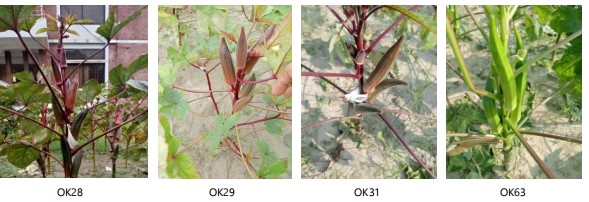
Plant material: Four okra (Abelmoschus esculentus L.) genotypes were evaluated: Three red-pod types (OK28, OK29, and OK31) and one green-pod check (OK63), shown in Fig. 1. Seeds were directly sown in the main field on 12 September, 2022.
Design and crop management: The experiment was laid out using a Randomized Complete Block Design (RCBD) with three replications. A spacing of 65 cm between rows and 45 cm between plants within a row was maintained throughout the trial to ensure optimal plant growth and uniformity. Standard agronomic practices, including irrigation, weeding, pest management, and thinning, were applied uniformly across all treatments.
Data collection
Agronomic traits: Observations on agronomic traits were recorded from five randomly selected plants per experimental plot at the fruiting stage. The number of fruits per plant was determined by counting all marketable fruits harvested from each sampled plant. The fruit length (cm) and fruit diameter (cm) were measured using a digital Vernier caliper on five randomly selected mature fruits. The average fruit weight (g) was obtained using an electronic weighing balance by recording the mean fresh weight of the sampled fruits. The plant height (cm) was measured from the soil surface to the tip of the main stem at final harvest using a measuring tape. The fruit yield per plant (g) was computed as the total weight of fruits produced per plant. All measurements were taken following the standard procedures described by Akinyele and Osekita6, and Reddy et al.7, with minor modifications to suit the experimental conditions.
|
Nutritional traits
Vitamin C (mg/100 g fresh weight): Quantified by High-Performance Liquid Chromatography (HPLC) following the Horwitz and AOACI8 protocol with slight modifications. Approximately 5 g of fresh okra tissue was homogenized in 3% metaphosphoric acid solution, centrifuged, and filtered through a 0.45 μm membrane filter. The filtrate was injected into an HPLC system equipped with a C18 reverse-phase column and a UV detector set at 254 nm. The mobile phase consisted of 0.1 M KH PO uffer (pH 2.5) at a flow rate of 1.0 mL/min. Quantification was performed using an external L-ascorbic acid standard curve.
Where:
| C | = | Concentration of ascorbic acid in the sample extract (mg/mL) obtained from the HPLC standard calibration curve | |
| V | = | Final volume of the extract (mL) | |
| DF | = | Dilution factor (if any applied before HPLC injection; if not diluted, DF = 1) | |
| W | = | Fresh weight of sample used for extraction (g) | |
| 100 | = | Conversion factor to express the result per 100 g fresh weight |
Mineral content (Ca, Mg, K; mg/100 g): The mineral content, including calcium (Ca), magnesium (Mg), and potassium (K), was determined using the atomic absorption spectrophotometer (AAS) method. Approximately 1 g of oven-dried and finely ground okra sample was digested with a nitric–perchloric acid mixture (3:1 v/v) until the digest became clear. After digestion, the solution was allowed to cool and then diluted to a known volume with deionized water. The concentrations of Ca, Mg, and K in the digests were quantified using an atomic absorption spectrophotometer, following the standard procedure described by Horwitz and AOACI8 and Pearson9, with slight modifications as necessary to suit laboratory conditions.
Where:
| C | = | Concentration of mineral in digest (mg/mL) obtained from AAS reading using the standard calibration curve | |
| V | = | Final volume of the digest (mL) after dilution | |
| DF | = | Dilution factor (if further dilution was made before AAS measurement; if not, DF = 1) | |
| W | = | Fresh weight of the sample used for digestion (g) | |
| 100 | = | Conversion factor to express per 100 g fresh weight |
Statistical analysis: Data were subjected to analysis of variance (ANOVA) as described by Gomez and Gomez10. Mean comparisons were performed using the F-test at the 1% and 5% significance levels11. Descriptive statistics, including mean, standard deviation (SD), and coefficient of variation (CV%) were calculated following Steel et al.12. Pearson’s correlation coefficients were computed to determine relationships among agronomic and nutritional traits13,14.
RESULTS AND DISCUSSION
Variation in growth and yield traits: The analysis of variance showed significant differences (p<0.01) among genotypes for all agronomic traits, indicating the presence of strong genetic variability (Table 1). Fruits per plant ranged from 9.3 in OK63 to 20.81 in OK28, with a high coefficient of variation (41.89%). This wide variation suggests that fruit number is highly influenced by genetic factors and may be a useful trait for selection. However, a higher number of fruits did not necessarily translate into higher yield, as observed in OK28.
Fruit length varied between 11.17 cm (OK28) and 17.1 cm (OK31), while fruit diameter ranged from 2.03 cm (OK29/OK63) to 3.14 cm (OK28). Fruit weight was highest in OK31 (31.4 g), which, combined with its greater plant height (115.77 cm), contributed to superior yield potential. The maximum fruit yield per plant was recorded in OK29 (1659.98 g) and OK31 (1664.24 g), consistent with previous studies highlighting the influence of fruit weight and plant vigor on yield15,16.
Variation in nutritional traits: Significant genetic variability was also evident in nutritional parameters (Table 1). Vitamin C content ranged from 10.27 mg/100 g in OK28 to 25.87 mg/100 g in OK31. Calcium displayed the widest variation, with OK63 recording the highest value (70.6 mg/100 g). Magnesium and potassium contents were highest in OK31 (45.8 and 250.27 mg/100 g, respectively) and OK63 (45.1 and 279.6 mg/100 g, respectively).
The results highlight that while OK29 and OK31 were superior for yield, OK31 and OK63 excelled in nutritional composition. Such variation confirms the possibility of improving yield and nutrition simultaneously in red okra, supporting earlier reports of nutrient-rich okra pods6,17.
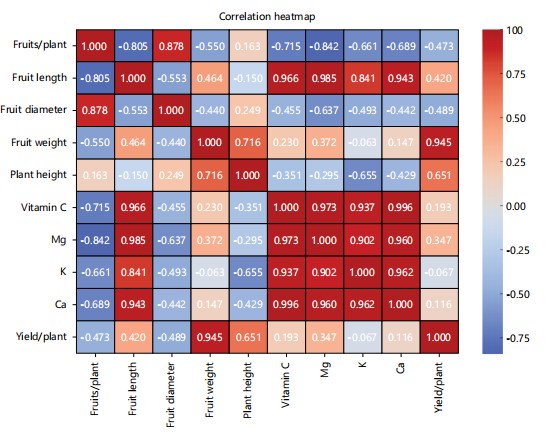
Correlation among traits: Correlation analysis revealed strong relationships among agronomic and nutritional traits (Table 2; Fig. 2). Fruit number per plant showed significant negative correlations with fruit length (r = -0.805, p<0.01), vitamin C (r = -0.715, p<0.01), magnesium (r = -0.842, p<0.01), potassium (r = -0.661, p<0.05), and calcium (r = -0.689, p<0.05). This indicates a trade-off between fruit number and fruit nutrient accumulation, similar to the findings of Ashraf et al.18 (2020). By contrast, fruit length was strongly and positively correlated with vitamin C (r = 0.966, p<0.01), magnesium (r = 0.985, p<0.01), potassium (r = 0.841, p<0.01), and calcium (r = 0.943, p<0.01), suggesting that larger fruits have greater nutrient concentration. Fruit weight exhibited strong positive correlations with plant height (r = 0.716, p<0.01) and fruit yield per plant (r = 0.945, p<0.01), highlighting the importance of plant vigor in yield improvement.
| Table 1: | Mean performance of ten agronomic and nutritional traits of three red okra with check one green okra | |||
| Accession | Fruit color | Fruits per plant |
Fruit length (cm) |
Fruit diameter (cm) |
Fruit weight (g) |
Plant height (cm) |
Vitamin C (mg/100 g) |
Magnesium (mg/100 g) |
Potassium (mg/100 g) |
Calcium (mg/100 g) |
Fruit yield per plant (g) |
| OK28 | Red | 20.81a | 11.17d | 3.14a | 23.8d | 105.37c | 10.27d | 27.07d | 198.3d | 9.87d | 1088.17b |
| OK29 | Red | 11.23b | 13.03c | 2.03c | 30.47b | 114.03b | 12.1c | 34.1c | 201.1c | 13.67c | 1659.98a |
| OK31 | Red | 10b | 17.1a | 2.43b | 31.4a | 115.77a | 25.87a | 45.8a | 250.27b | 68.1b | 1664.24a |
| OK63 | Green | 9.3b | 15.8b | 2.03c | 24.7c | 80.17d | 24.97b | 45.1b | 279.6a | 70.6a | 1194.01b |
| Mean | 12.84 | 14.28 | 2.41 | 27.57 | 103.32 | 18.32 | 38.08 | 232.31 | 40.08 | 1435.7 | |
| SD | 5.38 | 2.94 | 0.5 | 3.75 | 16.17 | 7.01 | 8.65 | 37.82 | 31.8 | 262.58 | |
| CV (%) | 41.89 | 20.59 | 20.75 | 13.6 | 15.65 | 38.25 | 22.72 | 16.28 | 79.36 | 18.29 | |
| F-test | ** | ** | ** | ** | ** | ** | ** | ** | ** | ** | |
| SD: Standard deviation, CV (%): Coefficient of variation and **,*Level of significance at 1 and 5%, respectively and same letters differ insignificantly at the 5% level | |||||||||||
|
| Table 2: | Pearson Correlation Matrix among agronomic and nutritional traits of okra | |||
| Traits | FPP | FL | FD | FW | PH | VC | Mg | K | Ca | FYPP |
| FPP | 1 | -0.805** | 0.878** | -0.55 | 0.163 | -0.715** | -0.842** | -0.661* | -0.689* | -0.473 |
| FL | 1 | -0.553 | 0.464 | -0.15 | 0.966** | 0.985** | 0.841** | 0.943** | 0.42 | |
| FD | 1 | -0.44 | 0.249 | -0.455 | -0.637* | -0.493 | -0.442 | -0.489 | ||
| FW | 1 | 0.716** | 0.23 | 0.372 | -0.063 | 0.147 | 0.945** | |||
| PH | 1 | -0.351 | -0.295 | -0.655* | -0.429 | 0.651* | ||||
| VC | 1 | 0.973** | 0.937** | 0.996** | 0.193 | |||||
| Mg | 1 | 0.902** | 0.960** | 0.347 | ||||||
| K | 1 | 0.962** | -0.067 | |||||||
| Ca | 1 | 0.116 | ||||||||
| FYPP | 1 | |||||||||
Significance marks: * = p<0.05, ** = p<0.01, FPP: Fruits per plant, FL: Fruit length (cm), FD: Fruit diameter (cm), FW: Fruit weight (g), PH: Plant height (cm), VC: Vitamin C (mg/100 g), Mg: Magnesium (mg/100 g), K: Potassium (mg/100 g), Ca: Calcium (mg/100 g) and FYPP: Fruit yield per plant (g) |
||||||||||
Correlation analysis of red okra traits revealed significant relationships among fruit, plant, and nutrient characteristics. Fruit number per plant was negatively correlated with fruit length (r = -0.805, p<0.01), vitamin C (r = -0.715, p<0.01), magnesium (r = -0.842, p<0.01), potassium (r = -0.661, p<0.05), and calcium (r = -0.689, p<0.05), indicating a trade-off between fruit quantity and fruit size or nutrient content. These results were supported by Ashraf et al.18 findings. Fruit length was strongly positively associated with vitamin C (r = 0.966, p<0.01), magnesium (r = 0.985, p<0.01), potassium (r = 0.841, p<0.01), and calcium (r = 0.943, p<0.01). Larger fruits accumulated more nutrients, with fruit length showing strong positive correlations with vitamin C, magnesium, potassium, and calcium19. Fruit weight showed strong positive correlations with plant height (r = 0.716, p<0.01) and fruit yield per plant (r = 0.945, p<0.01), while plant height also positively influenced yield (r = 0.651, p<0.05), suggesting that plant vigor contributes to both fruit quality and productivity16. These results indicate that breeding for larger, nutrient-rich fruits may affect overall yield and fruit number, emphasizing the importance of balancing fruit quality and productivity in red okra.
CONCLUSION
The study demonstrated wide genetic variability among red okra genotypes for agronomic and nutritional traits. The OK29 and OK31 were superior for yield, while OK31 and OK63 excelled in nutritional quality. These genotypes can serve as valuable resources for breeding programs aimed at producing high-yielding, nutrient-rich red okra varieties. The genotypes OK31 and OK29 are recommended for use in breeding programs aimed at improving yield potential in red okra. Additionally, OK31 and OK63 can be effectively utilized to enhance the vitamin C, potassium, and calcium content of future cultivars through biofortification strategies. To ensure the stability and consistency of these traits, it is further recommended to conduct multi-location trials for validating the performance of these genotypes under diverse environmental conditions.
SIGNIFICANCE STATEMENT
This study provides novel insights into the extent of genetic variability in red okra for both yield and nutritional traits. The identification of superior genotypes highlights the potential for combining productivity with nutritional enhancement. The findings are significant for plant breeders, nutritionists, and policymakers seeking to promote red okra as a functional and economically valuable crop.
REFERENCES
- Elkhalifa, A.E.O., E. Alshammari, M. Adnan, J.C. Alcantara and A.M. Awadelkareem et al., 2021. Okra (Abelmoschus esculentus) as a potential dietary medicine with nutraceutical importance for sustainable health applications. Molecules, 26.
- Ranga, A.D., A. Chaudhary and M.S. Darvhankar, 2023. Diversity analysis of phenotypic traits in okra (Abelmoschus esculentus L. Moench). J. Hortic. Sci., 17: 63-72.
- Olayiwola, R., R.A. Yusuf, O.A. Oyetunde, O.S. Sosanya and O.J. Ariyo, 2021. Assessment of genetic variability among accessions of okra (Abelmoschus esculentus L. Moench). Acta Hortic. Regiotecturae, 24: 141-147.
- Zhang, Y., T. Zhang, Q. Zhao, X. Xie and Y. Li et al., 2021. Comparative transcriptome analysis of the accumulation of anthocyanins revealed the underlying metabolic and molecular mechanisms of purple pod coloration in okra (Abelmoschus esculentus L.). Foods, 10.
- Yildiz, M., S.T. Sirke, M. Koçak, İ. Mancak and A.A. Özkaya et al., 2025. Characterization of a diverse okra (Abelmoschus esculentus L. Moench) germplasm collection based on fruit quality traits. Plants, 14.
- Akinyele, B.O. and O.S. Osekita, 2006. Correlation and path coefficient analyses of seed yield attributes in okra (Abelmoschus esculentus (L.) Moench). Afr. J. Biotechnol., 5: 1330-1336.
- Reddy, S.V., V.M. Prasad, S.E. Topno, V.B. Rajwade and Deepanshu, 2019. Genetic variability, heritability and correlation studies on tomato (Solanum lycopersicum L.). J. Pharmacogn. Phytochem., 8: 2465-2470.
- Horwitz, W. and AOACI, 2000. Official Methods of Analysis of AOAC International. 17th Edn., Association of Official Analytical Chemists, Rockville, Maryland, ISBN-13: 9780935584677, Pages: 2200.
- Pearson, D., 1976. The Chemical Analysis of Foods. 7th Edn., Churchill Livingstone, London, ISBN-13: 9780443014116, Pages: 575.
- Gomez, K.A. and A.A. Gomez, 1984. Statistical Procedures for Agricultural Research. 2nd Edn., John Wiley and Sons Inc., Hoboken, New Jersey, ISBN: 978-0-471-87092-0, Pages: 704.
- Snedecor, G.W. and W.G. Cochran, 1989. Statistical Methods. 8th Edn., Iowa State University Press, Ames, Iowa, USA, ISBN-13: 978-0813815619, Pages: 524.
- Steel, R.G.D., J.H. Torrie and D.A. Dickey, 1997. Principles and Procedures of Statistics: A Biometrical Approach. 3rd Edn., McGraw-Hill Co., New York, USA., ISBN: 9780070610286, Pages: 666.
- Pearson, K., 1895. VII. Note on regression and inheritance in the case of two parents. Proc. R. Soc. London, 58: 240-242.
- Sokal, R.R. and F.J. Rohlf, 2012. Biometry: The Principles and Practice of Statistics in Biological Research. 4th Edn., W.H. Freeman and Co., New York, ISBN-13: 978-0-7167-8604-7, Pages: 937.
- Adeniji, O.T., O.B. Kehinde, M.O. Ajala and M.A. Adebisi, 2007. Genetic studies on seed yield of West African okra (Abelmoschus caillei (A. chev.) stevels). J. Trop. Agric., 45: 36-41.
- Abdalla, A.I., E.A.S. Mohammed, M.M. Mahdi and N.T. Khiery, 2024. Impact of plant spacing and fertilization dose on the growth and yield traits of okra (Abelmoschus esculentus (L.) Moench) in Sudan. J. Trop. Crop Sci., 11: 268-277.
- Nwangburuka, C.C., O.A. Denton, O.B. Kehinde, D.K. Ojo and A.R. Popoola, 2012. Genetic variability and heritability in cultivated okra [Abelmoschus esculentus (L.) Moench]. Span. J. Agric. Res., 10: 123-129.
- Ashraf, A.T.M.H., M. Mizanur Rahman, M. Mofazzal Hossain and U. Sarker, 2020. Study of correlation and path analysis in the selected okra genotypes. Asian Res. J. Agric., 12: 1-11.
- Aboyeji, C.M., S.O. Dahunsi, D.O. Olaniyan, O. Dunsin, A.O. Adekiya and A. Olayanju, 2021. Performance and quality attributes of okra (Abelmoschus esculentus (L.) Moench) fruits grown under soil applied Zn-fertilizer, green biomass and poultry manure. Sci. Rep., 11.
How to Cite this paper?
APA-7 Style
Ullah,
M.Z., Biswas,
P. (2025). Genetic Variability in Yield and Nutritional Traits of Red Okra (Abelmoschus esculentus L.) Genotypes. Trends in Biological Sciences, 1(4), 269-276. https://doi.org/10.21124/tbs.2025.269.276
ACS Style
Ullah,
M.Z.; Biswas,
P. Genetic Variability in Yield and Nutritional Traits of Red Okra (Abelmoschus esculentus L.) Genotypes. Trends Biol. Sci 2025, 1, 269-276. https://doi.org/10.21124/tbs.2025.269.276
AMA Style
Ullah
MZ, Biswas
P. Genetic Variability in Yield and Nutritional Traits of Red Okra (Abelmoschus esculentus L.) Genotypes. Trends in Biological Sciences. 2025; 1(4): 269-276. https://doi.org/10.21124/tbs.2025.269.276
Chicago/Turabian Style
Ullah, Mohammad, Zahir, and Prince Biswas.
2025. "Genetic Variability in Yield and Nutritional Traits of Red Okra (Abelmoschus esculentus L.) Genotypes" Trends in Biological Sciences 1, no. 4: 269-276. https://doi.org/10.21124/tbs.2025.269.276

This work is licensed under a Creative Commons Attribution 4.0 International License.