
Shade Effects on Growth, Yield, and Oil Quality of Cymbopogon winterianus in the Deccan Plateau
-
Ranjith Kumar Sunkari
Crop Production and Protection Division, CSIR-Central Institute of Medicinal and Aromatic Plants, Research Centre, Boduppal, Hyderabad, Telangana 500092, India
Jnanesha A.C.Crop Production and Protection Division, CSIR-Central Institute of Medicinal and Aromatic Plants, Research Centre, Boduppal, Hyderabad, Telangana 500092, India
S. BharathkumarCrop Production and Protection Division, CSIR-Central Institute of Medicinal and Aromatic Plants, Research Centre, Boduppal, Hyderabad, Telangana 500092, India
R.K. Lal
Plant Breeding and Genetic Resources Conservation, CSIR-Central Institute of Medicinal and Aromatic Plants, Research Centre, Lucknow, Uttar Pradesh 226015, India
C.S. ChanotiyaPhytochemistry Division, CSIR-Central Institute of Medicinal and Aromatic Plants, Research Centre, Lucknow, Uttar Pradesh 226015, India
| Received 11 Jun, 2025 |
Accepted 11 Sep, 2025 |
Published 30 Sep, 2025 |
Background and Objective: Java citronella (Cymbopogon winterianus var. Bio-13) cultivation faces challenges in optimizing growth and essential oil yield under varying shade conditions, particularly in the Deccan Plateau Region. The present study aimed to evaluate the effects of different shade levels on vegetative growth, essential oil yield, composition, and biochemical parameters to identify optimal cultivation conditions. Materials and Methods: A field experiment was conducted at CSIR-CIMAP Research Centre, Hyderabad (2023-24), using a randomized block design (RBD) with four replications. Shade levels of 0, 25, 50, 70, and 90% were applied to assess plant growth, herbage yield, essential oil content and composition, chlorophyll, and phenolic contents. Gas chromatography was used for essential oil analysis. Statistical analysis included Principal Component Analysis and standard ANOVA to determine treatment effects with 0.05 significance level. Results: Maximum vegetative growth was recorded under 90% shade (plant height:142.3 cm, leaf length:113 cm, canopy width:119.5 cm). However, 50% shade resulted in optimal essential oil production (0.95%; 156.7 kg/acre), fresh herbage yield (19.4 t/acre), and dry herbage weight (16.5 t/acre), outperforming full sunlight (0.94%; 35.96 kg/acre). Chemical composition was superior under 50% shade, with citronellal (35.32%) and geraniol (23.42%) reaching peak levels. Biochemical parameters, including total chlorophyll (2.5 mg/g FW) and phenolic content (30.4 mg GAE/g DW), were also maximized under 50% shade. Principal Component Analysis indicated that shade treatments accounted for 78.5% of the total variance. Conclusion: Moderate shade (50%) provides optimal conditions for maximizing essential oil yield, quality, and biochemical composition in Java citronella, while higher shade levels promote vegetative growth. These findings offer practical recommendations for improving citronella cultivation under Deccan Plateau conditions.
| Copyright © 2025 Sunkari et al. This is an open-access article distributed under the Creative Commons Attribution License, which permits unrestricted use, distribution, and reproduction in any medium, provided the original work is properly cited. |
INTRODUCTION
Java citronella (Cymbopogon winterianus Jowitt) is a perennial aromatic herbaceous grass belonging to the Poaceae family. Native to Southeast Asia and widely cultivated in tropical and subtropical regions, it is primarily known for its essential oil, which has immense medicinal, cosmetic, and industrial value1. Java citronella is a valuable medicinal plant with multifaceted health benefits rooted in its essential oil’s bioactive compounds2-4. Its continued exploration offers promising potential in the development of eco-friendly therapeutics and natural health products5. Sustainable cultivation and further phytopharmacological studies are essential to unlock its full medicinal potential. The plant is an important source of citronella oil, rich in bioactive compounds such as citronellal, geraniol, and citronellol1-4. Java citronella essential oil is renowned for its diverse therapeutic properties, including antimicrobial, anti-inflammatory, antifungal, insect-repellent, and antioxidant activities. Its oil is widely used in traditional and modern medicine for the treatment of colds, fevers, digestive issues, muscle pain, and skin disorders. In aromatherapy, citronella oil is employed for its calming effects and ability to relieve stress and anxiety. Its antifungal properties are effective against Candida albicans, while its mosquito-repellent action is attributed to the high content of citronellal and geraniol, making it a natural alternative to chemical repellents like DEET. The primary phytochemical composition/ constituents of Java citronella oil include: citronellal (32-45%), geraniol (21-24%), and Citronellol (11-15%). These compounds contribute to the oil’s characteristic lemony aroma and bioactivity, especially its antimicrobial and insect-repellent properties. Due to its broad-spectrum bioactivity and natural origin, Java citronella is increasingly used in pharmaceutical, cosmetic, food, and agricultural industries. It is incorporated into soaps, perfumes, disinfectants, and topical formulations. Ongoing research on nano-formulations and biofilm inhibition mechanisms of citronella oil could lead to novel drug delivery systems and new treatments for resistant pathogens.
Java citronella is a commercially important aromatic grass grown for its essential oil. It finds widespread use in the fragrance, cosmetics, and pharmaceutical industries5,6. The cultivar Bio-13, developed by CSIR-CIMAP in India, is notable for its high essential oil production and outstanding quality2,3. The essential oil of Java citronella, which contains geraniol, citronellol, and citronellal, has been shown to repel pests such as the dengue vector mosquito Aedes aegypti7, as well as potential therapeutic effects5.
The impact of environmental factors like shade on Java citronella’s growth and essential oil production is still a topic of interest despite the extensive research on the plant’s genetic diversity1, fertilizer efficiency7,8, and management practices for essential oil production3,9. By altering photosynthetic activity and food intake, shade circumstances can have a substantial impact on plant growth, development, and essential oil production10. The Deccan Plateau, with its semi-arid climate and distinct soil composition, offers a unique environment for agricultural practices, including the cultivation of aromatic crops such as Java citronella3. Understanding how different shade levels influence the growth, yield, and quality of Java citronella in this particular geographic context is critical for optimizing cultivation practices and maximizing essential oil production.
Thus, by emphasizing the relationship between shade levels and plant performance, the study aims to contribute to the development of more sustainable and efficient production methods for this versatile aromatic grass in the unique environmental context of the Deccan Plateau. The findings of this investigation have the potential to have a significant impact on agricultural practices in the region, providing farmers and researchers with new perspectives on optimizing Java citronella cultivation.
MATERIALS AND METHODS
Experimental: The experiments were conducted at the CSIR-CIMAP, Research Centre, Hyderabad, experimental farm, Telangana State (Deccan Plateau Region), India (17°25'N, 78°27'E, elevation 544 m above sea level) from June, 2023 to May, 2024. The soil was clay loam with pH 6.8 and an organic matter content of 0.28%. The physico-chemical properties of the soil were determined at a depth of 30 cm (Table 1).
| Table 1: | Physical and chemical soil properties of the experimental site of CSIR-CIMAP R.C. at Boduppal, Hyderabad, Telangana State, India | |||
| Latitude | 17°25'N |
| Longitudes | 78°33'E |
| Mean sea level | 582 m above |
| Climate | Semi-arid tropical |
| Average annual rainfall | 764 mm |
| Rainfall during this experiment year | 725 mm |
| Soil | Red sandy soil (79.2% sand, 9.8% silt, 6.8% clay) |
| pH | 6.8 |
| EC | 0.65 dsm-1 |
| Organic carbon | 0.28% |
| Sand (%) | 30 |
| Slit (%) | 42 |
| Clay (%) | 18 |
| Available N | 172.4 kg/ha |
| Available P | 10.2 kg/ha |
| Available K | 292.6 kg-1 |
| Available Si mg/kg | 42 |
| Avg. Ann. Temp. (Long term) (°c) | 32 |
The study employed a Randomized Block Design (RBD) with five shade treatments (0, 25, 50, 75, and 90%) replicated four times. The experiment was conducted across 2 growing seasons (2023-2024) from June to May. The research site was located in a semi-arid subtropical region known for hot summers and mild winters.
Plant material and shade treatments: Java citronella (var. Bio-13) slips were sourced from the experimental farm of CSIR-CIMAP Research Centre in Hyderabad, Telangana. The crop was established with a planting geometry of 60×45 cm. To simulate varying light conditions, natural tree canopies were utilized to create five distinct shade levels:0 (full sun), 25, 50, 70, and 90%. Light intensity was monitored throughout the experiment using a calibrated lux meter (LX-1330B, Dr. Meter) to ensure consistent shade treatments.
Agronomic practices: Standard agronomic practices were followed for all treatments. Irrigation was provided as needed to maintain optimal soil moisture. Organic manure was applied at 10 t/ha before planting, and NPK fertilizer (100:40:40 kg/ha) was applied in split doses.
Traits
Growth parameters: In this study, various growth and yield parameters of citronella variety Bio-13 were meticulously measured to evaluate the effects of different treatments on plant performance. The parameters assessed included plant height (cm), leaf length (cm), leaf width (cm), number of leaves per slip, total number of leaves per plant, number of tillers, canopy width (cm), collar diameter (cm), and leaf area. Additionally, chlorophyll content was measured to assess the plant’s health and photosynthetic efficiency. These growth parameters were recorded at 30-day intervals to monitor the development of the plants over time.
Furthermore, yield-related metrics such as total fresh weight (t/ha), fresh bundle weight (t/ha), total dry weight (t/ha), essential oil yield, and oil composition were analyzed at regular intervals throughout the growing season. The essential oil yield was quantified using standard extraction methods, and the composition was determined through gas chromatography to identify the key constituents of the oil10.
Essential oil distillation and analysis: The oil was extracted from fresh herbage using hydro-distillation in a Clevenger apparatus for 3 hrs. Oil yield was calculated as a percentage of fresh herbage weight. GC-MS analysis was performed using an Agilent 7890B GC system coupled with a 5977A mass-selective detector.
Biochemical analysis: The quality parameters, such as essential oil content and composition, were analyzed using GC-MS. The yield parameters, including oil yield per plant and oil yield per hectare, were also determined. Total chlorophyll content was determined using the method described by Arnon11. Total phenolic content was estimated using the Folin-Ciocalteu method12.
Statistics: Data were subjected to ANOVA by applying SPSS software (ver. 26.0). Means were compared using Tukey’s HSD test at p≤0.05. The data obtained from the study were statistically analyzed using ANOVA to determine the significant differences among the treatments.
RESULTS AND DISCUSSION
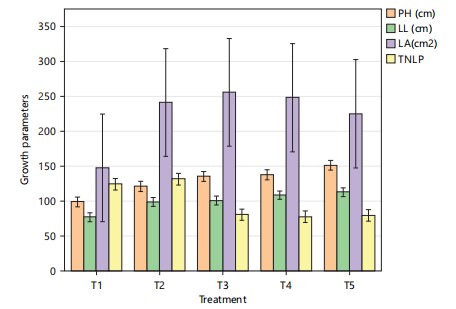
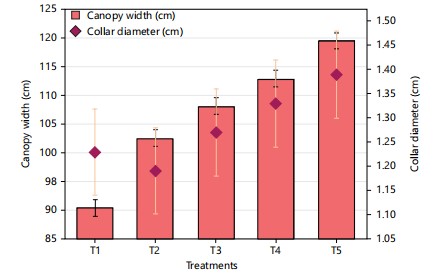
The study on Java citronella var Bio-13 revealed significant variations in growth parameters under different shade conditions. The 90% shade treatment emerged as the most favorable, demonstrating superior growth characteristics across multiple metrics, including plant height (142.3 cm), leaf length (113 cm), leaf width (3.65 cm), number of leaves per tiller (135.4), number of tillers (21.4), and canopy width (119.5 cm) compared to the other treatments. This was followed by the 70% shade treatment, which recorded plant height (137.6 cm), leaf length (108.5 cm), number of leaves per tiller (7.43), total number of leaves per plant (128.1), number of tillers (18.3), and canopy width (112.8 cm). Significantly lower growth parameters were observed in no-shade conditions compared to the other shade levels. Similarly, the 90% shade treatment recorded a significantly higher leaf area (240.1 cm²) compared to the other treatments and was comparable to the 70% shade treatment (235.4 cm²). In contrast, a significantly lower leaf area was noted in no-shade conditions (187.1 cm²) (Fig. 1-2). However, collar diameter did not show any significant differences across the varied shade levels (Fig. 3).
These results indicate that Java citronella var Bio-13 demonstrates significant shade tolerance, with optimal growth occurring at higher shade levels. The substantial improvement in growth parameters under 90% and 70% shade suggests that this variety may be well-suited for cultivation in partially shaded environments, potentially offering advantages for intercropping or cultivation in areas with partial canopy cover1,3,4(Fig. 3).
|

|
|
The differential response to shade levels likely relates to the plant’s photosynthetic adaptation mechanisms, light interception efficiency, and physiological plasticity. Light is crucial for controlling plant growth and has a significant impact on plant shape, productivity, and photosynthesis13. Etiolation is the process of growing citronella in the shade, which causes the plant to grow more slowly. According to Semichenko et al.14, many plant species react to shadow by reducing photosynthate allocation to roots, increasing leaf area, suppressing branching, and speeding up stem and leaf elongation.
The results indicated that among the various shade levels tested, the 50% shade treatment yielded the highest fresh herbage weight at 19.4 tons per acre and dry herbage weight at 16.5 tons per acre. This was followed closely by the 0% shade treatment, which produced 18.0 tons per acre of fresh weight and 15.3 tons per acre of dry weight. In contrast, the 25% shade treatment resulted in significantly lower herbage weights, with fresh weight recorded at 15.2 tons per acre and dry weight at 12.9 tons per acre (Fig. 4). These findings suggest that moderate shading (50%) may create an optimal environment for herbage growth, likely due to reduced stress from direct sunlight and improved moisture retention in the soil. The 0% shade condition, while still productive, may expose the plants to higher levels of light and heat, potentially leading to stress that could limit growth. Conversely, the 25% shade appears to be detrimental to herbage production, possibly due to insufficient light for photosynthesis or other environmental factors that may inhibit growth. In addition to the observed herbage weights, it is important to consider the physiological responses of the plants under different shade conditions. Moderate shading can enhance the efficiency of light utilization, allowing plants to optimize their photosynthetic processes without the detrimental effects of excessive light intensity. This balance is crucial for maintaining healthy growth and maximizing biomass production (Fig. 4).

|
Moreover, the 50% shade treatment may also contribute to better soil moisture retention, which is vital for plant health, especially in regions prone to drought or irregular rainfall patterns. The ability of shaded environments to reduce soil temperature can further enhance root development and nutrient uptake, leading to improved overall plant vigor.
On the other hand, the 0% shade condition, while yielding substantial herbage, may expose the plants to stress factors such as heat and water loss through evaporation, which could negatively impact their growth over time. The high light intensity in this condition may lead to photoinhibition, where the photosynthetic apparatus is damaged due to excessive light, ultimately reducing the plant’s ability to produce energy. The 25% shade treatment’s negative impact on herbage production could be attributed to insufficient light levels for optimal photosynthesis. While some shade can be beneficial, too much can hinder the plant’s ability to capture the light energy necessary for growth. This finding underscores the importance of finding a balance in shading practices to maximize herbage yield.
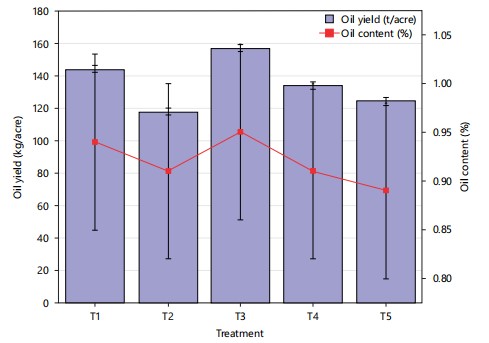
The results revealed that among the various shade levels tested, the 50% shade treatment exhibited significantly higher oil content at 0.95% and oil yield at 156.7 kg per acre, outperforming all other shade conditions. This was closely followed by the 0% shade treatment, which recorded an oil content of 0.94% and an oil yield of 143.8 kg per acre (Fig. 5). In contrast, the 90% shade treatment resulted in notably lower oil content at 0.89% and oil yield at 124.4 kg per acre. These findings suggest that a moderate level of shading (50%) may create an ideal environment for oil production, likely due to a balance between light availability and reduced stress from excessive sunlight. The slight decrease in oil content and yield observed in the 0% shade treatment indicates that while full sunlight can be beneficial, it may also lead to stress conditions that could limit overall oil production15. On the other hand, the significant reduction in oil content and yield under 90% shade suggests that insufficient light severely hampers the plant’s ability to synthesize and accumulate oil (Fig. 5).
|

|
The observed optimal oil production at 50% shade can be attributed to several physiological and biochemical factors. Moderate shading may enhance the plant’s photosynthetic efficiency by preventing photo inhibition, a condition where excessive light can damage the photosynthetic machinery. This balance allows the plant to allocate more resources toward oil synthesis rather than merely surviving under stress. Additionally, the 50% shade treatment may promote better leaf expansion and chlorophyll content, which are crucial for maximizing photosynthetic activity and, consequently, oil production (Fig. 6).
| Table 2: | Effect of shade levels on major essential oil components of Java citronella var. CIMAP-Bio-13 | |||
| Shade level (%) | Citronellal (%) | Geraniol (%) | Citronellol (%) |
| 0 (full sun) | 32.623 | 21.398 | 10.695 |
| 25 | 25.742 | 19.476 | 7.791 |
| 50 | 35.317 | 23.415 | 10.157 |
| 70 | 24.729 | 18.694 | 7.872 |
| 90 | 26.375 | 18.048 | 9.256 |
| Values are Means±SE. Different letters within a column indicate significant differences (p≤0.05) | |||
In contrast, the 0% shade treatment, while yielding high oil content, may expose the plants to stressors such as elevated temperatures and increased evaporation rates, which can negatively impact oil accumulation. The stress induced by full sunlight may lead to the production of reactive oxygen species (ROS), which can damage cellular structures and hinder oil biosynthesis pathways. This highlights the importance of managing light exposure to optimize both growth and oil yield.
The significant decline in oil content and yield under 90% shade further emphasizes the critical role of light in the metabolic processes of citronella. Insufficient light can limit photosynthesis, leading to reduced energy availability for oil synthesis. This finding aligns with previous research indicating that essential oil production in aromatic plants is closely linked to light intensity and quality. The reduced oil yield in heavily shaded conditions may also be associated with altered plant morphology, such as elongated stems and reduced leaf area, which can further compromise the plant’s ability to capture light effectively.
The essential oil analysis revealed key components, including citronellal, geraniol, and citronellol (Table 2). Among the various shade levels tested, the 50% shade treatment showed a significantly higher concentration of citronellal (35.32%) and geraniol (23.42%) compared to the other shade conditions. In contrast, the 70% shade treatment had the lowest citronellal content (24.8%), while the 90% shade treatment recorded the lowest geraniol content (18.05%). Interestingly, the full sun treatment resulted in the highest citronellol content (10.70%), closely followed by the 50% shade treatment (10.16%), whereas the 25% shade treatment showed the lowest citronellol content (7.79%). These results indicated that light availability plays a crucial role in the biosynthesis of these essential oil components13-16. The enhanced production of citronellal and geraniol under 50% shades may be attributed to the optimal balance of light and shade, which can promote the metabolic pathways responsible for their synthesis. Conversely, the higher citronellol content in full sun conditions indicates that this compound may require more intense light for its production, highlighting the complex interplay between light exposure and essential oil composition.
The distinctive flavor of basil increases with complete irradiation and diminishes in shaded circumstances, demonstrating how shading treatments impact the concentration of essential oils like linalool and eugenol17,18. Eucalyptus citriodora Hook is the subject of another investigation. Plants showed that more branches, thicker stems, and wider petals grew with a higher percentage of shadow; however, there was no significant difference in the amount of citronellal and β-Citronellol at 0, 50, and 75% shade19.
The results indicated significant differences in total chlorophyll content among the Java citronella plants subjected to varying shade levels. The 50% shade treatment exhibited the highest total chlorophyll content, measuring 2.5±0.3 mg/g fresh weight (FW), followed closely by the full sun treatment (0% shade), which recorded 2.2±0.2 mg/g FW. In contrast, the plants exposed to 90% shade demonstrated a significantly lower chlorophyll content of 1.5±0.4 mg/g FW.
Similarly, total phenolic content varied significantly across the different shade treatments. The 50% shade condition again showed the highest levels of total phenolics, with a measurement of 30.4±2.8 mg gallic acid equivalents (GAE)/g dry weight (DW), while the full sun treatment followed with 28.2±3.5 mg GAE/g DW. The 90% shade treatment resulted in a significantly lower phenolic content of 18.2±2.0 mg GAE/g DW.
All climate components, such as light, temperature, and humidity, have a direct influence on the physiological, morphological, and biochemical processes of plants, where the intensity is too high or too low causing the accumulation of less biomass4,12. These findings suggest that moderate shading (50%) is beneficial for enhancing both chlorophyll and phenolic content in Java citronella. The increased chlorophyll levels under 50% shade may enhance photosynthetic efficiency, leading to improved growth and essential oil production20-22. Additionally, the higher phenolic content could indicate enhanced plant defense mechanisms, as phenolics are known for their role in protecting plants against environmental stressors and pathogens. The increase in both chlorophyll and phenolics at 50% shade could indicate an adaptive response to moderate light stress. Plants often increase chlorophyll content to maximize light capture under reduced light conditions, while phenolics can serve as photo protective compounds23-25.
The lower chlorophyll and phenolic contents in full sun (0% shade) compared to 50% shade might indicate some level of high light stress or photo inhibition in unshaded conditions. The observed decline in both chlorophyll and phenolic content at 90% shade suggests that excessive shading may hinder photosynthesis and reduce the plant’s ability to synthesize secondary metabolites. This highlights the importance of optimizing light conditions for the cultivation of Java citronella, as both chlorophyll and phenolic compounds are crucial for the plant’s overall health and oil yield. The similar trends for both compounds suggest a possible physiological link between chlorophyll and phenolic production in response to varying light levels26-28.
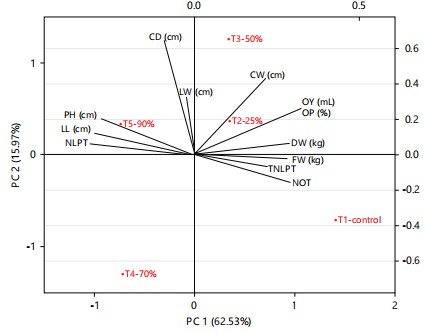
The PCA conducted on the effects of shade treatments on Java citronella growth and yield provides valuable insights that can guide cultivation practices and future research. Principal Component 1 (PC1) accounts for 62.53% of the total variance, while PC2 explains an additional 15.97%, together capturing 78.5% of the overall variance in the dataset. PC1 reveals a distinct separation of variables along the horizontal axis, with positive loadings for collar width (CW), dry weight (DW), and citronella oil percentage (COP). In contrast, plant height (PH), leaf length (LL), and number of leaves per plant (NLPT) exhibit negative loadings. This pattern suggests that PC1 primarily reflects a gradient of plant size and biomass characteristics, indicating that as one moves along this axis, there is a transition from smaller, less robust plants to larger, more vigorous ones. In PC2, positive loadings are observed for collar diameter (CD) and leaf width (LW), while the number of tillers (NOT) shows a negative loading. This indicates that PC2 may represent a different aspect of plant morphology, possibly related to leaf and stem structure, which could be influenced by the shading treatments.
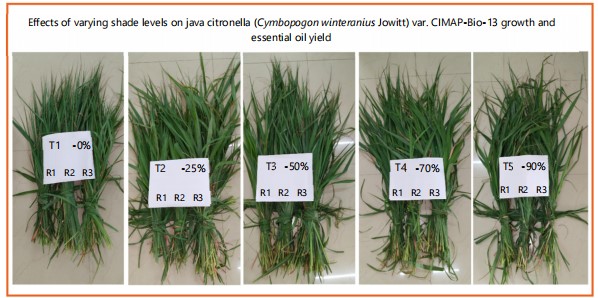
The positioning of the treatments in the PCA plot provides further insights into their effects. The Control treatment (T1) is located in the lower right quadrant, while T4 (70% shade) is found in the lower left quadrant, indicating contrasting impacts on plant growth parameters. T2 (25% shade) is situated near the center with a slight positive loading on PC1, and T3 (50% shade) occupies the upper left quadrant. This arrangement suggests that T1 and T4 represent two extremes in terms of plant response, with T2 and T3 exhibiting intermediate effects (Fig. 7).
The close clustering of variables such as PH, LL, and NLPT indicates strong correlations among these traits, suggesting that they may respond similarly to the applied shade treatments. This finding highlights the interconnectedness of morphological traits and their potential collective response to environmental conditions. Overall, the analysis underscores the significant influence of shade treatments on the morphological and physiological characteristics of Java citronella. The most pronounced effects were observed between the control and the 70% shade treatment, indicating that excessive shading may hinder growth and development.
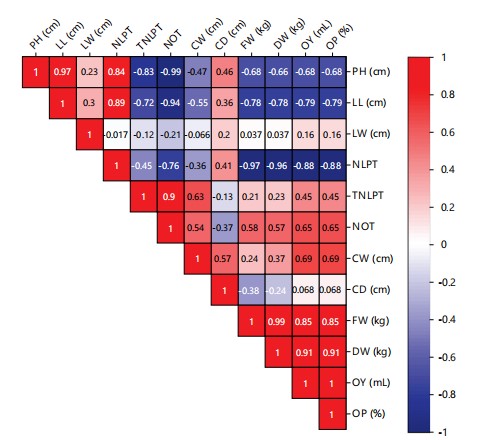
The correlation matrix illustrates the degree of association between multiple variables, revealing correlation coefficients that range from strongly positive to strongly negative. Notably, plant height (PH) exhibits a very strong positive correlation with leaf width (LW) (r = 0.97), indicating that taller plants consistently have longer leaves. Oil yield (OY) demonstrates a strong positive correlation with both fresh weight (FW) and dry weight (DW) (r>0.8), suggesting that biomass is a reliable predictor of oil production. Furthermore, FW, DW, OY, and oil percentage (OP) form a highly intercorrelated cluster (r>0.85), highlighting the strong relationships between biomass parameters and yield components. Canopy width (CW) shows moderate positive correlations with biomass parameters (FW, DW) and yield components (OY, OP). The number of leaves per plant (NLPT) and total number of leaves per plant (TNLPT) are moderately correlated with the number of tillers (NOT) (r≈0.9), indicating a consistent relationship between leaf counts and this parameter. Conversely, NLPT and TNLPT exhibit moderate to strong negative correlations with PH and leaf length (LL) (r≈-0.8 to -0.9), suggesting that taller plants with longer leaves tend to have fewer leaves. Canopy diameter (CD) shows negative correlations with several vegetative parameters, particularly with PH and LL (r≈-0.7). Additionally, LW displays relatively weak correlations with most parameters, except for LL, indicating that it may be independently regulated29-31.
|
|
|
| Table 3: | Effect of varied shade levels on gross return (Rs/acre), net return (Rs/acre), and benefit cost ratio in Java citronella | |||
| Treatment | Gross return (Rs/ha) | Net return (Rs/ha) | Benefit cost ratio (B:C ratio) |
| T1:0% (full sun) | 208539 | 160539 | 3.34 |
| T2:25% shade | 170479.4 | 122479.4 | 2.55 |
| T3:50% shade | 227149.8 | 179149.8 | 3.73 |
| T4:70% shade | 193808.2 | 145808.2 | 3.04 |
| T5:90% shade | 180334.5 | 132334.5 | 2.76 |
| SEM+ | 4239 | 4239 | |
| CD (p=0.05) | 12716 | 12716 |
The strong positive correlation between PH and LW suggests that as plants grow taller, they also develop broader leaves, which may enhance their ability to capture sunlight and perform photosynthesis more efficiently. This relationship could be particularly important for optimizing growth conditions in cultivation practices. The significant correlations between biomass parameters (FW, DW) and oil yield (OY) highlight the importance of managing plant health and vigor to maximize oil production. The intercorrelation among FW, DW, OY, and OP indicates that these parameters are likely influenced by similar environmental factors and physiological processes, reinforcing the idea that a holistic approach to plant management can yield better results. The moderate correlations between CW and biomass and yield components suggest that canopy structure may play a role in light interception and overall plant productivity (Fig. 8).
The economic analysis of Java citronella cultivation under varying shade conditions, as presented in Table 3, reveals significant differences in financial performance metrics. The study demonstrated that 50% shade (T3) generated significantly higher gross return at Rs 227,149.8/ha, exceeding the returns from full sun exposure (T1:Rs 208,539.0/ha), while 25% shade (T2) yielded the lowest gross return at Rs 170,479.4/ha. Net returns followed an identical pattern, with 50% shade achieving Rs 179,149.8/ha, followed by full sun at Rs 160,539.0/ha, and 25% shade showing the lowest returns at Rs 122,479.4/ha.
The benefit-cost ratio analysis further confirmed the superiority of moderate shading, with T3 (50% shade) achieving the highest B:C ratio of 3.73, while T2 (25% shade) recorded the lowest at 2.55. Notably, Java citronella-maintained profitability (B:C ratio>2.5) even under higher shade levels of 70% and 90%, though these conditions were not optimal for maximizing returns (Table 3; Fig. 9).
The superior performance under 50% shades can be attributed to improved microclimate conditions that enhance biomass production while protecting from excessive solar radiation. However, shade levels exceeding 50% resulted in diminishing returns, likely due to reduced photosynthetic efficiency. These findings support existing research on aromatic plants, emphasizing the importance of balanced light conditions for optimal growth and economic returns in Java citronella cultivation.
CONCLUSION
Java citronella is a valuable medicinal plant that has several health benefits that stem from the bioactive components in its essential oil. Its ongoing research holds great promise for the creation of natural health products and environmentally friendly medications. To fully realize its therapeutic potential, sustainable production and more phytopharmacological research are necessary. This study highlights the significant impact of varying shade levels on the growth, oil yield, and quality of citronella var. Bio-13 in the Deccan Plateau region. The findings indicate that moderate shading (50%) optimally enhances essential oil production and quality, while also promoting robust vegetative growth, as evidenced by increased chlorophyll and phenolic content. Conversely, excessive shading (90%) hinders oil synthesis and overall plant performance, while full sunlight (0% shade) may induce stress conditions that limit oil accumulation. The correlation and principal component analyses further elucidate the intricate relationships among growth parameters, emphasizing the importance of managing light exposure to optimize biomass and essential oil yield. These insights provide valuable guidance for cultivation practices, suggesting that strategic shade management can enhance the productivity and sustainability of Java citronella farming in this unique environmental context.
SIGNIFICANCE STATEMENT
This study identified the positive influence of moderate shade levels on biomass accumulation and essential oil composition in Cymbopogon winterianus, which could be beneficial for optimizing yield and oil quality in semi-arid regions. This study will assist researchers in uncovering critical areas of shade-responsive metabolic pathways and agro-management strategies that have remained unexplored by many. Consequently, a new theory on microclimate-driven modulation of essential oil biosynthesis in aromatic grasses may be developed.
ACKNOWLEDGMENT
The authors thank the Director, CSIR-Central Institute of Medicinal and Aromatic Plants, for providing the necessary facilities (CIMAP/Pub/2024/160).
REFERENCES
- Munda, S., S. Dutta and M. Lal, 2020. Variability estimation and genetic divergence in Cymbopogon winterianus for development of superior genotype. Agron. J., 113: 993-1007.
- Bahl, J.R., A.K. Singh, R.K. Lal and A.K. Gupta, 2018. High-Yielding Improved Varieties of Medicinal and Aromatic Crops for Enhanced Income. In: New Age Herbals: Resource, Quality and Pharmacognosy, Singh, B. and K.V. Peter (Eds.), Springer, Singapore, ISBN: 978-981-10-8291-7, pp: 247-265.
- Kumar, A., A.C. Jnanesha, R.K. Lal, C.S. Chanotiya, S. Srivastava and Y. Pant, 2022. Biplot investigation for essential oil yield and chemical compositions under the Deccan Plateau Region of Southern India in cultivars of Java citronella (Cymbopogon winterianus Jowitt). Ind. Crops Prod. 175.
- Lal, R.K., C.S. Chanotiya and R. Lahiri, 2025. Insights into genotype×environment interactions affecting essential oil yield and quality stability in Cymbopogon species and genotypes. Biochem. Syst. Ecol., 123.
- de Santana, M.T., M.G.B. de Oliveira, M.F. Santana, D.P. de Sousa and D.G. Santana et al., 2013. Citronellal, a monoterpene present in Java citronella oil, attenuates mechanical nociception response in mice. Pharm. Biol., 51: 1144-1149.
- Wany, A., S. Jha, V.K. Nigam and D.M. Pande, 2013. Chemical analysis and therapeutic uses of citronella oil from Cymbopogon winterianus: A short review. Int. J. Adv. Res., 1: 504-521.
- Sombra, K.E.S., C.V.S. de Aguiar, S.J. de Oliveira, M.G. Barbosa, G.J. Zocolo and P.L. Pastori, 2020. Potential pesticide of three essential oils against Spodoptera frugiperda (J.E. Smith) (Lepidoptera: Noctuidae). Chil. J. Agric. Res., 80: 617-628.
- Rao, E.V.S.P., M. Singh, M.R. Narayana and G. Chandrasekhara, 1984. Relative efficiency of prilled urea and urea-supergranules in Java citronella (Cymbopogon winterianus Jowitt). Fert. Res., 5: 435-437.
- da Costa, A.S.V., M.C. Hott and A.H. Horn, 2020. Management of citronella (Cymbopogon winterianus Jowitt ex Bor) for the production of essential oils. SN Appl. Sci., 2.
- Lima, T.S., Y.N.C. da Silva Melo, J.L. da Silva, J.F. de Oliveira Costa, G.S. de Andrade Lima and I.P. Assunção, 2021. Efficiency of essential oils to control Colletotrichum theobromicola in vitro. Rev. Agro@mbiente On-line, 15.
- Arnon, D.I., 1949. Copper enzymes in isolated chloroplasts. Polyphenoloxidase in Beta vulgaris. Plant Physiol., 24: 1-15.
- Singleton, V.L., R. Orthofer and R.M. Lamuela-Raventós, 1999. Analysis of Total Phenols and other Oxidation Substrates and Antioxidants by Means of Folin-Ciocalteu Reagent. In: Methods in Enzymology, Packer, L. (Ed.), Academic Press, Cambridge, Massachusetts, ISBN: 9780121822002, pp: 152-178.
- Hou, W., Y. Luo, X. Wang, Q. Chen and B. Sun et al., 2018. Effects of shading on plant growth, flower quality and photosynthetic capacity of Rosa hybrida. AIP Conf. Proc., 1956.
- Semchenko, M., M. Lepik, L. Götzenberger and K. Zobel, 2012. Positive effect of shade on plant growth: Amelioration of stress or active regulation of growth rate? J. Ecol., 100: 459-466.
- Danata, N.H., Nurul Aini, C. Udayana, A. Setiawan, W.S.D. Yamika and R. Prambudi, 2023. Diversity characterization of three varieties of Cymbopogon nardus under different shade conditions. Biodiversitas J. Biol. Divers., 24: 3574-3582.
- Lal, R.K. and A.K. Singh, 2024. Implications of phosphate solubilizing bacteria, Azotobacter and Azospirillium biofertilizers on strawberry (Fragaria×ananassa Duchesne) growth, quality and yield. J. Agric. Res. Adv. 6: 29-42.
- Changa, X., P.G. Alderson and C.J. Wright, 2008. Solar irradiance level alters the growth of basil (Ocimum basilicum L.) and its content of volatile oils. Environ. Exp. Bot., 63: 216-223.
- Yadav, K., Y. Pant, S. Srivatava, D. Bhatt and R.K. Lal et al., 2025. Chemistry and characterization of high value acyclic alcohols in Ocimum africanum Lour. hybrids and their biological potential. Ind. Crops Prod., 229.
- Degani, A.V., N. Dudai, A. Bechar and Y. Vaknin, 2016. Shade effects on leaf production and essential oil content and composition of the novel herb Eucalyptus citriodora Hook. J. Essent. Oil Bear. Plants, 19: 410-420.
- Rezai, S., N. Etemadi, A. Nikbakht, M. Yousefi and M.M. Majidi, 2018. Effect of light intensity on leaf morphology, photosynthetic capacity, and chlorophyll content insage (Salvia officinalis L.). Hortic. Sci. Technol., 36: 46-57.
- Muttaleb, Q.A., T.L. Abdullah, S.A. Hassan, A.A. Rashid, S. Taheri, O.A. Ahmed and D.A. Abdulameer, 2018. The role of shade and nitrogen on physiological traits and secondary metabolites of Piper betle L. J. Hortic., 5.
- Cansian, R.L., A. Staudt, J.L. Bernardi, B.M.S. Puton and D. Oliveira et al., 2023. Toxicity and larvicidal activity on Aedes aegypti of citronella essential oil submitted to enzymatic esterification. Braz. J. Biol., 83.
- Devi, K., S.K. Mishra, J. Sahu, D. Panda, M.K. Modi and P. Sen, 2016. Genome wide transcriptome profiling reveals differential gene expression in secondary metabolite pathway of Cymbopogon winterianus. Sci. Rep., 6.
- Dey, T., S. Bhattacharya and P.D. Ghosh, 2010. Somatic embryogenesis from rhizome explants of Cymbopogon winterianus. Biol. Plant, 54: 325-328.
- Eden, W.T., D. Alighiri, K.I. Supardi and E. Cahyono, 2020. The mosquito repellent activity of the active component of air freshener gel from java citronella oil (Cymbopogon winterianus). J. Parasitol. Res., 2020.
- Sukarno, N., R. Laelandi, I. Qayim and M.P. Amelya, 2022. Arbuscular mycorrhizal characteristics of citronella grass (Cymbopogon nardus L.) in shaded and unshaded fields [In Indonesian]. J. Ilmu Pertanian Indonesia, 27: 109-119.
- Pinheiro, P.F., V.T. de Queiroz, V.M. Rondelli, A.V. Costa, T. de Paula Marcelino and D. Pratissoli, 2013. Insecticidal activity of citronella grass essential oil on Frankliniella schultzei and Myzus persicae. Agric. Sci., 37: 138-144.
- Sarma, T.C., 2002. Variation in oil and its major constituents due to season and stage of the crop in Java citronella (Cymhopogon winterianus Jowitt.). J. Spices Aromat. Crops, 11: 97-100.
- Singh, M., R.S.G. Rao and E.V.S.P. Rao, 1996. Effect of depth and method of irrigation and nitrogen application on herb and oil yields of Java citronella (Cymbopogon winterianus Jowitt.) under semi-arid tropical conditions. J. Agron. Crop Sci., 177: 61-64.
- Verma, R.S., S.K. Verma, S. Tandon, R.C. Padalia and M.P. Darokar, 2020. Chemical composition and antimicrobial activity of Java citronella (Cymbopogon winterianus Jowitt ex Bor) essential oil extracted by different methods. J. Essent. Oil Res., 32: 449-455.
- Wijerathna, R.M.N., A.A. Wijeweera, A.M. Wijethunga and M.M.S.T. Mapa, 2023. Determination of oil quality and antifungal effect of selected citronella accessions (Cymbopogon nardus, Cymbopogon winterianus) to formulate an anti-dandruff shampoo. Biol. Med. Nat. Prod. Chem., 12: 485-498.
How to Cite this paper?
APA-7 Style
Sunkari,
R.K., A.C.,
J., Bharathkumar,
S., Lal,
R.K., Chanotiya,
C. (2025). Shade Effects on Growth, Yield, and Oil Quality of Cymbopogon winterianus in the Deccan Plateau. Trends in Biological Sciences, 1(2), 130-143. https://doi.org/10.21124/tbs.2025.130.143
ACS Style
Sunkari,
R.K.; A.C.,
J.; Bharathkumar,
S.; Lal,
R.K.; Chanotiya,
C. Shade Effects on Growth, Yield, and Oil Quality of Cymbopogon winterianus in the Deccan Plateau. Trends Biol. Sci 2025, 1, 130-143. https://doi.org/10.21124/tbs.2025.130.143
AMA Style
Sunkari
RK, A.C.
J, Bharathkumar
S, Lal
RK, Chanotiya
C. Shade Effects on Growth, Yield, and Oil Quality of Cymbopogon winterianus in the Deccan Plateau. Trends in Biological Sciences. 2025; 1(2): 130-143. https://doi.org/10.21124/tbs.2025.130.143
Chicago/Turabian Style
Sunkari, Ranjith, Kumar, Jnanesha A.C., S. Bharathkumar, R. K. Lal, and C.S. Chanotiya.
2025. "Shade Effects on Growth, Yield, and Oil Quality of Cymbopogon winterianus in the Deccan Plateau" Trends in Biological Sciences 1, no. 2: 130-143. https://doi.org/10.21124/tbs.2025.130.143

This work is licensed under a Creative Commons Attribution 4.0 International License.