
Enhancing Sustainable Food Production Through Effective Food System Management
-
Emeka Ugoala


Department of Biology and Forensic Science, Faculty of Science, Admiralty University of Nigeria, P.M.B. 1020, Ogwashi-Uku, Delta State, Nigeria
| Received 27 May, 2025 |
Accepted 13 Sep, 2025 |
Published 30 Sep, 2025 |
Soil health and fertility, climate change and variation, biodiversity loss, pollution, environmental dilapidation, and plant and animal diseases are some food systems disturbances that affect food security. Therefore, a systematic review of 152 published literature from Google, Google Scholar, and Web of Science databases revealed that the challenges impacting food production and food systems sustainability include an expanding population, competition for resources, the complexity of the global food chain, climate change, communicable diseases, and other biological hazards. However, attaining enhanced food system economic performance and social well-being may necessitate plant-based food fermentation, valorizing side-streams for functional ingredients, sustainable protein products, and data science and AI for sustainable business. A food system that wholly delivers food security and nutrition is economically, socially, and environmentally sustainable.
| Copyright © 2025 Emeka Ugoala. This is an open-access article distributed under the Creative Commons Attribution License, which permits unrestricted use, distribution, and reproduction in any medium, provided the original work is properly cited. |
INTRODUCTION
Food production and subsequent postharvest activities comprise numerous internal and external procedures, players, and exchanges. Food systems are, however, dynamic and can adjust to most unfavourable situations1,2. They are very complex, diverse, and location-specific because circumstances and production realities differ. The systems mostly develop according to the traditional expression of culture, history, and lifestyle of local people that reflect technological, environmental, economic, political, and social factors. Local knowledge-based technologies promote rural industrialization, thereby creating employment and income generation opportunities. However, food systems are shaped by state or institutional policies such as agriculture, animal welfare, food trade, food aid, and food safety. Others include food waste, food education, labeling guidance, and nutrition policy. Thus, food systems are supply chains revealing the universal structure of production and consumption, specifically theproducers, distributors, and consumers. Infrastructure and organizational structures are necessary to enable, sustain, or enhance the operation of a food system.
Food production generates greenhouse gases3. Climate change affects malnutrition, disease, poverty, livelihoods, unemployment, and conflict. Extreme weather-related natural disasters affect, on average, 160 million people per year4. Poor diet as a result of the technical and structural changes in the food systems is estimated to cause about 8 million deaths annually5. Food under provided with dietary sources of vitamins and minerals affects under nutrition, overweight, and obesity, and associated diet-related Non-Communicable Diseases (NCDs)5. These might cause the healthcare cost to exceed $1.3 trillion per year by 20306.
Studies indicated that the global population suffering from the food crisis is over 110 million7. Poor diet-related mortality is estimated at 8 million deaths annually5. This is due to the decrease of about 50% per capita arable land8. Agriculture’s low productivity and the high-level perishability of nutrient-dense foods impose major constraints on nutrition safety. Post-harvest losses drive food insecurity9-12. Economically, food waste causes the cost implications arising from pesticides, time, sophisticated machines used for land preparation and harvesting, transportation of produce, etc., to be a waste. Thus, impactful technologies are critical for high-input necessities, natural resource utilization, improved nutritional benefits, and managing climate change and biodiversity loss issues13. These have necessitated the re-engineering of the systems to keep pace with human apprehensions of the 21st century.
The major human concern is achieving a sustainable end to hunger through food system management. However, growing population, urbanization, environmental degradation, low adoption of new technologies, inadequate financial resources, and health crises are persuading vital changes in dietary preferences. This study aims, therefore, to identify some benefits of food systems management and sustainability by expanding the knowledge base and sharing experiences and approaches from the literature.
METHODOLOGY
A broad examination of published literature was undertaken to study how food production could be sustained through food systems management. A systematic review effectively handles the survey of many publications and helps develop a multifaceted background for the study14. It can suggest assessment outlines for further studies in various situations15,16.
Four databases (PubMed, Google, Google Scholar, and Web of Science) were searched for publications made in English from 1988 to 2024. Search terms were exclusive from the author’s past knowledge, in relevant articles found from initial searches, and in published similar systematic reviews. In addition, keywords, synonyms, and controlled vocabulary terms were combined using the Boolean operators AND, OR, and NOT. Searches were refined to ensure the inclusion of only articles published in English in all databases searched. The search used food systems-related terms as follows: “Food systems and sustainability*”, “Food systems and emerging vulnerabilities”, “Food system or food sustainable practices”, “Food security and safety”, and “Climate change adaptation and food safety”. In total, 1,758 papers were found.
For the included studies, basic information about the article (author(s), year of publication, title, DOI), analysis (study type, procedure used, theoretical contexts and tool/research procedures), food systems, and food production, intervention (system administration), outcomes (quantitative and qualitative) were extracted. The relevance of each publication to food system management and food system sustainability determined its selection. Therefore, of the 1758 papers, the 721 articles that were relevant to the subject matter were further screened down to 152.
RESULTS AND DISCUSSION
The number of articles about food systems management and sustainability increased progressively from 2000-2024, perhaps due to improved awareness. Publications reviewed indicated that developed countries are more interested in the subject matter: Europe (70%), Asia (14%), North America (10%), South America (5%), and Africa (1%). Food systems management and sustainability themes included supplier management (20%), sustainable development (18%), collaboration and coordination management (15%), performance management (13%), logistic management (9%), strategic management (6%), innovation (6%), agriculture (5%), a comprehensive view (concerning more than one subject) (4%), quality management (3%), and other issues (3%).
The percentage of publications that used data from surveys, experiments, interviews, focus groups, observation, etc., was 57%. Publications that used data sourced from archival, content extraction, and bibliometric records, etc., were 27%. Between 5-13% used a blend of primary and secondary data based on their studies on theoretical analyses, and viewpoint research, etc. Approximately two-thirds of the publications had no specific theoretical method in their studies. However, the reviewing technique used includes the stakeholder for 15 publications, the triple bottom line for 11 articles, and the life cycle approach for 7. The recycling economy approach, applied resource-based view and knowledge-based view situations, the institutional theory, applied the resource dependency theory, and the decision theory-based background for 7, 5, 6, 3, and 3, respectively.
Results of the literature review indicated that seventy-five journal articles focused on the supply chain, twenty-four publications echoed on the supply network, 16 were academically minded, 13 were based on the distributor’s perception, 9 took a dyadic opinion, 9 took the suppliers’/farmers’ perceptions, the logistic industry was examined by 6 articles, 5 discussed on the consumers, and 3 papers did not use any of this entity of study. Statistical investigation was the procedure used to study food systems management and sustainability17. Discovering the connection between consumer preferences and environmental issues linked with food production involved the use of mathematical models18. Studies have shown that systematized literature review and case studies can be used to scrutinize food supply chains19, and the effect of public procurement on various food company strategies20.
Generally, qualitative approaches accounted for 78% of the studies, while 22% were of quantitative methods. Theoretical and experimental investigations were conducted21-23. The situational analysis was the most used (24%), statistical analysis (22%), conceptual analysis and/or frameworks (21%), mathematical models (14%), quality tool (10%), and bibliometric analysis and/or literature review (9%).
The discussions are informed by published literature on the following major thematic findings that provide a comprehensive understanding of food systems management and sustainability.
CHALLENGES IMPACTING FOOD SYSTEMS
The food system is diverse. The food industry is disjointed with varieties of food products due to social and demographic trends, relative advantages of some products, lack of cooperation and coordination in food system research, and lack of innovation in marketing and promotion of generic domestic food products are some limitations on food systems. Other barriers hindering food systems development include laboratories providing inspection services for specifications, provision of information and networking services, identifying and publicizing market opportunities and advantages, funding, postharvest loss, the better price obtained for foreign food products, stumpy size and/or unpredictable supply of product due also to expected factors or the unpredictability of producers. The seasonality of some food products can limit rational and consistent supply, new product development, and investment in food systems. This can increase food and food products costs.
Therefore, achieving sustainable food and food products through food system management may necessitate the reinforcement of present industry fragmentation. Cooperative approaches can escalate participants’ consciousness of industry development, and confront problems hindering post-harvest development; for example, low volume and impulsiveness of supply, the cost of by-product expansion, and lack of market research. It can also aid in the use of alternative resources/and or recycling of resources (natural resources maximization), and the application of improved technology in raw material sourcing and manufacturing.
|
Accurate data acquisition and application are important in any future improvement plan. Therefore, accurate data acquisition should be a priority. Data needed include the value of crop production, industrial work input, industry organization and composition, agriculture preharvest and postharvest efforts, and consumer attitudes and behaviour. Accurate data is also needed for natural disaster management, sustainable agriculture promotion, water and food security management, and resilient livelihood solutions in climate-vulnerable communities.
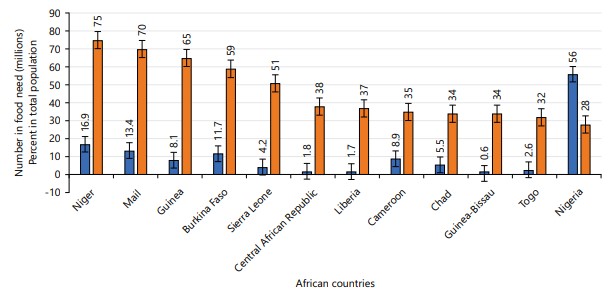
An expanding population: Current global development plans are targeted at reducing extreme poverty. FAO estimate indicates that 870 million people are malnourished, with insufficient resources to purchase or produce adequate food, as shown in Fig. 1. Nigeria has a high percentage of people with food needs, while Guinea-Bissau has the lowest.
With the rising world population, 130 million people would probably become acutely hungry25. Conflicts and disasters caused the displacement of 30.6 million persons26. Thus, the increase in the urban population means a numerical increase in food demand and a need to create jobs in rural areas27. The global agricultural production needs to increase to meet the global food requirements of the estimated 690 million who may be hungry28.
Competitions for resources: The sun emits about 3.86 watts out into space. The thermal radiation intensity is about137 at the radius of Earth’s orbit. Variation in the total luminosity as well as the Earth’s somewhat indirect revolution around the Sun, makes the solar constant vary by ±3%29. Due to the sun’s distance from the Earth, about 0.000000045% (of this power is intercepted by the Earth. These consist of visiblelight, infrared radiation, ultraviolet, and other forms ofelectromagnetic radiation (radio, UV, and X-ray), uniformly distributed in all directions at different wavelengths unsuitable forphotosynthesis. Thus, the swelling universal request for food, feed, and plant-based raw materials is stalled by the biological limits30. The 0.5 available solar energy is inadequate in satisfying the human biological needs of 4000/person. Thermodynamic factors further reduce biomass production from solar energy. Biomass is thus being produced through photosynthesis at a rate of 0.36 W/m2 31. Land availability is limited by industrialization and human settlement. These limitations drive up food prices, which are an added impediment to food systems development.
Complexity of the global food chain: Food supply chains are complex because they are multi-layered networks. The multidimensional network includes meat foods, dairy products, fruit and vegetables, grain mill products, bakery products, sugar and confections, fats and oils, and beverages. These food materials may require multiple transformation procedures, capital investment in technology, and waste management. Therefore, food systems are highly complex, especially due to social and demographic trends.
Climate change: Sustaining food production through food system management is a key component of the 21st century. Food crises can aggravate conflicts. Climate unpredictability is currently undermining food security. The unpredictability and change in temperature, rainfall, and humidity are disruptive to food production. However, current agricultural production is inefficient, high emitting, and relies heavily on fossil carbon resources. Greenhouse gas emissions occur from agricultural fields as a consequence of nitrogen fertilizers.
Climate unpredictability impacts the resident plant and microbial communities with diverse effects of pressure. Organisms’ physiological functions (food productivity), are endogenously controlled by the periodic changes in drought, temperature, and precipitation32,33. Immense pressure at the cell membrane, plasma membrane ion channels, neurotransmitter receptors, ion transporters, pumps, and the cellular cytoskeleton cause cell changes.
Variations in many environmental factors can compromise food safety. Improved occurrence of drought and heavy rainfalls, temperature fluctuations, salinity, and insect pest attacks stimulate the reproductive segment of plant growth. Flower initiation and inflorescence are severely affected by water stress in cereals34. During the meiotic phase, the water deficit causes a reduction in grain35. Drought stress during the meiotic phase significantly disturbs the process of fertilization and anthesis. Grain formation and the reproductive stage are critical in crop production36. Temperature increases during floret development cause sterility in cereals37. A reduction in crop productivity implies food insecurity. Thus, climate change and food uncertainty are major issues of the 21st century.
Communicable diseases and other biological hazards: Food production and distribution involve multiple processes with possible food contamination at any stage. Chemical adulteration could be from agriculture and aquaculture, food packaging, and disinfection, while biological contamination with pathogenic organisms poses an important threat to public health safety. Chemical contamination can result from the use of pesticides and agrochemicals. Persistent organic pollutants (POPs) (lubricants, stain-resistant treatments, fire-fighting foams, flame retardants, micro-plastics, fungicides, herbicides, pesticides, insecticides, pharmaceuticals, human contraceptives, detergents and herbals mixtures, moulds and algal toxins) persist in the environment long after application, and bio-accumulate in living organisms due to their exceptional stability, creating concerns about long-term and trans-generational health risks. Salmonella spp., Listeria monocytogenes, Clostridium botulinum, and Shiga-toxin-producing Escherichia coli are linked with consumer illness or disease from foods or food processing38.
Food and food product contamination present a major food safety challenge. Such products, implicated in foodborne disease outbreaks, burden public health and cause economic loss39. The astonishing rate of infectious disease rise and the requirement to sustainably feed the global population embody the most daunting ecological and public health challenges of the twenty-first century. Hunger and under nutrition may develop when food supplies are scarce, and these conditions may potentially lead to wasting, stunting, and immunological deficiencies40. Therefore, the food and food products production systems should integrate food safety mechanisms. Biological hazards in food can cause severe health risks and economic loss to the food production business.
PROMOTION OF ROBUST, COMPREHENSIVE, AND EQUITABLE FOOD SYSTEMS
The existing food system needs re-engineering to keep pace with current global food demand. An estimated 3.4 billion are undernourished41, micronutrient deficiencies affect around 2 billion people42, and Stunting affects about 22% of the world’s children under age five4. Unsafe food is responsible for the annual cases of foodborne illness38,43. Food systems are vulnerable to soil health and fertility, climate change and adaptation, biodiversity loss, pollution, environmental degradation, plant pests, and animal diseases. These disruptions can create disproportionate effects on food security, the state economy, and public health. The disproportionate effects are exacerbated by multiple stakeholders, processors, brokers, and transportation methods. Thus, vast disparities occurring between and within states along gender, ethnicity, socioeconomic status, and education demand that food systems be managed to prevent shocks as well as advance adaptive capacity to adapt to constant variations44.
APPROACHES TO ROBUST FOOD SYSTEM
Accessible and affordable nutritious food: Food insecurity drives individuals to consume energy-dense and nutrient-poor foods, resulting in increased risk for many chronic diseases. A robust food system aims to ensure the availability of healthy food, deliver jobs, and foster healthy neighborhoods. These may reinforce the economy by boosting revenue, stimulating commercial activities, and contributing to robust commercial development. Other measures may include:
| • | Agricultural extension services that promote the enactment of best agricultural practices in rural agrarian communities, as well as the use of available food crops | |
| • | Promotion of the consumption of diversified diets rich in protein, fruits, and vegetables | |
| • | Promotion of healthier eating patterns through nutrition education, literacy, and care in the primary healthcare systems and other levels of health institutions | |
| • | Investment in mechanization and agricultural technology |
VALUE CHAIN AND MARKET SYSTEM DEVELOPMENT
A market system integrates resources, roles, associations, guidelines, and results in which producers and consumers cooperate, manage, and participate in the manufacture, delivery, and consumption of food and food products. It is composed of vertically and horizontally linked businesses that can effectively transform, advance, and add value to their products and services to meet competitive market demand and maintain or grow market share. Thus, value chain and market system development are essential for improved output, enhanced incomes, and decreased deficiency. Therefore, the food system value chain can be developed through:
Funding the agricultural sector: To develop a sustainable food value chain, the agriculture sector generally needs both public and private sector funding through investment. Funding addresses problems connected with resource utilization, eradicates impediments to food chain development, and lessens resource waste resulting from non-cooperative planning. Thus, investments in the agriculture value chain can expand farming output, guarantee a sustainable food supply, promote farmers’ living, minimize the influences of climate change and sustainable natural resources management, and promote the rural economy through job creation. Non-governmental organizations and private sector partners’ investment in agriculture value chains may be towards capacity building, policy development and implementation, and improved farming methods for enhanced yields and output.
Urbanization and rural transformation: Urbanization causes improved demand for agricultural goods and services from rural areas. Rural areas meeting the urban demand for food can increase their income earnings. Studies indicated that more than 90 million vulnerable in rural areas are in extreme poverty.
These vulnerable groups spend around 70% of their earnings on food45. However, quality apprehensions over locally produced food and food products by urban populations, especially in many developing countries, are often the consequence of imported food products. The development of value chains for the food systems may encourage communally beneficial developments for urban and rural areas alike. Such creates huge markets for farmers, along with employment in various supply-chain segments, including food processors, wholesalers, and logistics firms. Food system value chain development, therefore, can produce a host of agribusiness jobs and enhance the agricultural sector’s ability to make productivity-boosting investments. Value chains reduce post-harvest losses, strengthen food security, and accelerate economic growth.
PROMOTION OF PEACE-BUILDING INITIATIVES, FOOD MARKETING, AND REGULATORY STANDARDS
A relationship exists between violent conflicts and food insecurity. Violent conflict disrupts food production, trade, and access. Food insecurity, however, can contribute to the emergence and extent of conflict, depending on the situation. The most common factors that exacerbate the danger of food uncertainty and contribute to violent struggle include environmental stress and climate-induced food scarcity, production supply rivalry, and complaints related to social issues and food prices. Equitable and sustainable food systems can foster peace. This can be through the integration of charitable, growth, and peace interventions.
Current food systems are unsustainable. They have harmful environmental impacts, do not reduce rural poverty in developing countries, and have power disparities in food chains. The integration of food production and trade, therefore, requires organizational structures, approaches, regulations, and food control systems, including supervisory authorities to boost public health, food safety, and international trade. Regulations benefit the food industry players in meeting legal and regulatory requirements. It also addresses consumer concerns (food safety, nutritional labelling, hygiene, and food additives, etc.).
Marketing is a determinant component in the choices connected to food consumption.However, in the food market, the two production sectors, agriculture and industry, with different dynamics, have implications for the respective markets. Agriculture is inadequate in its ability to create a conventional position. The food industry, on its part, is often accustomed to competition and value additions. Thus, management strategies for a robust food system require appropriate organizational functionality, performativity, and continuity. Food systems reform can be achieved through.
Role clarity: Economic (population growth), social (dietary changes), and environmental (climate change, overexploitation of natural resources) drivers make food systems and food production sustainability complex. However, specialization can aid the appraisal and planning of strategies seeking to accomplish food security and sustainability, if outlined within distinctive disciplinary descriptions46. Specialization can produce varied yet reasonable results for providing sustainable, healthy diets that are culturally sensitive and attend to the needs of susceptible populations. Role clarity and independence can stimulate productivity, improve well-being and work engagement, and reduce employee stress.
Food systems reorganization for job delivery: Climate change crisis is usually significant in the developing economies food systems due to the prevalence of smallholders, low productivity, and weak vertical connectivity. However, inclusive, resilient, and sustainable food systems may result from upstream and downstream agriculture investments.
Therefore, sustaining the growing population and improving employment for the next generation will require food systems reorganization. Though climate change, automation, and the digital revolution may likely decline farm jobs, agricultural productivity will not necessarily be lower than in other sectors. Value chain activities account for a large share of any economy’s manufacturing and services sectors.
Personnel motivation modernization: Workplace traditional motivational techniques, with their insufficient social protection of employees, lack of elasticity, personnel services, bureaucratic relations, and vertical career growth, do not provide necessary legal support, among others.
Personnel motivation in the food industry that encourages workers’ abilities, morale, communication, and motivation can:
| • | Promote improved problem identification, participatory decision-making, and feedback | |
| • | Facilitates communication within the organization that inspires a shared vision, stimulates creativity, and innovation, ideal influence, and job design and execution |
Linking research, innovation, and extension for food system sustainability: Food systems serve different societal, public health, individual nutrition, and environmental objectives. Current poverty, malnutrition, and climate change trends reflect widespread failures (food supply, consumption patterns, nutrition, livelihoods, and the environment) in food systems. About three billion people lack healthy diets47,48. About two billion people in the informal food sector lack economic access to basic food49,50. Only half a billion small-scale self-employed rural producers are involved in food production51. These challenges necessitate high-quality skills and the evidence stemming from their application interpreted into policy and action.
Data-driven policymaking: The present food industry is challenged mostly by competitiveness. Policy conclusions involve a complex process prejudiced by logic, current evidence, existing models and authorities, previous experiences, emotions, and cognitive biases. Data is required to drive critical decisions. Data management builds capacity for success and growth by creating a culture and infrastructure that speeds up production, reduces waste, and improves systems or processes to optimize resourcing. Thus, leveraging data in decision-making profits generates the capacity to reach long-term production goals. The use of digital and data-driven technologies at each segment of the agriculture value chains can guide and support decisions on production methods, value chain optimization, and storage methods to avoid food waste and loss52. Data influences human lives in all areas and causes vital economic and societal changes. If leveraged purposefully and inclusively, it can positively impact the food system to provide healthy diets through sustainable and resilient agriculture and food systems.
Data use in food systems is fundamental in:
| • | Aid the coordination of varying perceptions from multiple stakeholders to better decision-making, product development, and partnership models, and the empowerment of value chain stakeholders | |
| • | Aid in the measurement of policy outcomes, especially with the intensity of climate variability | |
| • | indicates poverty level in regions, communities, households, and individuals, as well as aid governments and non-governmental agencies in its eradication | |
| • | Accurate and accessible data drives innovation and progress | |
| • | Food insecurity exposes the fragilities in food production and food systems. When data is leveraged purposely and inclusively, it can aid in understanding the response needed | |
| • | Collaborative data management aids the food system by adding value at every stage of the production systems. It helps to reduce friction between food systems, cut costs, and generate more revenue | |
| • | Use of data in the food systems aid in the resilience to meet unprecedented challenges that increase risk and damage profitability by identifying how processes proceed (descriptive analytics), how the processes run (diagnostic analytics), what will likely happen next (predictive analytics), and how to make it happen-or not happen-again (prescriptive analytics) | |
| • | Data-driven food systems are scalable and adjustable to future challenges | |
| • | Data-driven systems ensure that maintenance activities are properly planned and scrutinized, and help expose and avoid costly problems through analytics on productivity, anticipatory, and remedial maintenance logs and plans | |
| • | Data application in food production processes benefits faster improvement times, reduction of errors, and increased productivity that result in direct cost savings | |
| • | Data-driven logistics and production operations aid in maintaining audit readiness and meeting regulatory requirements | |
| • | Food system operations in a complex global supply chain with thin margins and plenty of risks require workable data to drive business agility and provide the means to build capacity in a scalable way for the future marketplace |
Emerging technologies in food processing: Emerging (non-thermal) technologies can preserve perishable foods, maintain food components’ bioavailability, recover functional and technological properties, and enhance the retrieval of products.
Thermal technologies enhance energy conversions. The mechanical processes maximize heat and mass transfer processes, improve the quality and digestibility of processed foods, and reduce waste and energy consumption. Emerging technologies reduce heating and residence time, improve energetic yield and product quality, control Maillard reactions, and protect from environmental stresses53,54. Emerging technologies in food processing are based on the internal generation of energy through heat transmission. This reduces the deterioration of sensory, nutritional, and functional food characteristics.
Emerging food processing technologies include:
High-Pressure Processing (HPP): High-pressure processing rapidly inactivates microorganisms and viruses and denatures enzymes without heat by damaging their membranes or modifying their proteins’ hydrophobicity. It increases the permeability of plant cells, thus accelerating the mass transfer rate of bioactive compounds and allowing diffusion in phase transition55. This technology offers faster solubilization of food components without affecting the colour, flavour, and texture of foods56.
Ultrasound techniques: Ultrasound-based drying technology is known to accelerate mass transfer by generating cavitations in the food matrices when applied in high-intensity (>10 W/cm2, 100 kHz) mode57. The technique can dry fruits and vegetables, coffee, powdered foods, and pasta with excellent product quality. Antioxidants, vitamin C, and other nutritional components are usually retained. Mega Ultrasound Technology (sound waves at the megahertz scale) is used in de-foaming, food texturization, extraction of bio-products, and extracting oil from olives, coconut, and soybeans. Ultrasounds eliminate pathogens (Escherichia coli)58, and are used for encapsulation59.
Radio-frequency: The low energy efficiency radio-frequency drying technique evaporates water below 80°C at uniform heating60.
Electro-osmotic dewatering, an energy-efficient technique, works by applying mechanical pressure with the simultaneous formation of double layers at the colloidal particles’ interface with water suspensions61.
Pulsed electric field (PEF): The technique used for microbial deactivation can soften the texture and disrupt the integrity of cell membranes. It also improves the recovery of valuable compounds from different vegetables and fruits55. Pulsed electric fields aid in the preservation of milk nutrients, eggs, and juices, and improve the encapsulation of bioactive compounds by intensifying fluid bed agglomeration of instant soy protein isolate62.
High-voltage electric discharge: This technique may be used to recover high-added-value compounds from food63.
Ohmic heating for food processing: In ohmic heating, electrical resistance creates a fast and uniform heat generation in food. Ohmic heating may be applied in pasteurization and sterilization of shear-sensitive, liquid, and solid foods such as poultry, fruits, fish, vegetables, and ready-to-serve meals for food thawing64.
Cold plasma processing: Cold plasma is caused by electric discharges applied at different levels of pressure in high-moisture foods, as a vacuum boosts liquid conversion to gas. This technology neutralizes microorganisms in foods61.
Modern technology in food production: Cutting-edge technologies in food production are enhancing efficiency, sustainability, and product quality. These technologies also improve output, reduce waste, and safeguard food safety.
Precision/personalized food production: The precision agriculture technique optimizes yields and minimizes resource utilization. Specific crops with known characteristics (health, growth patterns, nutrient requirements, soil moisture requirements, and temperature) are cultured, allowing farmers to tailor practices and mitigate risks.
Precision/personalized food, such as sugar-free, gluten-free, plant-based diets, and clean-label food products, influences food experts and patients to leverage data-driven eating traditions personalized to patient-specific diet goals.
Vertical farming: The vertical farming technique of food production involves the use of hydroponics and aeroponics technologies. These techniques maximize land and water use, reduce pesticide use, enables precise control over growth factors by delivering nutrients directly to plant roots.
3D printing in food production: Food nutrient complex shapes are customized and tailored to an individual’s nutrient requirement. The food composition and texture are adjusted according to preferences or dietary needs. Waste and energy are decreased in food processing exactness control.
Food safety and internet of things: Internet of things through its sensors enhances food safety by its ability to monitor food temperature, humidity, and air quality. It can aid in detecting contamination sources.
Blockchain technology in supply chain management: Blockchain technology enhances sustainable practices and support responsible food production by precise labeling. This enables quick response to recalls and containment of adulteration incidents.
Artificial intelligence in quality control and food safety assurance: Artificial Intelligence (AI) assures food safety by the use of algorithms to identify defects in food products, and contaminants detection. Thus, AI can improve food inspection process, contaminant detection, compliance, and overall product safety.
Alternative proteins: Alternative sources of proteins include insects, cultured meat, mycoproteins, algae, and plant proteins. Plant-based proteins can be sourced from microalgae. The amino acid content of various microalgae species compares favourably with that of other food proteins. Microalgal proteins have immunomodulation, anti-cancer activity, hepatoprotective, anti-inflammatory, and antioxidant properties65. Conjugate proteins are composed of other structural elements besides amino acids, e.g., chromoproteins, lipoproteins, metalloproteins, and glycoproteins are also contained in microalgal species.
Fungi resources (mushrooms) can provide alternative or supplemental protein sources. yeast protein represents a certified, fully traceable organic protein source. It provides a cleaner and potentially healthier product for the marketplace. The aquaculture industry is confronted with the identification, utilization, and sustainability of alternative protein and lipid sources. Black soldier flies used for the recycling of organic waste could be an alternative protein source.
FOOD SYSTEMS CURRENT TRENDS
Nutraceuticals: Nutraceuticals include dietary supplements that are derived from food sources with physiological benefits and protection against diseases. They can also prevent oxidative stress-related disorders such as allergies, diabetes, and immune-related conditions. Thus, nutraceuticals improve health, delay the aging process, prevent chronic diseases, increase life expectancy, or support the structure or function of the body.
E-commerce: Electronic, online, or e-commerce is a current trend in food systems, especially for customers who are handicapped in food procurement from suppliers due to health or work restrictions. E-commerce techniques include business relationships, the type of platform used, and/or the business model. The direct-to-customer (D2C) distribution model ensures that customers access products online. E-commerce allows both manufacturers and distributors to launch robust networks with their clients.
Restaurant digitization: Theapplication of technological systems for restaurant management aids food providers in modernizing their operations based on customer behaviour and attributes. Digital management solutions aid data-driven decisions (number of orders for a particular item or finding the least ordered dishes). Digital platforms optimize customer-restaurant interactions, thereby increasing order frequency.
Digital food management: The digitization of food systems aids the systems in gathering data at each step of the value chain. This gives valuable insights into production operations as well as market and consumer preferences. Such data is used in aiding:
| • | Personalize dish production | |
| • | Productivity improvements and cost minimization by reducing inventory loss and optimizing supply chain management | |
| • | Low-quality products and products nearing expiry can be monitored using digital platforms | |
| • | Marketing of food products |
Food safety and transparency: Food safety and transparency arecritical issues for consumers and regulators in food supply chains.Food safety and transparency involveapplying systems to improve the product's quality, assure its safety, and trace its origin and journey.Such measures are achieved byusing consistent and corresponding data, digitalization, and collaboration between supply chain actors.
Food waste reduction: Food systems are changing at a dramatic pace due mainly to urbanization. The change in consumption patterns entails improvement in diets and nutrition. However, food loss and wasteaffect the availability and affordability of food. Reducing loss and waste in nutritious foods can minimize hunger and malnutrition, improve the economy, and the natural environment. Processed and packaged food with radically improved packaging can expand the marketability of products and reduce food losses. Appropriate food packaging, whether used to prevent food losses or as a marketing tool to entice a new cadre of consumers, will be essential in making food systems more competitive and sustainable.
Globally, food waste valued at about USD 400 billion accounts for 14% of the food produced66. Presently, around 931 million tons of food are wasted (17% of total global food production)67. Behavioural change can minimize and reduce food loss and waste. Substantial food waste occurs in the younger generation. Education should be geared towards the inculcation of habits that can reduce waste. Food waste reduction can help to achieve sustainability and cut operational costs. Achieving zero waste in food manufacturing and distribution is achieved through food waste upcycling and recycling.
IMPLICATIONS AND RESEARCH DIRECTIONS
Globally, food systems significantly contribute to the economy19,68,69. Attaining enhanced economic performance and social well-being may necessitate maximizing food systems through new techniques. The tasks of sustainability can be solved through the development of concepts and applied tools based on the specific attractiveness of food systems. However, the needs of the consumers may aid in the implementation of more effective, sustainable, innovative techniques. State regulations, motivation strategies, related cultural and social consequences, entrepreneurs’ inclinations, the costs of raw materials, and new technology entail precise knowledge that cannot be disregarded. Therefore, future investigations can emphasize:
Fermentation of plant-based food: Diverse microorganisms (bacteria and fungi) are employed to initiate a series of reactions that modify the chemical components of the substrate into fermented foods (foods and beverages). Such foods include wine, beer, kimchi, and cheese, etc.70. Fermentation increases bioactive compounds and functional properties of food plant materials. Holistic approaches for the identification and complete profiling of these microorganisms may be of interest to food microbiologists.
Valorization of side-streams for functional ingredients: The biorefinery of biowastes will curtail food waste generated across food chains. The resulting useful products may be applied in liquid and solid food products using a range of instrument characterization methods.
Sustainable protein products: Plant-based proteins characterize a more sustainable alternative. However, studies are needed to explore several methods to modify and enhance protein functionality to broaden their application spectrum. Additionally, studies should aim to explain the complex interplay between protein chemistry and structure, their functional properties, the impacts of food processing, and the performance of end-use products.
CONCLUSION
The food systems are under growing pressure from climate change, population growth, and environmental degradation. A sustainable transformation requires technological innovation, efficient resource use, and equitable distribution. This review highlights the need for strategies like plant-based fermentation, AI integration, and sustainable protein sources to enhance food security. Strengthening governance, research agendas, and science-policy linkages is vital. Ultimately, a resilient, inclusive, and environmentally sound food system is essential to meet current and future nutritional needs.
SIGNIFICANCE STATEMENT
Global food systems face mounting pressure due to population growth, climate change, and socio-political instability, which collectively threaten long-term food security and environmental sustainability. This research highlights the necessity of transitioning from merely increasing food production to implementing smarter, more integrated food system management. The findings emphasize that innovations in resource efficiency, equitable distribution, and climate-resilient practices can reshape food systems to be more sustainable and inclusive. By promoting good governance, fostering science-policy collaboration, and aligning food system reforms with global sustainability targets, this study underscores a pathway toward resilient, health-promoting, and environmentally sound food production. The broader impact lies in informing policy and practice to support sustainable food systems that address hunger, health, and ecological balance for future generations.
REFERENCES
- Darnhofer, I., 2010. Strategies of family farms to strengthen their resilience. Environ. Policy Governance, 20: 212-222.
- Walker, B., C.S. Holling, S.R. Carpenter and A. Kinzig, 2004. Resilience, adaptability and transformability in social-ecological systems. Ecol. Soc., 9.
- Khan, M.A., H.H. Ngo, W.S. Guo, Y. Liu and L.D. Nghiem et al., 2016. Optimization of process parameters for production of volatile fatty acid, biohydrogen and methane from anaerobic digestion. Bioresour. Technol., 219: 738-748.
- Adepoju, O.O., O.D. Bekesuomowei and K. Bello, 2023. Correlate of blue economy potentials: Challenges and prospects for economic development in Nigeria. Int. J. Formal Sci.: Curr. Future Res. Trends, 19: 7-19.
- Kennedy, E., P. Webb, S. Block, T. Griffin, D. Mozaffarian and R. Kyte, 2021. Transforming food systems: The missing pieces needed to make them work. Curr. Dev. Nutr., 5.
- Cai, J. and P.S. Leung, 2022. Unlocking the potential of aquatic foods in global food security and nutrition: A missing piece under the lens of seafood liking index. Global Food Secur., 33.
- Elgarahy, A.M., M.G. Eloffy, A. Alengebawy, D.M. El-Sherif, M.S. Gaballah, K.Z. Elwakeel and M. El-Qelish, 2023. Sustainable management of food waste; pre-treatment strategies, techno-economic assessment, bibliometric analysis, and potential utilizations: A systematic review. Environ. Res., 255.
- Searchinger, T.D., S. Wirsenius, T. Beringer and P. Dumas, 2018. Assessing the efficiency of changes in land use for mitigating climate change. Nature, 564: 249-253.
- Amoah, I., C. Cairncross, E.O. Osei, J.A. Yeboah, J.C. Cobbinah and E. Rush, 2022. Bioactive properties of bread formulated with plant-based functional ingredients before consumption and possible links with health outcomes after consumption-A review. Plant Foods Hum. Nutr., 77: 329-339.
- Arrazat, L., S. Nicklaus, B. de Lauzon-Guillain and L. Marty, 2023. Identification of three dietary groups in French university students and their associations with nutritional quality and environmental impact. Front. Nutr., 10.
- Willett, W., J. Rockström, B. Loken, M. Springmann and T. Lang et al., 2019. Food in the anthropocene: The EAT-Lancet commission on healthy diets from sustainable food systems. Lancet, 393: 447-492.
- Ugoala, C., G. Ndukwe and T. Audu, 2009. Investigation of the constituent fatty acids of some freshwater fishes common in Nigeria. Braz. J. Aquat. Sci. Technol., 13: 65-70.
- Fan, F., H. Lian, X. Liu and X. Wang, 2021. Can environmental regulation promote urban green innovation efficiency? An empirical study based on Chinese cities. J. Cleaner Prod., 287.
- Garcia-Buendia, N., J. Moyano-Fuentes, J.M. Maqueira-Marín and M.J. Cobo, 2021. 22 years of lean supply chain management: A science mapping-based bibliometric analysis. Int. J. Prod. Res., 59: 1901-1921.
- Feng, Y., Q. Zhu and K.H. Lai, 2017. Corporate social responsibility for supply chain management: A literature review and bibliometric analysis. J. Cleaner Prod., 158: 296-307.
- Fahimnia, B., J. Sarkis and H. Davarzani, 2015. Green supply chain management: A review and bibliometric analysis. Int. J. Prod. Econ., 162: 101-114.
- Sharma, R., S.S. Kamble, A. Gunasekaran, V. Kumar and A. Kumar, 2020. A systematic literature review on machine learning applications for sustainable agriculture supply chain performance. Comput. Oper. Res., 119.
- Taghikhah, F., A. Voinov, N. Shukla, T. Filatova and M. Anufriev, 2021. Integrated modeling of extended agro-food supply chains: A systems approach. Eur. J. Oper. Res., 288: 852-868.
- Thomé, K.M., G. Cappellesso, E.L.A. Ramos and S.C. de Lima Duarte, 2021. Food supply chains and short food supply chains: Coexistence conceptual framework. J. Cleaner Prod., 291.
- Asp, N.G., 1994. Nutritional classification and analysis of food carbohydrates. Am. J. Clin. Nutr., 59: 679S-681S.
- Khan, S.A., M.S. Mubarik, S. Kusi-Sarpong, S.I. Zaman and S.H.A. Kazmi, 2021. Social sustainable supply chains in the food industry: A perspective of an emerging economy. Corporate Social Responsibility Environ. Manage., 28: 404-418.
- Zhao, Y.S., A.S. Eweys, J.Y. Zhang, Y. Zhu and J. Bai et al., 2021. Fermentation affects the antioxidant activity of plant-based food material through the release and production of bioactive components. Antioxidants, 10.
- Yakavenka, V., I. Mallidis, D. Vlachos, E. Iakovou and Z. Eleni, 2020. Development of a multi-objective model for the design of sustainable supply chains: The case of perishable food products. Ann. Oper. Res., 294: 593-621.
- Ugoala, E., 2023. Antimicrobial drug resistance: A systematic review and assessment of resistant pathogen infection prevention and control. Trends Med. Res., 18: 36-57.
- Etscheidt, J., A. Shahien, M. Gainey, D. Kronenfeld, R. Niu, D. Freccero and E. Smith, 2020. Review of therapeutic options for the prevention of VTE in total joint arthroplasty. Geriatrics, 5.
- Isaksen, T., L.H. Evensen, S.K. Brækkan and J.B. Hansen, 2019. Dietary intake of marine polyunsaturated n-3 fatty acids and risk of recurrent venous thromboembolism. Thromb. Haemost., 119: 2053-2063.
- Boudebbouz, A., S. Boudalia, A. Bousbia, S. Habila, M.I. Boussadia and Y. Gueroui, 2021. Heavy metals levels in raw cow milk and health risk assessment across the globe: A systematic review. Sci. Total Environ., 751.
- FAO, IFAD, UNICEF, WFP and WHO, 2020. The State of Food Security and Nutrition in the World 2020. FAO, Rome, Italy, ISBN: 978-92-5-132901-6, Pages: 320.
- Alexander, J., D. Benford, A. Cockburn, J.P. Cravedi and E. Dogliotti et al., 2008. Polycyclic aromatic hydrocarbons in food-scientific opinion of the panel on contaminants in the food chain. Eur. Food Saf. Authority J., 6.
- Emeka, U., 2017. Biobased products industrial utilization limitations. New Mater. Compd. Appl., 1: 94-114 .
- Zondag, S.D.A., T.M. Masson, M.G. Debije and T. Noël, 2022. The development of luminescent solar concentrator-based photomicroreactors: A cheap reactor enabling efficient solar-powered photochemistry. Photochem. Photobiol. Sci., 21: 705-717.
- Gourdji, S.M., A.M. Sibley and D.B. Lobell, 2013. Global crop exposure to critical high temperatures in the reproductive period: Historical trends and future projections. Environ. Res. Lett., 8.
- Olokor, J., E. Ugoala and A. Ibitoye, 2009. Study of fish weight loss in solar dryer across different agro-ecological zones of Nigeria. Nat. Prec.
- Winkel, T., J.F. Renno and W.A. Payne, 1997. Effect of the timing of water deficit on growth, phenology and yield of pearl millet (Pennisetum glaucum (L.) R. Br.) grown in Sahelian conditions. J. Exp. Bot., 48: 1001-1009.
- Sheoran, I.S. and H.S. Saini, 1996. Drought-induced male sterility in rice: Changes in carbohydrate levels and enzyme activities associated with the inhibition of starch accumulation in pollen. Sex Plant Reprod., 9: 161-169.
- Pradhan, G.P., P.V.V. Prasad, A.K. Fritz, M.B. Kirkham and B.S. Gill, 2012. Effects of drought and high temperature stress on synthetic hexaploid wheat. Funct. Plant Biol., 39: 190-198.
- Saini, H.S. and D. Aspinall, 1982. Abnormal sporogenesis in wheat (Triticum aestivum L.) induced by short periods of high temperature. Ann. Bot., 49: 835-846.
- Ugoala, E., 2023. Antibacterial-resistant pathogens mechanisms of transmission and strategies for prevention and control. Res. J. Microbiol., 18: 28-45.
- Hussain, M.A. and C.O. Dawson, 2013. Economic impact of food safety outbreaks on food businesses. Foods, 2: 585-589.
- Schaible, U.E. and S.H. Kaufmann, 2007. Malnutrition and infection complex mechanisms and global impacts. PLoS Med., 4.
- Mohamad, N., N. Draman, R. Muhamad and H.M. Yusoff, 2015. Knowledge and attitude towards exclusive breastfeeding practices among fathers who attend primary health care facilities in Suburban, Malaysia. Int. J. Collab. Res. Intern. Med. Public Health, 7: 154-163.
- Akadri, A. and O. Odelola, 2020. Breastfeeding practices among mothers in Southwest Nigeria. Ethiopian J. Health Sci., 30: 697-706.
- Primo, C.C. and M.A.G. Brandão, 2017. Interactive theory of breastfeeding: Creation and application of a middle-range theory. Rev. Bras. Enfermagem, 70: 1191-1198.
- Tendall, D.M., J. Joerin, B. Kopainsky, P. Edwards and A. Shreck et al., 2015. Food system resilience: Defining the concept. Global Food Secur., 6: 17-23.
- Laborde, D., A. Herforth, D. Headey and S. de Pee, 2021. COVID-19 pandemic leads to greater depth of unaffordability of healthy and nutrient-adequate diets in low- and middle-income countries. Nat. Food, 2: 473-475.
- Béné, C., P. Oosterveer, L. Lamotte, I.D. Brouwer and S. de Haan et al., 2019. When food systems meet sustainability-Current narratives and implications for actions. World Dev., 113: 116-130.
- Hirvonen, K., Y. Bai, D. Headey and W.A. Masters, 2020. Affordability of the EAT-Lancet reference diet: A global analysis. Lancet Global Health, 8: E59-E66.
- Herforth, A., W. Masters, Y. Bai and D. Sarpong, 2019. The cost of recommended diets: Development and application a food price index based on food-based dietary guidelines (P10-033-19). Curr. Dev. Nutr., 3.
- Plaza, M., A. Cifuentes and E. Ibanez, 2008. In the search of new functional food ingredients from algae and microalgae. Trends Food Sci. Technol., 19: 31-39.
- Zhuang, P., M.B. McBride, H. Xia, N. Li and Z. Li, 2009. Health risk from heavy metals via consumption of food crops in the vicinity of Dabaoshan Mine, South China. Sci. Total Environ., 407: 1551-1561.
- Pena, L.B., C.E. Azpilicueta, M.P. Benavides and S.M. Gallego, 2011. Protein Oxidative Modifications. In: Metal Toxicity in Plants: Perception, Signaling and Remediation, Gupta, D.K. and L.M. Sandalio (Eds.), Springer Berlin, Heidelberg, Verlag, Berlin Heidelberg, ISBN: 978-3-642-22081-4, pp: 207-225.
- Demasi, M., O. Augusto, E.J.H. Bechara, R.N. Bicev and F.M. Cerqueira et al., 2021. Oxidative modification of proteins: From damage to catalysis, signaling, and beyond. Antioxid. Redox Signaling, 35: 1016-1080.
- Barba, F.J., C.M. Galanakis, M.J. Esteve, A. Frigola and E. Vorobiev, 2015. Potential use of pulsed electric technologies and ultrasounds to improve the recovery of high-added value compounds from blackberries. J. Food Eng., 167: 38-44.
- Roselló-Soto, E., F.J. Barba, O. Parniakov, C.M. Galanakis, N. Lebovka, N. Grimi and E. Vorobiev, 2015. High voltage electrical discharges, pulsed electric field, and ultrasound assisted extraction of protein and phenolic compounds from olive kernel. Food Bioprocess Technol., 8: 885-894.
- Oroian, M. and I. Escriche, 2015. Antioxidants: Characterization, natural sources, extraction and analysis. Food Res. Int., 74: 10-36.
- Meléndez-Martínez, A.J., P. Mapelli-Brahm, A. Benítez-González and C.M. Stinco, 2015. A comprehensive review on the colorless carotenoids phytoene and phytofluene. Arch. Biochem. Biophys., 572: 188-200.
- Mutemberezi, V., O. Guillemot-Legris and G.G. Muccioli, 2016. Oxysterols: From cholesterol metabolites to key mediators. Prog. Lipid Res., 64: 152-169.
- Zinoviadou, K.G., C.M. Galanakis, M. Brnčić, N. Grimi and N. Boussetta et al., 2015. Fruit juice sonication: Implications on food safety and physicochemical and nutritional properties. Food Res. Int., 77: 743-752.
- Ofori, J.A. and Y.H. Peggy, 2013. Novel Technologies for the Production of Functional Foods. In: Bio-Nanotechnology: A Revolution in Food, Biomedical and Health Sciences, Bagchi, D., M. Bagchi, H. Moriyama and F. Shahidi (Eds.), Wiley, United States, ISBN: 9781118451915, pp: 141-162.
- Pereira, R.N. and A.A. Vicente, 2010. Environmental impact of novel thermal and non-thermal technologies in food processing. Food Res. Int., 43: 1936-1943.
- Galanakis, C.M., 2013. Emerging technologies for the production of nutraceuticals from agricultural by-products: A viewpoint of opportunities and challenges. Food Bioprod. Process., 91: 575-579.
- Dacanal, G.C. and F.C. Menegalli, 2010. Selection of operational parameters for the production of instant soy protein isolate by pulsed fluid bed agglomeration. Powder Technol., 203: 565-573.
- Liu, D., E. Vorobiev, R. Savoire and J.L. Lanoisellé, 2011. Intensification of polyphenols extraction from grape seeds by high voltage electrical discharges and extract concentration by dead-end ultrafiltration. Sep. Purif. Technol., 81: 134-140.
- Naveh, D., I.J. Kopelman and S. Mizrahi, 1983. Electroconductive thawing by liquid contact. Int. J. Food Sci. Technol., 18: 171-176.
- Aggett, P.J., J. Alexander, M. Alles, P.A. Anderson and J.M. Antoine et al., 1999. Scientific concepts of functional foods in Europe consensus document. Br. J. Nutr., 81: S1-S27.
- Hoffman, J.B., M.C. Petriello and B. Hennig, 2017. Impact of nutrition on pollutant toxicity: An update with new insights into epigenetic regulation. Rev. Environ. Health, 32: 65-72.
- Bishop, K.S. and L.R. Ferguson, 2015. The interaction between epigenetics, nutrition and the development of cancer. Nutrients, 7: 922-947.
- Joshi, O., B. Chapagain, G. Kharel, N.C. Poudyal, B.D. Murray and S.R. Mehmood, 2022. Benefits and challenges of online instruction in agriculture and natural resource education. Interact. Learn. Environ., 30: 1402-1413.
- Ingenbleek, L., P. Verger, M.M. Gimou, A. Adegboye and S.B. Adebayo et al., 2020. Human dietary exposure to chemicals in Sub-Saharan Africa: Safety assessment through a total diet study. Lancet Planet. Heath, 4: E292-E300.
- Tiffon, C., 2018. The impact of nutrition and environmental epigenetics on human health and disease. Int. J. Mol. Sci., 19.
How to Cite this paper?
APA-7 Style
Ugoala,
E. (2025). Enhancing Sustainable Food Production Through Effective Food System Management. Trends in Biological Sciences, 1(2), 155-170. https://doi.org/10.21124/tbs.2025.155.170
ACS Style
Ugoala,
E. Enhancing Sustainable Food Production Through Effective Food System Management. Trends Biol. Sci 2025, 1, 155-170. https://doi.org/10.21124/tbs.2025.155.170
AMA Style
Ugoala
E. Enhancing Sustainable Food Production Through Effective Food System Management. Trends in Biological Sciences. 2025; 1(2): 155-170. https://doi.org/10.21124/tbs.2025.155.170
Chicago/Turabian Style
Ugoala, Emeka.
2025. "Enhancing Sustainable Food Production Through Effective Food System Management" Trends in Biological Sciences 1, no. 2: 155-170. https://doi.org/10.21124/tbs.2025.155.170

This work is licensed under a Creative Commons Attribution 4.0 International License.