
Prevalence and Causes of Stress and Depression Among Students at Karachi Universities
-
Irfan Sajid


Department of Biochemistry, Federal Urdu University of Arts, Science and Technology, Karachi, Pakistan
Shoaib AhmedDepartment of Biochemistry, Federal Urdu University of Arts, Science and Technology, Karachi, Pakistan
Lubna AnisDepartment of Biochemistry, Federal Urdu University of Arts, Science and Technology, Karachi, Pakistan
Hafsah KhanDepartment of Biochemistry, Federal Urdu University of Arts, Science and Technology, Karachi, Pakistan
Tahira FatimaDepartment of Behavioural Sciences, Karachi Institute of Medical Sciences, Karachi, Pakistan
Shahnawaz HussainDepartment of Biochemistry, Federal Urdu University of Arts, Science and Technology, Karachi, Pakistan
| Received 30 Apr, 2025 |
Accepted 29 Jun, 2025 |
Published 30 Jun, 2025 |
Background and Objective: Stress and depression are increasingly prevalent among university students in Karachi, a developing city grappling with economic instability. The study addresses the mental health impact of academic demands, technostress from forced digitalization during the COVID-19 pandemic, and the dual burden of jobs and studies. The main objective is to examine the prevalence, causes, and consequences of stress and depression and identify vulnerable subgroups among undergraduates. Materials and Methods: A mixed-methods design was employed, combining quantitative surveys and qualitative interviews. The sample included 404 undergraduate students from five major universities: The University of Karachi, Federal Urdu University (Gulshan and Abdul Haq Campuses), NED University, and Sir Syed University. Data were analyzed using descriptive statistics and comparative analysis, showing p<0.05 between working and non-working students. Results: Findings indicate high levels of stress and depressive symptoms, with academic pressure and financial strain as leading contributors, but the actual reason is still needed to understand. Technostress and sleep disturbances were significant among students affected by digital learning transitions. Working students reported higher emotional exhaustion and cognitive overload. Gender-based differences in coping mechanisms and reported symptoms were also observed. Conclusion: This study highlights a complex interplay of academic, economic, and social factors affecting student mental health in Karachi. The findings contribute to understanding localized stressors and support the need for targeted mental health interventions and policy adjustments.
| Copyright © 2025 Sajid et al. This is an open-access article distributed under the Creative Commons Attribution License, which permits unrestricted use, distribution, and reproduction in any medium, provided the original work is properly cited. |
INTRODUCTION
Stress is a multifaceted concept, permeates various domains such as biology, psychology, physiology, and sociology. Delineate stress into three types: Stress (inadequate stress), eustress (positive stress), and distress (negative stress)1. The present study significantly impacts university students globally, particularly in Karachi, where it intersects with challenges posed by forced digitalization during the COVID-19 pandemic2. Studies reported that various factors contribute to stress among university students, including academic demands and disruptions caused by global events such as the pandemic. Insufficient time for extracurricular activities, sleep problems, and the challenges associated with combining studies and employment further compound stress levels3.
Scientists3 reveal about mental health dimensions in which sleep disturbances are supposed to be a common companion of stress. Further reported that university students suffer from some mental illness issues, and it is associated with sleep problems. Scientists reported that stress is associated with different cognitive challenges, like memory functions and difficulty concentrating4. Chronic stress, specifically during the COVID-19 pandemic, had a great impact on memory and concentration abilities among students5. Some researchers found that nervousness, overthinking, and emotional irritability are the manifestations of stress6. As far as low socioeconomic backgrounds students have the stress of job searching and financial status, and such people face anxiety and depression with time7.
It has been observed that eating habits get disturbed due to stress and could lead to abnormal nutritional patterns, further resulting in the consumption of unhealthy foods8. To understand stress among university students, there is a need to correlate it with academic demands, sleep disruptions, and emotional challenges. Researchers reported that stress type and its causes must be addressed, as depression, defined as persistent feelings with a loss of interest, shows a significant decline in mental performance among university students9. Some aspects of social capital, including increasing duties, competition, workload, and self-expectations, encompass the depression10. Similarly, depression effects can be understood by reporting burnout symptoms, social loneliness, sadness feelings and cognitive impairments9.
Studies indicated that increased exposure to stress among university students causes depression, which appears in their behaviour, emotions, and cognitive problems2. Dyrbye et al.11 explained that university life itself acts as a stressor, with a lot of academic expectations, social adjustments, and some new responsibilities leading to highlighting the stress levels. Different researchers3 also explain the correlation between academic workload and mental health problems, with students already facing challenges managing time and participation in different extracurricular activities.
The objective of this study is to investigate the prevalence, causes, and consequences of stress and depression among university students in Karachi. It aims to identify key stressors, such as academic pressure, financial strain, and employment burden, and examine their impact on students’ mental health and academic performance.
MATERIALS AND METHODS
Study area: This observational study was conducted in November, 2023 across five prominent universities in Karachi, namely, the University of Karachi, Federal Urdu University (Gulshan Iqbal and Abdul Haq Campus), NED University of Engineering and Technology, and Sir Syed University of Engineering and Technology.
Data collection: Data collection involved randomly inviting students from these universities to participate. Out of 404 students approached, the majority willingly participated after being informed about the research. The data collection process centred around a structured questionnaire.
Research design: The questionnaire, developed using Google Forms, facilitated efficient data collection and was managed in Microsoft Excel. The questionnaire consisted of four sections:
Section 1 of 4-introduction:
| • | Overview of the research on stress and depression levels among undergraduate students in Karachi | |
| • | Mention of the research’s objective to compare results between students exclusively focused on studies and those concurrently managing studies and jobs |
Section 2 of 4-personal details:
| • | Gathered personal information for research purposes | |
| • | Included demographic details, university affiliation, semester, marital status, job status, and issues affecting personal life |
Section 3 of 4-stress-related questions:
| • | Explored the participants experiences and perceptions related to stress | |
| • | Addressed stress-related factors, sleep troubles, feelings of overwhelm, memory and concentration issues, and emotional manifestations |
Section 4 of 4-depression related questions:
| • | Investigated participants experiences and perceptions related to depression | |
| • | Explored withdrawal from others, feelings of sadness, lack of energy, decision-making troubles, restlessness, and thoughts of suicide |
Participants: All the participants of the mentioned universities were undergraduate students enrolled in different disciplines and regularly attending classes with no age restrictions.
Ethics and limitations: There are some ethical considerations because of the sensitivity of the study. Questionnaire answers from participants will be kept confidential because of personal information and data. Despite our intention to capture a comprehensive view, logistical constraints limited the study to universities in Karachi. Expanding to include more universities or covering diverse geographical locations was pragmatically challenging. The study’s focus on Karachi, while offering valuable insights, acknowledges the limitation of not encompassing all universities or regions. The commitment to ethical research practices and acknowledgment of limitations underscores our dedication to conducting a responsible and meaningful investigation. Ethical considerations and practical constraints are integral aspects of our research journey, ensuring a balanced and respectful exploration of stress and depression among undergraduates in Karachi.
Statistical analysis: The data were analyzed using descriptive statistics and comparative analysis, revealing a statistically significant difference (p<0.05) between working and non-working students.
RESULTS
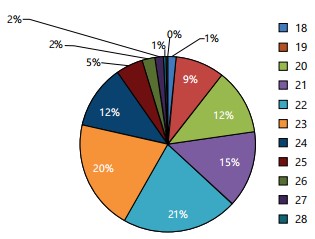
The pie chart represents the age distribution among the research participants, shown in Fig. 1. Many respondents fall within the age range of 20 to 23, with the highest percentage being 21.3% for those aged 22. The age distribution gradually decreases beyond 23, with a smaller percentage of participants aged 26 and older. The chart represents the age diversity among the surveyed university students, emphasizing the concentration in the early twenties.
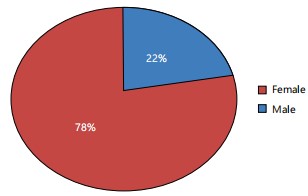
Figure 2 shows a pie chart illustrating the gender distribution among the research participants. Many respondents, constituting 77.7%, identify as male, while 22.3% identify as female. This distribution highlights a gender imbalance within the sample, with a significantly higher representation of male participants compared to female participants. The pie chart visually emphasizes the gender composition of the surveyed university students, underlining the need for considerations related to gender dynamics in the subsequent analysis and interpretation of the research findings.
Figure 3 elaborates study regarding university affiliation among the research participants. The largest segment comprises individuals affiliated with FUUAST Gulshan Campus, accounting for 31.9% of the participants. Following closely, students from Karachi University constitute 23.3%, while Sir Syed University and FUUAST Abdul Haq Campus make up 18.3 and 13.6%, respectively. The NED University has the smallest representation at 12.9%. This distribution visually highlights the varying participation rates from different universities, providing insights into the diverse backgrounds of the surveyed university students in Karachi.
|
|

|
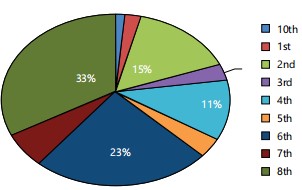
The pie chart depicts the distribution of university students across different semesters, as shown in Fig. 4. The largest proportion of participants, constituting 33.2%, belongs to the 8th semester. The 6th semester follows closely, representing 23.3% of the participants. Notably, the 2nd semester and 8th semester students also contribute significantly, with percentages of 15.6% and 11.1%, respectively. The chart provides a visual representation of the diverse distribution of students across various semesters, with the higher semesters having a more substantial representation in the research sample.
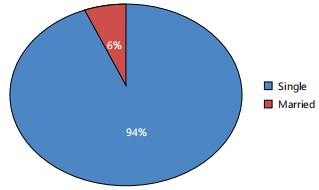
Figure 5 represents the marital status of students involved in the current study. Overwhelmingly, the majority of participants, constituting 93.6%, are single. In contrast, a smaller proportion, representing 6.4%, is married. This distribution underscores the predominantly single status of the surveyed university students, indicating that a significant majority of participants have not entered into marriage at the time of the study. The pie chart visually emphasizes the prevalence of single marital status among the research participants.
|
|
|
| Table 1: | Independent samples t-test results comparing stress and depression levels between working and non-working students | |||
| Independent samples test |
Levene’s test for equality of variances |
t-test for equality of means | 95% confidence interval of the difference |
|||||||
| F | Sig. | t | df | Sig. (2-tailed) | Mean difference | Std. Error difference | Lower | Upper | ||
| Stress | Equal variances assumed | 0.228 | 0.633 | -1.25 | 402 | 0.212 | -0.0701 | 0.05606 | -0.18031 | 0.04012 |
| Equal variances not assumedb | -1.25 | 192.684 | 0.213 | -0.0701 | 0.05609 | -0.18074 | 0.04054 | |||
| Depression | Equal variances assumed | 0.376 | 0.54 | -1.039 | 402 | 0.299 | -0.05352 | 0.05149 | -0.15475 | 0.0477 |
| Equal variances not assumed | -1.03 | 189.723 | 0.304 | -0.05352 | 0.05194 | -0.15598 | 0.04893 | |||
| F: Levene’s test statistic, Sig.: Significance level, t: T-test statistic, df: Degrees of freedom, Std. error difference: Standard error of the difference, and Negative mean difference indicates lower average scores among working students compared to non-working students | ||||||||||
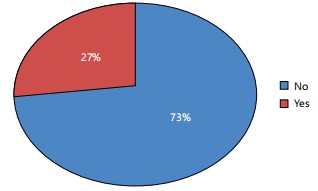
The pie chart represents the distribution of job status among university students in the research shown in Fig. 6. The majority of participants, accounting for 73.0%, do not have a job, while 27.0% of students are engaged in some form of employment. This distribution highlights the prevalence of students without jobs in the surveyed sample, emphasizing the challenges and responsibilities faced by those who are combining work and academic pursuits. The pie chart visually conveys the significant proportion of students who are not currently employed, shedding light on the employment dynamics within the university student population.
Table 1 presents the results of the independent samples t-test for comparing stress and depression levels between working and non-working students. Levene’s Test for Equality of Variances indicated that the assumption of equal variances was met for both stress (p = 0.633) and depression (p = 0.540). The t-test results revealed no statistically significant difference in stress levels (t (402) = -1.250, p = 0.212) or depression levels (t (402) = -1.039, p = 0.299) between the two groups. The mean differences for stress and depression were -0.07010 and -0.05352, respectively, both with 95% confidence intervals that crossed zero, further confirming the lack of significant difference.
Interpretation of the overall study: Since the p-values are greater than 0.05 in both conditions. This suggests that there is insufficient evidence to conclude a significant difference in stress levels between the two groups. Therefore, based on the results of the independent samples test, we do not find statistical support for the presence of a significant difference in stress levels among the compared groups.
DISCUSSION
The prevalence of stress and depression among the sampled university students is analyzed, drawing parallels with global trends. The multifaceted nature of stress, encompassing inadequate stress, eustress, and distress1 is explored. The influence of technostress during the COVID-19 pandemic on student stress3, is considered, shedding light on the evolving challenges in the digital age.
Causes and effects of stress, including academic demands, sleep disturbances, and emotional manifestations, are examined in alignment with previous studies12,13. The impact of job-study balance on mental health is explored, resonating with the work of Lederer et al.14 and highlighting the need for targeted interventions. The study delves into various dimensions of depression, addressing its background, causes, and effects. Studies suggested that depression has a multidimensional nature, explaining about social capital10. Moreover, previous literature also explains different depression results about personal care, decision-making, and suicidal ideation9. In the past, a few studies also explained stress and depression concerning the demographic factors influencing it12.
Depression and stress, no doubt, have an impact on academic performance, but the need is to emphasize some holistic approaches. The implications of the findings for educators, policymakers, and mental health professionals are discussed, providing a basis for future interventions. The research on stress and depression among university students in Karachi provides valuable insights into the complex interplay of factors influencing the mental health of this demographic. Female students are especially often facing higher levels of stress, which can be attributed to their social roles and physiological status12,13. The prevalence of stress and depression, influenced by academic demands, technostress, and socio-economic challenges, underscores the need for targeted interventions. The differentiation between eustress and distress offers a nuanced perspective on stress, emphasizing the importance of addressing both positive and negative stressors. Students belonging to low socioeconomic backgrounds face a significant stress level7. Research reported that there is a difference in stress and depression levels between genders. The study confirms existing knowledge on the impact of job-study balance, gender disparities, and socio-cultural factors on stress and depression. Additionally, it extends the understanding of these issues within the unique context of Karachi, a developing city facing economic challenges. The findings contribute to the theoretical framework by offering a localized perspective on the multifaceted nature of stress and depression.
To enhance the understanding of stress and depression among university students, future research should expand the geographical scope, encompassing diverse regions in Pakistan. Longitudinal studies would allow for a more in-depth exploration of causal relationships and the evolving nature of stress and depression. Integrating qualitative methods, such as interviews and focus groups, could provide richer insights into the lived experiences of students. The practical implications of this research extend to educational institutions, policymakers, and mental health professionals. Students who are specifically involved in jobs parallel to their studies face more working hours influence on their mental health that resulting in mood and sleep disorders14. Tailored interventions addressing the specific stressors identified, such as job-study balance and socio-economic factors, are essential. Implementing mental health support services within universities and promoting awareness campaigns can contribute to a more supportive environment for students. Moving forward, research in this domain should delve deeper into cultural influences on stress and depression, exploring how societal norms and expectations contribute to the experiences of university students. Academic challenges that were identified by Kimzey et al.15, are a significant marker of stress among university students, as it impact their personal and academic life. Students of different age and gender categories could contribute to variable stress levels. New students in any institute face higher stress and anxiety due to challenges in novel environments, and among these, females may experience increased levels of stress and depression12. Comparative studies between urban and rural settings could further elucidate the impact of the local context on mental health. The theoretical framework, grounded in the existing literature, is enriched by the study's findings. It highlights the applicability of stress theories in the unique context of Karachi and emphasizes the need for a comprehensive understanding of stress and depression beyond the global perspective.
CONCLUSION
This study reveals a high prevalence of stress and depression among university students in Karachi, primarily driven by academic pressure, financial strain, technostress, and sleep disturbances. Working students were more emotionally and cognitively affected, with gender-based differences noted in coping strategies. These findings emphasize the need for targeted mental health support and policy reforms. Future research should incorporate additional parameters to uncover the underlying mechanisms affecting student well-being and academic performance.
SIGNIFICANCE STATEMENT
This study identified key stressors such as academic pressure, financial difficulties, and technostress, which could be beneficial for developing targeted mental health interventions and institutional support strategies. This study will assist researchers in uncovering critical areas of student mental health and coping mechanisms that have remained unexplored by many. Consequently, a new theory on the interplay between academic demands, economic stress, and psychological well-being among students may be developed.
REFERENCES
- Lu, S., F. Wei and G. Li, 2021. The evolution of the concept of stress and the framework of the stress system. Cell Stress, 5: 76-85.
- Sequeira, C., O. Araújo, T. Lourenço, O. Freitas, J.C. Carvalho and P. Costa, 2022. The impact of the COVID-19 pandemic on the mental health of Portuguese university students. Int. J. Mental Health Nurs., 31: 920-932.
- Wang, X., H. Chen, L. Liu, Y. Liu and N. Zhang et al., 2020. Anxiety and sleep problems of college students during the outbreak of COVID-19. Front. Psychiatry, 11.
- Liu, C., H. Chen, X. Cao, Y. Sun and C.Y. Liu et al., 2022. Effects of mindfulness meditation on doctors’ mindfulness, patient safety culture, patient safety competency and adverse event. Int. J. Environ. Res. Public Health, 19.
- Pisano, F., G. Torromino, D. Brachi, A. Quadrini, C. Incoccia and P. Marangolo, 2021. A standardized prospective memory evaluation of the effects of COVID-19 confinement on young students. J. Clin. Med., 10.
- Amirkhan, J.H., R. Manalo and S.E. Velasco, 2023. Stress overload in first-generation college students: Implications for intervention. Psychol. Serv., 20: 636-646.
- Shao, R., P. He, B. Ling, L. Tan and L. Xu et al., 2020. Prevalence of depression and anxiety and correlations between depression, anxiety, family functioning, social support and coping styles among Chinese medical students. BMC Psychol., 8.
- Wang, P., E.R. Garcia and I.S. Yim, 2022. Acculturative stress and eating disinhibition among Asian young adults: The role of depressive symptoms and gender. Appetite, 169.
- Jezzini-Martinez, S., J.H. Martinez-Garza, A. Quiroga-Garza, X.G. Quiroz-Perales and L. Gil-Flores et al., 2023. Assessment of burnout syndrome and associated factors among medical students during the COVID-19 pandemic. J. Affective Disord. Rep., 14.
- Peng, S., X.Y. Yang and I.R.H. Rockett, 2019. A typology of social capital and its mixed blessing for suicidal ideation: A multilevel study of college students. Social Sci. Med., 243.
- Dyrbye, L.N., M.R. Thomas and T.D. Shanafelt, 2015. Medical student distress: Causes, consequences and proposed solutions. Mayo Clin. Proc., 80: 1613-1622.
- Khademian, F., S. Delavari, Z. Koohjani and Z. Khademian, 2021. An investigation of depression, anxiety, and stress and its relating factors during COVID-19 pandemic in Iran. BMC Public Health, 21.
- Bangasser, D.A., A. Curtis, B.A.S. Reyes, T.T. Bethea and I. Parastatidis et al., 2010. Sex differences in corticotropin-releasing factor receptor signaling and trafficking: Potential role in female vulnerability to stress-related psychopathology. Mol. Psychiatry, 15: 896-904.
- Lederer, A.M., D.M. Autry, C.R.T. Day and S.B. Oswalt, 2015. The impact of work and volunteer hours on the health of undergraduate students. J. Am. Coll. Health, 63: 403-408.
- Kimzey, M., B. Mastel-Smith and A. Seale, 2019. Effects of dementia-specific education for nursing students. Nurse Educ., 44: 338-341
How to Cite this paper?
APA-7 Style
Sajid,
I., Ahmed,
S., Anis,
L., Khan,
H., Fatima,
T., Hussain,
S. (2025). Prevalence and Causes of Stress and Depression Among Students at Karachi Universities. Trends in Biological Sciences, 1(1), 101-109. https://doi.org/10.21124/tbs.2025.101.109
ACS Style
Sajid,
I.; Ahmed,
S.; Anis,
L.; Khan,
H.; Fatima,
T.; Hussain,
S. Prevalence and Causes of Stress and Depression Among Students at Karachi Universities. Trends Biol. Sci 2025, 1, 101-109. https://doi.org/10.21124/tbs.2025.101.109
AMA Style
Sajid
I, Ahmed
S, Anis
L, Khan
H, Fatima
T, Hussain
S. Prevalence and Causes of Stress and Depression Among Students at Karachi Universities. Trends in Biological Sciences. 2025; 1(1): 101-109. https://doi.org/10.21124/tbs.2025.101.109
Chicago/Turabian Style
Sajid, Irfan, Shoaib Ahmed, Lubna Anis, Hafsah Khan, Tahira Fatima, and Shahnawaz Hussain.
2025. "Prevalence and Causes of Stress and Depression Among Students at Karachi Universities" Trends in Biological Sciences 1, no. 1: 101-109. https://doi.org/10.21124/tbs.2025.101.109

This work is licensed under a Creative Commons Attribution 4.0 International License.