
Beneficial Microorganisms in Plant Health: Mechanisms, Challenges and Future Directions
-
In Sokra


Department of Soil and Crop Production, Faculty of Agronomy, University of Kratie, Cambodia
Horn MetaDepartment of Food Engineering, Faculty of Agro-Industry, University of Kratie, Cambodia
Horn SarunFaculty of Agricultural Economics and Rural Development, Royal University of Agriculture, Phnom Penh 12401, Cambodia
Chhaun MolikoyFaculty of Agricultural Economics and Rural Development, Royal University of Agriculture, Phnom Penh 12401, Cambodia
| Received 16 Jan, 2026 |
Accepted 13 Apr, 2026 |
Published 30 Jun, 2026 |
Modern agriculture has faced growing sustainability challenges as a result of declining soil quality, increasing climate variability, and the widespread reliance on chemical fertilizers and pesticides. These pressures have intensified interest in biologically based alternatives that support productivity while reducing environmental harm. Beneficial microorganisms have therefore emerged as important components of plant health, as they contribute to improved growth, nutrient acquisition, and tolerance to both biotic and abiotic stresses. A detailed understanding of how these microorganisms function and interact with plants is essential for their successful application in agricultural systems. This review drew upon recent peer-reviewed publications focusing on plant-associated beneficial microorganisms, with particular attention given to bacterial and fungal groups involved in plant growth promotion and disease control. Studies examining molecular, physiological, and ecological processes were assessed in order to clarify dominant functional mechanisms. In addition, reported limitations related to field application and emerging directions in microbial-based technologies were carefully analyzed. The reviewed literature indicated that beneficial microorganisms supported plant performance through multiple, interconnected pathways. These processes included biological nitrogen fixation, mobilization of phosphorus and potassium, regulation of plant hormone signaling, stimulation of induced systemic resistance, and direct suppression of plant pathogens. Although such effects were repeatedly confirmed under controlled experimental conditions, outcomes in field settings varied considerably. This variability was largely attributed to environmental heterogeneity, specificity of host–microbe interactions, competition with indigenous microbial populations, and challenges associated with formulation stability and delivery methods. Beneficial microorganisms constitute an important foundation for sustainable plant health management. Recent progress in omics-based research, the development of microbial consortia, and advances in synthetic biology has expanded opportunities to enhance consistency and effectiveness. Moving forward, research and application efforts should emphasize systems-level integration, aligning microbial functions with crop genetics and agronomic practices to achieve reliable field performance and support long-term agricultural resilience.
| Copyright © 2026 Sokra et al. This is an open-access article distributed under the Creative Commons Attribution License, which permits unrestricted use, distribution, and reproduction in any medium, provided the original work is properly cited. |
INTRODUCTION
Plant health remains a fundamental driver of agricultural productivity and the long-term stability of ecosystems1. For many years, explanations of crop performance relied mainly on plant genetics, soil nutrient status, and climatic conditions2. These factors clearly matter, yet they do not fully account for the wide variation in plant performance observed under field conditions. In practice, plants rarely behave as isolated biological entities. Their growth and survival are shaped by continuous interactions with surrounding organisms, particularly microorganisms3. Plants host diverse microbial populations across the rhizosphere, phyllosphere, and internal tissues4. These communities do not remain constant. Their composition shifts with plant age, soil conditions, and environmental fluctuations, and they interact continuously with plant metabolic processes. Through such interactions, microorganisms affect nutrient availability, root system development, stress responses, and disease dynamics. In certain agroecosystems, microbial activity has been observed to partially offset poor soil quality or environmental stress, enabling plants to sustain growth under conditions that would otherwise be restrictive. The rise of intensive agriculture altered many of these long-standing biological relationships5. Synthetic fertilizers and pesticides were adopted widely to increase yields and suppress pests, often producing immediate and measurable benefits. With repeated application, however, their influence on soil ecosystems became increasingly apparent. Reduced microbial diversity, disrupted nutrient cycling, degradation of soil structure, and accumulation of toxic residues have all been documented6. At the same time, pathogen populations adapted to these inputs, leading to reduced control efficacy and growing resistance. Together, these developments have raised serious concerns regarding the long-term sustainability of chemically dependent cropping systems. In response to these challenges, beneficial microorganisms have attracted attention as biological tools for restoring soil function and improving plant health7. Their modes of action differ fundamentally from those of chemical inputs. Rather than targeting a single physiological process, microorganisms influence plant systems through multiple, interconnected pathways8. They are involved in nutrient transformations, modify hormonal signaling, and interact with plant immune responses. Many also suppress pathogens through competition, antibiosis, or direct parasitism. These processes often occur simultaneously and are shaped by local environmental conditions. Even so, the performance of microbial products in agriculture has remained inconsistent9. Plant-microbe interactions are strongly influenced by soil properties, climatic factors, plant genotype, and the structure of native microbial communities. Consequently, microorganisms that show consistent benefits in laboratory or greenhouse experiments frequently exhibit variable or diminished effects under field conditions10. Such variability suggests that current application strategies oversimplify the ecological complexity of soil-plant systems.
This review considers beneficial microorganisms as integral components of plant systems rather than as external inputs. Attention is given to the mechanisms that govern plant-microbe interactions, the ecological constraints that limit their effectiveness, and emerging strategies aimed at improving field-level performance. By integrating perspectives from microbiology, ecology, and agronomy, this article seeks to clarify how microbial-based approaches can be applied more reliably and sustainably in agricultural production.
DIVERSITY OF BENEFICIAL MICROORGANISMS ASSOCIATED WITH PLANTS
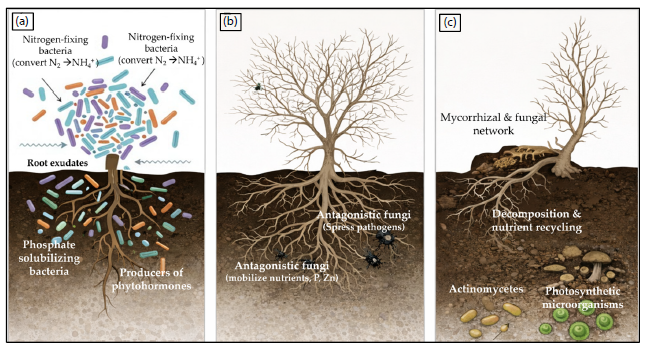
Bacterial communities and functional specialization: Bacteria are the most abundant and functionally diverse members of the plant microbiome. In many cropping systems, beneficial bacterial populations tend to accumulate around roots, where carbon-rich exudates sustain microbial activity11. These communities do not behave as a single functional unit. Some bacteria occupy narrow ecological niches, while others perform broader roles that support plant health. Where nitrogen is limited, nitrogen-fixing bacteria have long been recognized as important contributors, converting atmospheric nitrogen into ammonium that plants can assimilate12. Other bacterial groups were shown to increase the availability of phosphorus, potassium, and several micronutrients. This usually occurs through the release of organic acids, chelating compounds, or hydrolytic enzymes that gradually modify soil mineral chemistry13.
|
As these processes continue, nutrient availability in the rhizosphere increases and uptake by roots becomes more efficient. The influence of beneficial bacteria is not restricted to nutrient dynamics. Many strains produce bioactive metabolites, including phytohormones, vitamins, and signaling molecules, that affect plant growth. These compounds can alter root system architecture, promote lateral root formation, or support shoot development, depending on environmental conditions14. Over time, the combined effects of nutrient mobilization and growth regulation lead to improved plant vigor and productivity (Fig. 1a).
Fungal contributions to plant health: Fungi are another important group of beneficial microorganisms associated with plants, and their contributions extend well beyond simple nutrient exchange15. Mycorrhizal fungi, which associate symbiotically with the majority of terrestrial plant species, effectively enlarge the functional root system. Through the development of extensive hyphal networks, these fungi expanded the soil volume accessible to plants and improved the acquisition of nutrients with limited mobility, particularly phosphorus and zinc16. In many cases, enhanced nutrient uptake was accompanied by noticeable improvements in plant growth and overall performance. Beyond nutrition, mycorrhizal associations have been reported to strengthen plant tolerance to abiotic stresses such as drought and salinity17. These effects were not driven by a single process but emerged from improved water absorption, modifications in root physiology, and changes in the regulation of stress-related genes. Mycorrhizal fungi also influenced soil properties by promoting aggregate formation, which improved soil aeration and increased water-holding capacity18. At the same time, antagonistic fungi played a complementary role in plant protection. They suppressed pathogenic microorganisms through competition for resources, production of antimicrobial substances, and direct parasitism19. Importantly, several antagonistic fungi were found to activate plant defense mechanisms, resulting in prolonged resistance against disease development (Fig. 1b).
Actinomycetes and supporting microbial groups: Actinomycetes represent a distinctive group of microorganisms that share features of both bacteria and fungi, giving them a unique ecological role in soil environments20. They are especially abundant in soils rich in organic residues, where they actively participate in the decomposition of complex materials and the recycling of essential nutrients21.
|
Their well-known capacity to produce a broad spectrum of secondary metabolites, including many antibiotics, has made actinomycetes important agents in the natural suppression of plant pathogens22. In several systems, their presence was associated with improved soil quality and enhanced biological control. Alongside actinomycetes, other microbial groups such as yeasts and photosynthetic microorganisms also contributed to ecosystem functioning23. These organisms supported soil fertility, promoted the turnover of organic matter, and assisted plant establishment in stressed or degraded habitats. Although they have been studied less intensively than other soil microorganisms, their ecological roles remain significant24. Collectively, these groups highlight the importance of maintaining microbial diversity for sustaining plant health and stable soil ecosystems (Fig. 1c).
MECHANISMS OF MICROBIAL ENHANCEMENT OF PLANT HEALTH
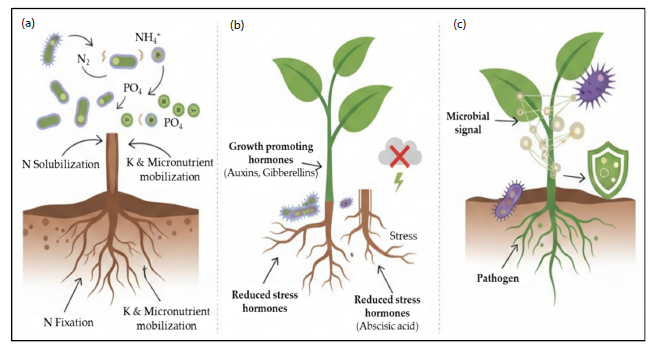
Microbial-mediated nutrient cycling: Limited nutrient availability has often restricted plant growth across many agricultural systems. Beneficial microorganisms help to alleviate this limitation by transforming nutrients that are otherwise unavailable into forms that plants can absorb25. In practice, these microbial processes reduce the need for external fertilizer inputs and improved the efficiency with which plants used available nutrients. Nitrogen-fixing microorganisms supplied plants with biologically usable nitrogen, while phosphorus-solubilizing microbes released phosphate from stable mineral complexes in the soil26. Other nutrients were also influenced by microbial activity. The mobilization of potassium and trace elements supported key physiological processes, including enzyme function and photosynthesis, and contributed to improved stress tolerance27. These transformations were not uniform but varied with soil conditions, microbial activity, and plant nutrient demand. As a result, nutrient dynamics within the soil-plant system were shaped by continuous interactions among these factors (Fig. 2a).
Regulation of plant growth through hormonal interactions: Plant hormones govern nearly every stage of plant growth and development, from early root formation to shoot expansion. Beneficial microorganisms interact with these regulatory systems by producing phytohormones themselves or by
influencing hormone signaling within the plant28. In several studies, microbial activity was associated with enhanced root elongation, greater lateral root proliferation, and improved shoot growth, effects that ultimately contributed to stronger plant establishment29. At the same time, microorganisms shown to regulate hormones linked to stress responses. By lowering the accumulation of stress-related hormones, they helped plants to maintain growth under adverse conditions such as drought, salinity, or nutrient limitation. This adjustment of hormonal balance allowed plants to respond more effectively to environmental challenges. Overall, microbial modulation of plant hormone dynamics emerged as a key process underlying enhanced plant resilience and adaptability (Fig. 2b).
Activation of plant defense systems: Plants have evolved intricate immune systems that allow them to detect and respond to diverse microbial cues present in their environment. Beneficial microorganisms engage with these systems in a finely regulated manner, stimulating defensive pathways while avoiding any harmful effects on the host. As a consequence, plants maintained in a primed condition, enabling them to mount quicker and more effective responses when exposed to pathogenic challenge30. This preparatory state is widely known as induced systemic resistance. The establishment of induced resistance depended on coordinated signaling networks that linked hormonal signaling with metabolic reprogramming31. These interactions resulted in defense responses that were activated earlier and expressed more strongly, thereby restricting pathogen spread and limiting damage to plant tissues. Importantly, because defenses were not continuously expressed, plants avoided the substantial metabolic costs associated with constant immune activation41. For these reasons, induced systemic resistance is considered a highly efficient and sustainable strategy for long-term plant protection (Fig. 2c).
CHALLENGES LIMITING FIELD APPLICATION OF BENEFICIAL MICROORGANISMS
Environmental and ecological constraints: Environmental variability continues to pose a major challenge to the practical use of beneficial microorganisms. Soil pH, temperature, moisture availability, and nutrient status strongly affect microbial survival and functional activity. After application, introduced microorganisms were also required to compete with well-established native microbial populations, which often limited successful colonization and long-term persistence32. Given the inherent complexity and heterogeneity of soil ecosystems, predicting microbial performance under field conditions remains difficult. As a consequence, products that performed reliably in laboratory or greenhouse experiments frequently showed inconsistent or reduced effectiveness when applied under real agricultural conditions33.
Formulation, storage, and delivery issues: The commercial viability of microbial products is closely tied to their formulation and ease of use. Many beneficial microorganisms are highly sensitive to environmental stresses such as desiccation, temperature fluctuations, and ultraviolet radiation34. Ensuring microbial viability during storage, transport, and field application therefore remains a key technological limitation. In addition, the mode of delivery influences product performance35. Application strategies including seed coating, soil drenching, and foliar spraying exposed microorganisms to distinct environmental pressures, which affected their ability to establish, survive, and express beneficial traits after application36.
Host specificity and genetic compatibility: Plant-microbe interactions are rarely universal and are often shaped by a high degree of host specificity. A microorganism that promoted growth or stress tolerance in one plant species, or even in a particular cultivar, did not necessarily produce similar outcomes in another37. Such specificity reflects variation in root exudate composition, plant immune signaling, and microbial recognition processes. Understanding the genetic and physiological determinants of host compatibility is therefore essential. Integrating microbial screening with plant breeding programs may help improve consistency and enhance the overall effectiveness of microbial-based interventions38.
Regulatory and socioeconomic barriers: In addition to biological and technical constraints, regulatory and socioeconomic factors further limit widespread adoption of microbial products. Regulatory frameworks differ markedly among countries and are often fragmented or poorly harmonized39. Lengthy approval procedures and inconsistent quality control standards have slowed product development and commercialization. Moreover, limited awareness among farmers, coupled with skepticism regarding the reliability of microbial inputs, has reduced adoption rates, particularly within smallholder farming systems. Overcoming these barriers will be critical for the successful integration of beneficial microorganisms into sustainable agricultural practices40.
FUTURE DIRECTIONS AND EMERGING OPPORTUNITIES
Omics-driven discovery and precision microbiology: The expanding use of genomics, transcriptomics, proteomics, and metabolomics has markedly changed the way plant-microbe interactions are investigated. These techniques make it possible to examine microbial functions and plant responses in a highly resolved and integrated manner. In several cases, they revealed mechanisms underlying beneficial effects that were previously observed only at the phenotypic level. Such information has increasingly guided strain selection and functional refinement. When omics-derived insights are interpreted together with ecological conditions and agronomic practices, they enable the development of precision microbial applications that are better suited to specific crops and production environments41.
Microbial consortia and community engineering: In soil ecosystems, plants coexist with diverse microbial assemblages rather than individual microorganisms acting alone. Recognizing this complexity has encouraged the development of microbial consortia that combine organisms with complementary biological roles. Compared with single-strain inoculants, these consortia often display improved stability under fluctuating field conditions. Functional redundancy within the community further ensured that essential processes were maintained even when certain strains declined or failed to establish42.
Synthetic biology and metabolic engineering: Advances in synthetic biology have opened new avenues for enhancing microbial performance in agriculture. Through targeted genetic modification and metabolic engineering, microorganisms can be designed to improve nutrient mobilization, tolerate abiotic stresses, or exert stronger antagonistic effects against plant pathogens. Despite these possibilities, the application of engineered microorganisms must carefully address issues of biosafety, regulatory approval, and public perception to ensure responsible use43.
Integration into climate-resilient agriculture: Climate variability and increasing environmental stress continue to challenge agricultural productivity. Beneficial microorganisms have shown the capacity to support plant growth under drought, salinity, and temperature extremes, highlighting their potential role in climate-resilient farming systems. Their effective integration with sustainable agronomic practices, such as soil conservation and reduced chemical inputs, will be essential for maintaining productivity under changing climatic conditions44.
CONCLUSION
Beneficial microorganisms constitute a fundamental component of sustainable plant production systems. Through multiple and interconnected mechanisms, they enhance nutrient availability, regulate plant growth, strengthen immune responses, and suppress pathogens. Although achieving consistent performance under field conditions remains difficult, ongoing progress in molecular biology, microbial ecology, and systems-based agriculture provides a strong foundation for future applications. The strategic integration of beneficial microorganisms will be crucial for the development of resilient, sustainable, and environmentally responsible agricultural systems.
SIGNIFICANCE STATEMENT
Agricultural systems today must meet rising food demands while minimizing risks to environmental and human health. The widespread use of chemical fertilizers and pesticides has increased crop productivity, but it has also led to soil deterioration and contamination of water resources. In recent years, beneficial microorganisms naturally associated with soils and plant roots have emerged as promising tools for sustainable crop management. These organisms contribute to improved nutrient uptake, enhanced plant growth, and suppression of plant diseases. Nevertheless, their performance in open-field conditions has frequently been less reliable than in controlled experiments, due to variations in climate, soil characteristics, and microbial interactions. Strengthening scientific understanding and optimizing application practices are therefore essential for reducing chemical dependence and promoting resilient, sustainable agricultural production systems.
ACKNOWLEDGMENT
The authors thank colleagues and institutions for general academic support and constructive discussions during the preparation of this review. The authors also sincerely acknowledge the editor and anonymous reviewers for their valuable comments and insightful suggestions, which substantially improved the quality and clarity of the manuscript.
REFERENCES
- >Kumar, M., P. Kumari and A. Kumari, 2025. Determinants of Soil Health and Its Role in Environmental Sustainability. In: Soil Health and Nutrition Management, Joshi, N.C., T. Leustek and P.K. Singh (Eds.), CABI, Wallingford, UK, ISBN: 9781800624597.0014, pp: 238-250.
- Sokra, I., H. Meta, R. Chanra, H. Linan, T. Pang and H. Sarun, 2025. Different microorganisms used in fermentation for biofertilizer: A review. J. Agric. Technol., 1: 41-65.
- Trivedi, P., J.E. Leach, S.G. Tringe, T. Sa and B.K. Singh, 2020. Plant-microbiome interactions: From community assembly to plant health. Nat. Rev. Microbiol., 18: 607-621.
- Sokra, I. and S. Somaly, 2024. The efficacy of Bordeaux mixture and Trichoderma powder in preventing fungal diseases on cashew nut wounds after pruning. Int. J. Innovative Sci. Res. Technol., 9: 2502-2509.
- Gupta, A., U.B. Singh, P.K. Sahu, S. Paul and A. Kumar et al., 2022. Linking soil microbial diversity to modern agriculture practices: A review. Int. J. Environ. Res. Public Health, 19.
- Yasir, M., Abul Hossain and A. Pratap-Singh, 2025. Pesticide degradation: Impacts on soil fertility and nutrient cycling. Environments, 12.
- Liang, X., S. Yu, Y. Ju, Y. Wang and D. Yin, 2025. Integrated management practices foster soil health, productivity, and agroecosystem resilience. Agronomy, 15.
- O'Callaghan, M., R.A. Ballard and D. Wright, 2022. Soil microbial inoculants for sustainable agriculture: Limitations and opportunities. Soil Use Manage., 38: 1340-1369.
- Poppeliers, S.W.M., J.J. Sánchez-Gil and R. de Jonge, 2023. Microbes to support plant health: Understanding bioinoculant success in complex conditions. Curr. Opin. Microbiol., 73.
- Barney, B.M., 2020. Aerobic nitrogen-fixing bacteria for hydrogen and ammonium production: Current state and perspectives. Appl. Microbiol. Biotechnol., 104: 1383-1399.
- Olaniyan, F.T., E.T. Alori, A.O. Adekiya, B.B. Ayorinde, F.Y. Daramola, O.O. Osemwegie and O.O. Babalola, 2022. The use of soil microbial potassium solubilizers in potassium nutrient availability in soil and its dynamics. Ann. Microbiol., 72.
- In, S., P. Khunnonkwao, N. Wong, C. Phosiran, S.S. Jantama and K. Jantama, 2020. Combining metabolic engineering and evolutionary adaptation in Klebsiella oxytoca KMS004 to significantly improve optically pure D-(-)-lactic acid yield and specific productivity in low nutrient medium. Appl. Microbiol. Biotechnol., 104: 9565-9579.
- Custos, J.M., C. Moyne and T. Sterckeman, 2020. How root nutrient uptake affects rhizosphere pH: A modelling study. Geoderma, 369.
- Zhang, W., D. Fang, K. Dong, F. Hu, Z. Ye and J. Cao, 2023. Insights into the environmental factors shaping lateral root development. Physiol. Plant., 175.
- Abdul Wahab, M. Muhammad, A. Munir, G. Abdi and W. Zaman et al., 2023. Role of arbuscular mycorrhizal fungi in regulating growth, enhancing productivity, and potentially influencing ecosystems under abiotic and biotic stresses. Plants, 12.
- Diagne, N., M. Ngom, P.I. Djighaly, D. Fall, V. Hocher and S. Svistoonoff, 2020. Roles of arbuscular mycorrhizal fungi on plant growth and performance: Importance in biotic and abiotic stressed regulation. Diversity, 12.
- Brazhnikova, Y., A. Belimov, L. Ignatova, T. Mukasheva, T. Karpenyuk and A. Goncharova, 2025. The antagonistic activity of beneficial fungi and mechanisms underlying their protective effects on plants against phytopathogens. Sustainability, 17.
- Shahbaz, M., Y. Kuzyakov, M. Sanaullah, F. Heitkamp, V. Zelenev, A. Kumar and E. Blagodatskaya, 2017. Microbial decomposition of soil organic matter is mediated by quality and quantity of crop residues: Mechanisms and thresholds. Biol. Fertil. Soils, 53: 287-301.
- Diab, M.K., H.M. Mead, M.M.A. Khedr, A.M. Abu-Elsaoud and S.A. El-Shatoury, 2024. Actinomycetes are a natural resource for sustainable pest control and safeguarding agriculture. Arch. Microbiol., 206.
- Goyal, T., G.K. Chouhan, A.K. Gaurav, A. Mukherjee, B.N. Singh and J.P. Verma, 2025. Plant Beneficial Rhizosphere Microorganisms Help in Degraded Land Restoration. In: Plantation-Based Land Restoration, Pandey, V.C. (Ed.), Springer Nature, Singapore, ISBN: 978-981-95-2860-8, pp: 299-317.
- Briat, J.F., A. Gojon, C. Plassard, H. Rouached and G. Lemaire, 2020. Reappraisal of the central role of soil nutrient availability in nutrient management in light of recent advances in plant nutrition at crop and molecular levels. Eur. J. Agron., 116.
- Dincă, L.C., P. Grenni, C. Onet and A. Onet, 2022. Fertilization and soil microbial community: A review. Appl. Sci., 12.
- Buttò, V., A. Deslauriers, S. Rossi, P. Rozenberg, V. Shishov and H. Morin, 2020. The role of plant hormones in tree-ring formation. Trees, 34: 315-335.
- del Carmen Orozco-Mosqueda, M., G. Santoyo and B.R. Glick, 2023. Recent advances in the bacterial phytohormone modulation of plant growth. Plants, 12.
- Li, Q., H. Li, Z. Yang, X. Cheng and Y. Zhao et al., 2022. Plant growth-promoting rhizobacterium Pseudomonas sp. CM11 specifically induces lateral roots. New Phytol., 235: 1575-1588.
- Wang, Y., R.N. Pruitt, T. Nürnberger and Y. Wang, 2022. Evasion of plant immunity by microbial pathogens. Nat. Rev. Microbiol., 20: 449-464.
- Yu, Y., Y. Gui, Z. Li, C. Jiang, J. Guo and D. Niu, 2022. Induced systemic resistance for improving plant immunity by beneficial microbes. Plants, 11.
- He, Z., S. Webster and S.Y. He, 2022. Growth-defense trade-offs in plants. Curr. Biol., 32: R634-R639.
- Sokra, I., S. Somaly, H. Meta, H. Sarun and C. Molikoy, 2026. Factors affecting rice production: A systematic review. J. Agric. Technol., 2: 19-46.
- Bogati, K.A., P. Sewerniak and M. Walczak, 2025. Unraveling the effect of soil moisture on microbial diversity and enzymatic activity in agricultural soils. Microorganisms, 13.
- Nunan, N., H. Schmidt and X. Raynaud, 2020. The ecology of heterogeneity: Soil bacterial communities and C dynamics. Phil. Trans. R. Soc. B, 375.
- Fiore, W., S. Arioli and S. Guglielmetti, 2020. The neglected microbial components of commercial probiotic formulations. Microorganisms, 8.
- Kavusi, E., B.S.K. Ansar, Z. Dehghanian, B.A. Lajayer, K. Nobaharan, Y. Ma and B.R. Glick, 2023. Delivery of beneficial microbes via seed coating for medicinal and aromatic plant production: A critical review. J. Plant Growth Regul., 42: 575-597.
- Sokra, I., S. Somaly, H. Meta, H. Sarun and C. Molikoy, 2026. Mechanisms of potential bacteria in controlling crop diseases: A systematic review. J. Agric. Technol., 2: 1-18.
- Kliebenstein, D.J., 2024. Specificity and breadth of plant specialized metabolite-microbe interactions. Curr. Opin. Plant Biol., 77.
- Wang, N.Q., C.H. Kong, P. Wang and S.J. Meiners, 2021. Root exudate signals in plant-plant interactions. Plant Cell Environ., 44: 1044-1058.
- Pilarski, K., A.A. Pilarska and M.B. Pietrzak, 2025. Biogas production in agriculture: Technological, environmental, and socio-economic aspects. Energies, 18.
- Sharma, M., S. Sudheer, Z. Usmani, R. Rani and P. Gupta, 2020. Deciphering the omics of plant-microbe interaction: Perspectives and new insights. Curr. Genomics, 21: 343-362.
- Jiao, S., Y. Yang, Y. Xu, J. Zhang and Y. Lu, 2020. Balance between community assembly processes mediates species coexistence in agricultural soil microbiomes across Eastern China. ISME J., 14: 202-216.
- del Carmen Orozco-Mosqueda, M., A. Kumar, O.O. Babalola and G. Santoyo, 2023. Rhizobiome transplantation: A novel strategy beyond single-strain/consortium inoculation for crop improvement. Plants, 12.
- Gao, Z., Y. Gao, S. Wang, X. Li and W. Cao et al., 2025. Application progress and biosafety challenges of gene editing and synthetic biotechnology in diagnosis, treatment and prevention of infectious diseases. Biosafety Health, 7: 312-322.
- Bayu, T., 2020. Review on contribution of integrated soil fertility management for climate change mitigation and agricultural sustainability. Cogent Environ. Sci., 6.
- Goold, H.D., P. Wright and D. Hailstones, 2018. Emerging opportunities for synthetic biology in agriculture. Genes, 9.
- Muhammad, M., Abdul Wahab, Abdul Waheed, K.R. Hakeem and H.I. Mohamed et al., 2025. Navigating climate change: Exploring the dynamics between plant-soil microbiomes and their impact on plant growth and productivity. Global Change Biol., 31.
How to Cite this paper?
APA-7 Style
Sokra,
I., Meta,
H., Sarun,
H., Molikoy,
C. (2026). Beneficial Microorganisms in Plant Health: Mechanisms, Challenges and Future Directions. Trends in Biological Sciences, 2(2), 201-209. https://doi.org/10.21124/tbs.2026.201.209
ACS Style
Sokra,
I.; Meta,
H.; Sarun,
H.; Molikoy,
C. Beneficial Microorganisms in Plant Health: Mechanisms, Challenges and Future Directions. Trends Biol. Sci 2026, 2, 201-209. https://doi.org/10.21124/tbs.2026.201.209
AMA Style
Sokra
I, Meta
H, Sarun
H, Molikoy
C. Beneficial Microorganisms in Plant Health: Mechanisms, Challenges and Future Directions. Trends in Biological Sciences. 2026; 2(2): 201-209. https://doi.org/10.21124/tbs.2026.201.209
Chicago/Turabian Style
Sokra, In, Horn Meta, Horn Sarun, and Chhaun Molikoy.
2026. "Beneficial Microorganisms in Plant Health: Mechanisms, Challenges and Future Directions" Trends in Biological Sciences 2, no. 2: 201-209. https://doi.org/10.21124/tbs.2026.201.209

This work is licensed under a Creative Commons Attribution 4.0 International License.