
Comprehensive Nutritional Profiling and Biochemical Characterization of Roasted Pork Meat Commonly Consumed in Calabar, Nigeria
-
Chibuzor O. Okonkwo


Department of Biochemistry, Faculty of Basic Medical Sciences, University of Calabar, Calabar, Nigeria
Sunday N. OkonkwoDepartment of Ophthalmology, University of Calabar, Calabar, Cross River, Nigeria
Oluomachi C. ChukwuDepartment of Pharmaceutical Microbiology and Biotechnology, Faculty of Pharmaceutical Sciences. Abia State University, Uturu, Abia, Nigeria
Favour O. KekongDepartment of Human Nutrition and Dietetics, University of Calabar, Calabar Nigeria
Divine A. OmangDepartment of Human Nutrition and Dietetics, University of Calabar, Calabar Nigeria
Faith Eja-OsangDepartment of Human Nutrition and Dietetics, University of Calabar, Calabar Nigeria
| Received 08 Jan, 2026 |
Accepted 20 Jul, 2026 |
Published 30 Sep, 2026 |
Background and Objective: Pork is widely consumed globally and is often perceived as a potential cardiovascular risk due to its fatty acid composition, particularly among the elderly. In Calabar, Nigeria, roasted pork is a popular street snack consumed across age groups. Scientific evaluation of its nutritional quality is necessary to provide evidence-based dietary recommendations. This study evaluated the nutritional composition, fatty acid profile, amino acid profile, and biochemical characteristics of roasted pork commonly consumed in Calabar, Nigeria. Materials and Methods: Fresh pork meat samples were collected, roasted under conditions simulating commercial street-vended preparation, and analyzed for nutritional composition. Proximate composition, vitamins, macro- and micro-minerals were determined using standard AOAC methods, while fatty acid and amino acid profiles were analyzed using GC-MS and HPLC, respectively. All analyses were performed in triplicate, and results were expressed as mean±standard deviation. Results: The fatty acid profile comprised saturated fatty acids (34.6%), monounsaturated fatty acids (41.2%), and polyunsaturated fatty acids (24.2%), indicating a predominance of unsaturated fatty acids. Essential amino acids including valine (47.3 mg/100 g), isoleucine (44.5 mg/100 g), leucine (60.2 mg/100 g), and histidine (59.3 mg/100 g) were present in appreciable amounts. The meat contained adequate levels of protein, carbohydrates, vitamins, and minerals required for healthy living. Antinutritional factors ranged from 0.50 mg/100 g (phytate) to 2.46 TIU/g (lectins). Despite potential effects on nutrient bioavailability, antinutrients have also been associated with protective health benefits. Conclusion: The results demonstrate that roasted pork consumed in Calabar contains approximately twice as much unsaturated fatty acids as saturated fatty acids, suggesting a relatively favorable fatty acid profile. The meat provides essential amino acids, micronutrients, and bioactive compounds that support its inclusion in a balanced diet. However, portion control remains important to ensure saturated fatty acid intake stays within recommended limits
| Copyright © 2026 Okonkwo et al. This is an open-access article distributed under the Creative Commons Attribution License, which permits unrestricted use, distribution, and reproduction in any medium, provided the original work is properly cited. |
INTRODUCTON
Even though meat is known for its rich protein, vitamin and mineral contents, it has also been associated with an increased incidences of cardiovascular diseases and various kinds of cancer, particularly red meat including pork which contains a lot of fat1-3. Pork is known to constitute about 30% of global meat consumption. It offers a unique nutrient profile, with a rich composition of quality proteins vitamins and minerals such as zinc and iron. Pork contains protein of high biological value rich in essential fatty acids, energy and micro. However, it’s role in human nutrition is ladened with a lot of controversy particularly regarding its perceived high saturated fatty acid contents. According to Choe et al.4, pork consists of about 30% fat, with a high concentration of saturated fatty, and cardiovascular diseases (CVD) which is prevalent in Nigeria, due to poor dietary habits5 have been associated with the consumption of saturated fatty acid. However, the exact concentration of fatty acids and nutrients is largely dependent on the breed6, the pig’s diet7 and the tissue assessed8. The question as to the nutritional quality and fatty acid profile of pork readily available and consumed by many Calabar residents is what this research seeks to answer. The research will also address the question of how safe the snack is for consumption based on its nutrient composition.
Despite some controversial reports, pork is said to contain several important nutrients including; zinc, iron, selenium, choline, thiamine, and vitamins B6 and vitamin B12 which are thought to influence cognitive function9,10. Pork has been reported to contribute to improved diet quality score, higher vegetable intake, higher intake of energy and most nutrients, and improved health biomarkers in Korean adults11,12.
While some studies have looked at the nutritional composition of pork meat, none has specifically analyzed the nutritional, antinutrient, fatty acid and amino acid composition of pork meat, especially as commonly processed and consumed as a popular street snack in Calabar, Nigeria. The current study therefore aims to analyse the nutritional quality of pork commercially available on the streets of Calabar South-south Nigeria to advise on its suitability and safety as a popular street food in the city by comparing with the estimated dietary reference intake for nutrients in adults 19 to 70 years, and to provide evidence-based recommendations for its consumption as part of a healthy diet.
MATERIALS AND METHODS
Study area and duration: This study was carried out between May to September 2024, in the Department of Human Nutrition and Dietetics, Faculty of Basic Medical Sciences, of the university of Calabar, and the analytical food laboratory of the National Root Crop Research Institute, Umudike, Abia State, Nigeria.
Equipment: The GC-MS machine (Agilent technologies), HPLC (Prominence-iLC), Atomic Absorption Spectrophotometer (Analyst 300, Perkin Elmer, U.S.A), sensitive balance (WANT, WT-N), centrifuge, water bath, colorimeter, UV-spectrophotometer, heating mantle, fume chamber, kjeldahl flask (Thermo Scientific), microwave oven (Panasonic), desiccator (Wheaton), electric blender (Philips, HR3760/00), stirring rod (unbranded).
Collection, identification and preparation of samples: Five hundred grams of the lean part of fresh pork meat cut from the shoulder was purchased from the Marian market Calabar, Nigeria. The sample was identified by a registered Dietician at the University of Calabar, Department of Human Nutrition and Dietetics. The meat was cleaned and roasted over medium heat (180°C) with charcoal (to replicate the commercial vendors) for 25 min. It was thereafter allowed to cool for 2 hrs, chopped into smaller cubes and ground into powder used for analysis (Fig. 1).
The nutritional quality of pork commercially available on the streets of Calabar South-South Nigeria as a popular street food is compared with the estimated dietary reference intake for nutrients in adults 19 to 70 years (Table 1).

|
| Table 1: | Estimated average requirements (EAR) for basic nutrients in adults aged 19-70 years | |||
| Nutrient | Unit | Males (19-70 years) | Females (19-70 years) |
| Macronutrients | |||
| Carbohydrates (CHO) | g/d | 100 | 100 |
| Protein and Amino Acids | g/kg/d | 0.66 | 0.66 |
| Linoleic acid | g/d | 17-14 | 12-Nov |
| Linolenic acid | g/d | 1.6 | 1.1 |
| Minerals | |||
| Iron (Fe) | mg/d | 6 | 8.1-5 |
| Sodium (Na) | mg/d | 1500 | 1500 |
| Magnesium (Mg) | mg/d | 330-350 | 255-265 |
| Potassium (K) | mg/d | 3400 | 2600 |
| Zinc (Zn) | mg/d | 9.4 | 6.8 |
| Calcium (Ca) | mg/d | 800 | 800-1000 |
| Copper (Cu) | μg/d | 700 | 700 |
| Iodine | μg/d | 95 | 95 |
| Manganese (Mn) | mg/d | 2.3 | 1.8 |
| Phosphorus (P) | mg/d | 580 | 580 |
| Selenium (Se) | μg/d | 45 | 45 |
| Vitamins | |||
| Vitamin A | μg/d | 625 | 500 |
| Vitamin B1 (Thiamin) | mg/d | 1 | 0.9 |
| Vitamin B2 (Riboflavin) | mg/d | 1.1 | 0.9 |
| Vitamin B3 (Niacin) | mg/d | 12 | 11 |
| Vitamin B5 (Pantothenic) | mg/d | 5 | 5 |
| Vitamin B6 | mg/d | 1.1-1.4 | 1.1-1.3 |
| Vitamin B9 (Folate) | μg/d | 320 | 320 |
| Vitamin B12 | μg/d | 2 | 2 |
| Vitamin C | mg/d | 75 | 60 |
| Vitamin D | μg/d | 10 | 10 |
| Vitamin E | mg/d | 12 | 12 |
| Vitamin K | μg/d | 120 | 90 |
Fatty acid and amino acid determination: The AOAC13 method was used to determine fatty acids using Gas Chromatography-Mass Spectrometry (GC-MS) after conversion to fatty acid methyl esters (FAMEs). Fatty acids were identified by comparison of their mass spectra and retention times with certified FAME standards and the NIST mass spectral library 201114. Fatty acid composition was expressed as relative percentage of total identified fatty acids. Amino acids were determined using HPLC, after hydrolysis and derivatization according to the method of Elkin and Griffith15.
Determination of macro-nutrients: The proximate composition of the food samples was determined using the standard methods of the AOAC16. Moisture was determined by drying sample until a constant weight was achieved and weight calculated, dry matter, ash content was done by igniting at 550°C in a muffle furnace for 3 hrs, until a grey ash was obtained, crude protein was determined by the Kjeldahl method of calculating as a percentage of nitrogen, crude fat was determined using the Soxhlet extraction method, crude and dietary fibers were determined by the incineration method at 600°C for 30 min, and the enzymatic-gravimetric method17 respectively. Carbohydrate was determined by difference as follows:
Determination of vitamins: The AOAC16 method using the colorimeter was adopted for vitamin A by monitoring the reaction between vitamin A and Sodium Bisulfite (SbL3) and measuring absorbance at 620 nm. Thiamine content was determined using the scalar analyzer method using potassium dichromate solution, and absorbance read at 360 nm. Riboflavin was determined according to the fluorometric method using glacial acetic acid, KMnO4 and H2SO4, with excitation and emission wavelengths measured at 470 and 525 nm, respectively. Niacin was determined by treating the sample with potassium ferrocyanide and H2SO4 solution, and absorbance read at 470 nm. Pantothenic acid was determined using the spectrophotometric method described by Shehata et al.18, using hydroxylamine reagent, sodium hydroxide and ferric chloride solution to remove air bubbles, and absorbance red at 500 nm. Pyridoxine chloride was determined by the spectrophotometric method using 2,6-dichloroquinone chloroimide19, with absorbance read at 650 nm. Folic acid was determined using the spectrophotometric method of AI Tikrity and AI Rashidy20 with diethyl aniline dye in 1sopropyl alcohol, and absorbance was read at 535 nm. Cyanocobalamin was determined using the spectrophotometric method described by Lalitha and Dhandapani21 with the use of sodium phosphate, citric acid and sodium metabisulfite. Absorbance was measured at 530 nm. Vitamin C was determined using the titrimetric method described by AOAC16 using EDTA/TCA solution. Vitamin D was determined using spectrophotometric method described by AOAC22, after initial extraction with hexane, absorbance was read at 275 nnm. Vitamin E was determined using the method described by AOAC16 with absolute alcohol and H2SO4, absorbance was read at 470 nm wavelength. Vitamin K was determined by the spectrophotometric method described by van koetsveld23, using 2, 4-dinitrophenylhydrazine in 20% HCl solution, with absorbance measured at 635 nm.
Determination of macro minerals: Sodium was determined by the flame photometry method as described by Webber and Wilson24. Calcium was determined using the method described by AOAC16, using Eriochrome Black-T- Indicator and NaOH solution. Phosphorus was determined according to Onwuka25 by molybdate method using hydroquinone as a reducing agent. Potassium was determined by a procedure described by AOAC16 using a flame photometer. The Atomic absorption spectrophotometer (AAS) method as described by Nnadi26 was used magnesium determination, using Magnesium hollow cathode lamp at a wave length of 202.6 nm.
Determination of micro minerals: Analysis for selenium, zinc, iron, manganese, iodine and copper were carried out after wet digestion using the method of AOAC16. Working standard solutions of the elements were then prepared from the stock standard solutions. Atomic Absorption Spectrophotometer was used to measure absorbances.
Statistical analysis: All analyses were performed in triplicate and results expressed as Mean±Standard Deviation.
Data were analyzed using Agilent Chem station chromatography data system B.04.03, and the NIST Mass spectral library 201114.
RESULTS
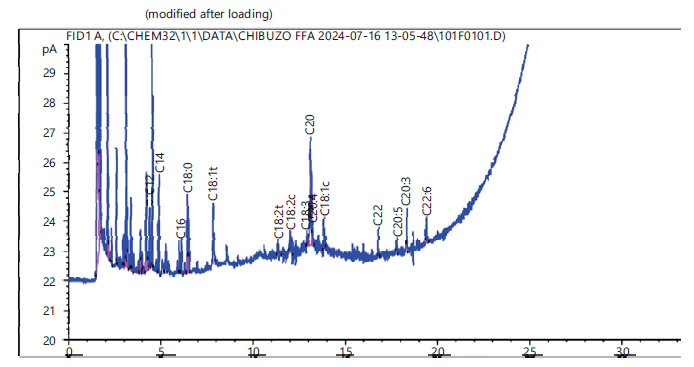
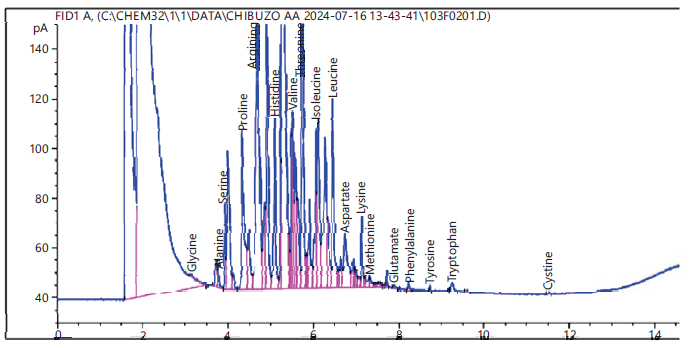
The GCMS and HPLC chromatograms showing the individual fatty acids and amino acid components respectively with their peak area concentrations on the vertical axis and their retention time on the horizontal axis are presented in Fig. 2 and 3. Table 2 presents the fatty acid profile of roasted pork, detailing the retention time, percentage composition, and concentration (ppm) for each component. While the analysis reveals a diverse range of unsaturated fatty acids, the cumulative percentage of SFAs is higher, despite being represented by fewer individual fatty acid species. Among the saturated fatty acids, arachidonic acid and myristic acid were the highest in concentration (5.2 and 2.9 ppm, respectively) Furthermore, although only two distinct MUFAs were identified, they were present in significantly high quantities (Elaidic acid; 2.36 ppm and Oleic acid; 1.31 ppm. Linoleic acid was highest in concentration for polyunsaturated fatty acids amounting to 1.76 ppm for both trans and cis isomers, followed closely by eicosatrienoic acid 1.19ppm, and docosahexaenoic acid 0.91ppm.
|
|
The amino acid profile of the sample demonstrates the presence of both essential and non-essential amino acids in varying proportions, indicating a nutritionally diverse protein composition. Among the essential amino acids, the highest concentrations were observed for threonine (114.12 mg/100 g; 16.75%), leucine (60.25 mg/100 g; 8.84%), and histidine (59.29 mg/100 g; 8.70%), followed closely by isoleucine (44.49 mg/100 g; 6.53%) and valine (47.39 mg/100 g; 6.96%). Moderate levels were recorded for aspartate (38.01 mg/100 g; 5.58%), while comparatively lower amounts were observed for lysine (16.05 mg/100 g; 2.36%), methionine (3.99 mg/100 g; 0.59%), phenylalanine (1.80 mg/100 g; 0.27%), and tryptophan (3.83 mg/100 g; 0.56%). Tyrosine also contributed minimally (6.91 mg/100 g; 1.03%).
| Table 2: | Fatty acid profile of roasted pork meat | |||
| Fatty acids | Systemic name | Retention time (min) | Area (pA*s) | Amount (ppm) | Total of (%) |
| Saturated fatty acid | |||||
| Lauric acid | C12 | 4.395 | 3.45568 | 1.27087 | 5.84 |
| Myristic acid | C14 | 4.896 | 7.74692 | 2.92148 | 13.43 |
| Palmitic acid | C16 | 5.991 | 1.72054 | 0.599278 | 2.75 |
| Stearic acid | C18 | 6.422 | 4.7898 | 1.78023 | 8.18 |
| Arachidic acid | C20 | 13.115 | 13.71261 | 5.21346 | 23.96 |
| Behenic acid | C22 | 16.804 | 2.24852 | 0.797712 | 3.67 |
| Monounsaturated fatty acid | |||||
| Elaidic acid | C18:1t | 7.828 | 6.29453 | 2.3612 | 10.85 |
| Oleic acid | C18:1c | 13.851 | 3.59135 | 1.30593 | 6 |
| Polyunsaturated fatty acid | |||||
| Linoleic acid (trans isomer) | C18:2t | 11.374 | 1.77679 | 0.616282 | 2.83 |
| Linoleic acid (cis isomer) | C18:2c | 12.037 | 3.16736 | 1.14597 | 5.27 |
| Alpha-linolenic acid | C18:3 | 12.955 | 1.47571 | 0.49981 | 2.3 |
| Arachidonic acid | C20:4 | 13.238 | 2.4915 | 0.801315 | 3.68 |
| Eicosapentaenoic acid | C20:5 | 17.792 | 1.0784 | 0.339636 | 1.56 |
| Eicosatrienoic acid | C20:3 | 18.34 | 3.26702 | 1.18958 | 5.47 |
| Docosahexaenoic acid | C22:6 | 19.423 | 2.52498 | 0.913888 | 4.2 |
| Total | 59.34171 | 21.75665 | 100 | ||
| pA*s (picoAmpere): Peak area concentration, %: percentage, ppm: parts per million, Values are expressed as mean ±SEM and p≤0.05 | |||||
| Table 3: | Amino acid profile of roasted pork meat | |||
| Amino acid | Retention time (min) | Area (pA*s) | Amount (mg/100 g) | Total of (%) |
| Essential amino acid | ||||
| Histidine | 5.093 | 215.00049 | 59.29403 | 8.695 |
| Isoleucine | 6.065 | 161.33862 | 44.4871 | 6.534 |
| Leucine | 6.465 | 218.45047 | 60.24639 | 8.84 |
| Aspartate | 6.76 | 137.88336 | 38.01117 | 5.578 |
| Lysine | 7.124 | 58.31236 | 16.05245 | 2.36 |
| Methionine | 7.315 | 14.5719 | 3.99607 | 0.586 |
| Phenylalanine | 8.247 | 6.62545 | 1.8042 | 0.265 |
| Tyrosine | 8.736 | 2.69717 | 6.91044 | 1.025 |
| Threonine | 5.731 | 413.6087 | 114.11871 | 16.747 |
| Valine | 5.492 | 171.80127 | 47.38726 | 6.956 |
| Tryptophan | 9.271 | 13.96184 | 3.82602 | 0.562 |
| Non-essential amino acid | ||||
| Serine | 3.938 | 57.663 | 15.88205 | 2.333 |
| Glycine | 3.134 | 6.83252 | 1.86598 | 0.274 |
| Alanine | 3.76 | 22.51701 | 6.19081 | 0.91 |
| Proline | 4.331 | 254.54799 | 70.19315 | 10.304 |
| Arginine | 4.681 | 710.25537 | 195.99124 | 28.817 |
| Glutamate | 7.891 | 3.28541 | 0.88445 | 0.129 |
| Cystine | 11.545 | 1.65345 | 0.43026 | 0.431 |
| Total | 1194.0507 | 681.35239 | 100 | |
| pA*s (pico Ampere): Peak area concentration, %: Percentage, mg/100g: Milligram per 100 g, Values are expressed as mean±SEM and p≤0.05 | ||||
For the non-essential amino acids, arginine (195.99 mg/100 g; 28.82%) was the most abundant, followed by proline (70.19 mg/100 g; 10.30%), indicating their dominant contribution to the total amino acid pool. Other detected amino acids included serine (15.88 mg/100 g; 2.33%), alanine (6.19 mg/100 g; 0.91%), glycine (1.87 mg/100 g; 0.27%), glutamate (0.88 mg/100 g; 0.13%), and cystine (0.43 mg/100 g; 0.43%). Overall, the total amino acid content was 681.35 mg/100 g, with a combined peak area of 1194.05 pA·s, suggesting a protein profile rich in functional and nutritionally important amino acids, particularly arginine, threonine, and leucine, which play key roles in metabolism, growth, and tissue repair shown in Table 3.
| Table 4: | Proximate composition findings of the experimental samples | |||
| Moisture (%) | Dry matter (%) | ASH (%) | Crude protein (%) | FAT (%) | Dietary fibre (%) | Carbohydrate (%) |
| 10.76±0.01 | 89.24±0.01 | 3.46±0.01 | 32.75±0.03 | 7.47±0.02 | 9.89±0.04 | 35.64±0.08 |
| Vitamins composition of pork | ||||||
| Beta-Carotene | Vitamin A | Vitamin B1 | Vitamin B2 | Vitamin B3 | Vitamin B5 | Vitamin B6 |
| (ug/g) | (IU) | (mg/100 g) | (mg/100 g) | (mg/100 g) | (mg/100 g) | (mg/100 g) |
| 9.64±0.03 | 124.72±0.02 | 0.72±0.00 | 0.94±0.00 | 1.74±0.01 | 0.78±0.00 | 0.75±0.00 |
| Vitamin B9 | Vitamin B12 | Vitamin C | Vitamin D | Vitamin E | Vitamin K | |
| (Ug/100 g) | (mg/100 g) | (mg/100 g) | (Ug/100 g) | (mg/100 g) | (Ug/100 g) | |
| 228.61±0.11 | 0.90±0.00 | 5.60±0.01 | 0.03±0.00 | 1.94±0.00 | 35.68±0.04 | |
| Mineral composition of pork | ||||||
| Magnesium | Sodium | Potassium | Phosphorus | Calcium | ||
| (mg/100 g) | (mg/100 g) | (mg/100 g) | (mg/100 g) | (mg/100 g) | ||
| 241.50±3.14 | 73.32±0.04 | 584.32±0.63 | 416.76±0.04 | 231.13±0.74 | ||
| Iron (mg/100 g) | Zinc (mg/100 g) | Iodine (mg/100 g) | Copper (mg/100 g) | Selenium (mg/100 g) | Manganese (mg/100 g) | |
| 4.83±0.01 | 1.97±0.01 | 126.39±0.02 | 1.93 ±0.01 | 5.77±0.01 | 1.36±0.01 | |
| Anti-nutrient composition | ||||||
| Saponins (mg/100 g) | Tannins (mg/100 g) | Phytates (mg/100 g) | Trypsin Inhibitor (TIU/g) | Oxalates (mg/100 g) | ||
| 1.26±0.00 | 1.05±0.01 | 0.50±0.01 | 2.46±0.01 | 1.59±0.01 | ||
| TIU/g: Trypsin inhibitor units per gram, Ug; microgram, IU: international unit, Values are expressed as mean±SEM and p≤0.05) | ||||||
The proximate, vitamin, mineral and anti-nutrient composition of the roasted pork have been summarized in Table 4. The results show that the meat was rich in vitamins and minerals. However, sodium concentration was quite low and may require supplementation to meet the DRI. The anti-nutrient composition ranged from 0.05mg/100g for phytate to 2.46 TIU/g for lectins. The pork was also rich in protein, carbohydrates, fatty acids (Table 4).
DISCUSSION
Results from this study show that pork is indeed a very rich source of protein, carbohydrates, fatty acids, as well as essential minerals and vitamins. From our study, just 200 g of pork in a day is sufficient to meet the dietary reference intake (DRI) of 0.66 g/kg/day and 100 g/day (Table 1) for proteins and carbohydrates, respectively. Healthy adults are encouraged to consume about 46 g of carbohydrate especially fibre, as it is found to reduce the risk of coronary heart disease, strokes, and digestive issues27. Proteins on the other hand perform a variety of functions in the body, including the formation of tissues, enzymes, hormones, antibodies, and the provision of energy. This shows that port contains sufficient amounts of energy and protein to meet the DRI in adults between 19 and 70 years old. Our findings on SFAs agree with that of de Vizcarrondo et al.28 who reported the presence of palmitic and stearic acids as the primary SFAs in pork. The FAs with the highest concentrations in this study were; arachidic acid, myristic acid, elaidic acid and stearic acid in descending order. Elaidic acid was the only unsaturated fatty acid in this category, as the rest are saturated fatty acids. The total fatty acid composition of the roasted pork was 57.83% for SFAs, 16.31% for MFAs and 25.31% for PFAs. This makes SFAs the major fatty acid in roasted pork in Calabar.
While fat is necessary for providing energy, supporting the absorption of fat-soluble vitamins, as structural components of cell membranes, and as hormones29, excessive fat intake especially of saturated fatty acids can lead to issues such as unhealthy weight gain and, in some cases, negatively impact cardiovascular health in the long term due to their contribution to platelet aggregation30. It has been recommended that fat alone should not exceed 30% of total energy intake13. especially saturated fatty acids31. Saturated fatty acids are however, not entirely bad as they have been associated with certain health benefits like lowering the risk of incident heart failure, coronary heart disease and atrial fibrillation. According to Lamaitre and King32, increased concentrations of long chain fatty acids like arachidic acid is beneficial to the heart. Phosphatidylglycerol lipids carrying arachidic acid components have been reported to mediate waist to hip ratio and cognition in older adults cognitively unimpaired. This fatty acid is projected as a candidate for the preservation of cognitive health33.
Myristic acid have also been reported to alleviate hippocampal aging correlated with GABAergic signalling, which might provide insight into the treatment of aging-associated diseases34.
Unsaturated fatty acids were also present including polyunsaturated fatty acids like; linoleic acid, alpha-linolenic acid, docosahexaenoic acid, eicosapentaenoic acid, eicosatrienoic acid, and arachidonic acid, however, they were not as high in concentration as the saturated fatty acids. Linoleic acid is an essential omega-6 fatty acid that plays a critical role in maintaining cell membrane integrity and promoting inflammatory responses. The alpha-linolenic acid (ALA) content of 2.30% was higher than what was reported by Burns-Whitmore et al.35. ALA is an essential omega-3 fatty acid known to support cardiovascular health, reduce inflammation, and promote brain development. The arachidonic acid content of 3.68% was within the range of 2-4% reported by Burns-Whitmore et al.35 and Jandacek36. Arachidonic acid is an omega-6 fatty acid involved in immune responses and inflammatory processes. It is also important to see reasonable amounts of eicosatrienoic acid (5.47%) and DHA (4.20%), considering the very crucial role of docosahexaenoic acid in brain development, eye development and cognitive function. Some studies had reported DHA levels of less than 0.1% in pork Burns-Whitmore et al.35 and Jandacek36.
The meat was also rich in vitamins and minerals which are essential for normal metabolism, growth, development, and regulation of cell function37. Together with minerals, they play very important roles in metabolic pathways in humans, particularly energy-yielding metabolisms, DNA synthesis, oxygen transport, and neuronal functions. This makes them very unique for brain and muscular function as they are instrumental to energy extraction from food in many cases38. However, sodium concentration was quite low and may require supplementation to meet the DRI. The anti-nutrient composition ranged from 0.05 mg/100 g for phytate to 2.46 TIU/g for lectins, these compounds also play crucial roles in regulating metabolic processes, and fighting diseases39.
Pork contains a rich array of essential amino acids with threonine having the highest concentration. These amino acids play multiple roles both individually and synergistically in muscle metabolism, immune systems, energy production2. The cooking method applied to pork can slightly alter its amino acid profile, particularly reducing the amounts of heat-sensitive amino acids like tryptophan, as evident from our result40. The concentrations of essential amino acids in this study were generally consistent with those reported in previous studies by Chen et al.41. Among the non-essential amino acids (NEAAs) arginine was the most abundant, followed by proline. Aspartate, serine, and glutamate were also present in appreciable amounts. The current findings were generally consistent with the report of Tornberg42, revealed similar concentrations of glycine, alanine, serine, proline, and arginine in raw pork. Anti-nutrients even though generally considered detrimental to nutrient availability and absorption, have been reported to possess incredibly beneficial roles in preventing human diseases, and hence have become important targets for drug development39.
CONCLUSION
For an important electrolyte like sodium, supplements may be required to meet the dietary reference intake. Consumers may consider complementing pork with food sources rich in vitamin C, D and sodium in order to obtain best nutritional benefits from the snack. There is need for further studies on the fatty acid and amino acid profiles of different cuts both processed and unprocessed in order to provide more detailed nutritional information on the various parts for consumers and policy makers. Care must also be taken to control rations and regulate the intake of saturated fats. Pork is rich in nutrients and relevant as part of a healthy diet.
SIGNIFICANCE STATEMENT
The study highlights that roasted pork is a nutrient-dense food source with significant implications for human nutrition and dietary planning. It provides sufficient energy and high-quality protein capable of meeting the dietary reference intake (DRI) requirements of adults aged 19-70 years, indicating its potential role in supporting daily nutritional needs. Although saturated fatty acids constitute more than 50% of the total fatty acid content in roasted pork from Calabar, its overall nutritional profile also includes a rich supply of vitamins, minerals, and essential amino acids necessary for body metabolism, growth, and tissue maintenance. Additionally, the relatively low sodium content compared to recommended dietary intake suggests potential benefits for cardiovascular health when consumed in moderation. Overall, roasted pork can be considered a valuable food source for supporting balanced nutrition and healthy living when incorporated appropriately into the diet.
REFERENCES
- Vicente, F. and P.C. Pereira, 2024. Pork meat composition and health: A review of the evidence. Foods, 13.
- Zhang, Y., H. Li, Y. Zhang, L. Wang and P. Zhang et al., 2022. Storage stability and flavor change of marinated pork. Foods, 11.
- Zduńczyk, W., K. Tkacz, R. Pietrzak-Fiećko, B. Bottari and M. Modzelewska-Kapituła, 2024. Pork as a source of nutrients in a human diet-comparison of meat obtained from conventional and organic systems offered in the Polish market. NFS J., 37.
- Choe, J.H., H.S. Yang, S.H. Lee and G.W. Go, 2015. Characteristics of pork belly consumption in South Korea and their health implication. J. Anim. Sci. Technol., 57.
- Uloko, A.E., B.M. Musa, M.A. Ramalan, I.D. Gezawa and F.H. Puepet et al., 2018. Prevalence and risk factors for diabetes mellitus in Nigeria: A systematic review and meta-analysis. Diabetes Ther., 9: 1307-1316.
- Soare, E. and I.A. Chiurciu, 2017. Study on the pork market worldwide. Sci. Pap. Ser. Manage. Econ. Eng. Agric. Rural Dev., 17: 321-326.
- Gül, E.T., O. Olgun, A. Yıldız, A.E. Tüzün and A. Sarmiento-García, 2022. Use of maca powder (Lepidium meyenii) as feed additive in diets of laying quails at different ages: Its effect on performance, eggshell quality, serum, ileum, and bone properties. Vet. Sci., 9.
- Burnett, D.D., J.F. Legako, K.J. Phelps and J.M. Gonzalez, 2020. Biology, strategies, and fresh meat consequences of manipulating the fatty acid composition of meat. J. Anim. Sci., 98.
- Penkert, L.P., R. Li, J. Huang, A. Gurcan, M.C. Chung and T.C. Wallace, 2021. Pork consumption and its relationship to human nutrition and health: A scoping review. Meat Muscle Biol., 5.
- Drewnowski, A., 2024. Perspective: The place of pork meat in sustainable healthy diets. Adv. Nutr., 15.
- Jung, A.J., A. Sharma, M. Chung, T. Wallace and H.J. Lee, 2024. The relationship of pork meat consumption with nutrient intakes, diet quality, and biomarkers of health status in Korean older adults. Nutrients, 16.
- Trumbo, P., S. Schlicker, A.A. Yates and M. Poos, 2002. Dietary reference intakes for energy, carbohydrate, fiber, fat, fatty acids, cholesterol, protein and amino acids. J. Am. Diet. Assoc., 102: 1621-1630.
- AOAC, 2019. Official Methods of Analysis of AOAC International. 21st Edn., Association of Official Analytical Chemists, Washington, DC, USA, ISBN: 978-0935584899.
- Stein, S., 2012. Mass spectral reference libraries: An ever-expanding resource for chemical identification. Anal. Chem., 84: 7274-7282.
- Elkin, R.G. and J.E. Griffith, 1985. Amino acid analysis of feedstuff hydrolysates by cation exchange high performance liquid chromatography. J. Assoc. Off. Anal. Chem., 68: 1028-1032.
- Mudge, E.M., J.M. Betz and P.N. Brown, 2016. The importance of method selection in determining product integrity for nutrition research. Adv. Nutr., 7: 390-398.
- Rogers, H.A., 2013. How composition methods are developed and validated. J. Agric. Food Chem., 61: 8312-8316.
- Shehata, M.A.M., S.M. Tawakkol and L.E. Abdel Fattah, 2002. Colorimetric and fluorimetric methods for determination of panthenol in cosmetic and pharmaceutical formulation. J. Pharm. Biomed. Anal., 27: 729-735.
- Gentili, A., F. Caretti, G. D'Ascenzo, S. Marchese, D. Perret, D. di Corcia and L.M. Rocca, 2008. Simultaneous determination of water-soluble vitamins in selected food matrices by liquid chromatography/electrospray ionization tandem mass spectrometry. Rapid Commun. Mass Spectrom., 22: 2029-2043.
- Al Tikrity, R.S.S. and A.A.M. Al Rashidy, 2023. Spectrophotometric determination of folic acid (B9) by oxidative coupling reaction with 4-nitro-aniline. Tikrit J. Pure Sci., 27: 28-32.
- Lalitha, N. and R. Dhandapani, 2018. Estimation of vitamin components in selected green algal sea weeds collected from gulf of Mannar Islands, Tamil Nadu State South India. Int. J. Pharm. Biol. Sci., 8: 426-433.
- Blake, C., 2023. AOAC Official Method 2002.05: Cholecalciferol (Vitamin D3) in Selected Foods. In: Official Methods of Analysis of AOAC International, Latimer, Jr., G.W. (Ed.), Oxford University Press, London, United Kingdom, ISBN: 9780197610145, pp: C45-35-C45-36.
- van Koetsveld, E.E., 1950. A colorimetric method for the determination of vitamin K3 in fortified fodders. Recueil Travaux Chimiques Pays-Bas, 69: 1217-1222.
- Webber, H.M. and A.L. Wilson, 1969. The flame-photometric determination of sodium in high purity water. Analyst, 94: 569-574.
- Onwuka, G.I., 2005. Food Analysis and Instrumentation: Theory and Practice. 1st Edn., Naphthali Prints, Lagos, Nigeria, Pages: 219.
- Nnadi, P.C., 2020. Determination and comparative evaluation of mineral content of honey obtain from Rivers State University, forestry arboretum and Port Harcourt local market. J. Appl. Sci. Environ. Manage., 24: 1593-1597.
- Holesh, J.E., S. Aslam and A. Martin, 2023. Physiology, Carbohydrates. In: StatPearls, Holesh, J.E., S. Aslam and A. Martin (Eds.), StatPearls Publishing, Treasure Island, Florida.
- de Vizcarrondo, C.A., F.C. de Padilla and G.E. Martín, 1998. Fatty acid composition of beef, pork, and poultry fresh cuts, and some of their processed products. Archivos Latinoamericanos Nutrición, 48: 354-358.
- Vieira, B.M., G.N. de Mello e Silva and M.I. Silva, 2025. Nutritional Elements I: Nutrients, Proteins, Carbohydrates, and Lipids. In: Fundamentals of Drug and Non-Drug Interactions: Physiopathological Perspectives and Clinical Approaches, Fajemiroye, J.O. (Ed.), Springer Nature, Switzerland, ISBN: 978-3-031-82323-7, pp: 35-56.
- Liput, K.P., A. Lepczyński, M. Ogłuszka, A. Nawrocka and E. Poławska et al., 2021. Effects of dietary n-3 and n-6 polyunsaturated fatty acids in inflammation and cancerogenesis. Int. J. Mol. Sci., 22.
- Zhao, M., D. Chiriboga, B. Olendzki, B. Xie and Y. Li et al., 2018. Substantial increase in compliance with saturated fatty acid intake recommendations after one year following the American Heart Association diet. Nutrients, 10.
- Lemaitre, R.N. and I.B. King, 2022. Very long-chain saturated fatty acids and diabetes and cardiovascular disease. Curr. Opin. Lipidol., 33: 76-82.
- Kadyrov, M., L. Whiley, K.I. Erickson, B. Brown and E. Holmes, 2025. Arachidic acid-carrying phosphatidylglycerol lipids statistically mediate the relationship between central adiposity and cognitive function in cognitively unimpaired older adults. Nutrients, 17.
- Shang, Q., G. Chen, P. Zhang, W. Zhao and H. Chen et al., 2022. Myristic acid alleviates hippocampal aging correlated with GABAergic signaling. Front. Nutr., 9.
- Burns-Whitmore, B., E. Froyen, C. Heskey, T. Parker and G.S. Pablo, 2019. Alpha-linolenic and linoleic fatty acids in the vegan diet: Do they require dietary reference intake/adequate intake special consideration? Nutrients, 11.
- Jandacek, R.J., 2017. Linoleic acid: A nutritional quandary. Healthcare, 5.
- El Ati-Hellal, M. and F. Hellal, 2021. Food Supplementation with Vitamins and Minerals: An Overview. In: Natural Food Additives, Prieto, M.Á. and P. Otero (Eds.), IntechOpen, London, United Kingdom, ISBN: 978-1-83968-961-1.
- Tardy, A.L., E. Pouteau, D. Marquez, C. Yilmaz and A. Scholey, 2020. Vitamins and minerals for energy, fatigue and cognition: A narrative review of the biochemical and clinical evidence. Nutrients, 12.
- Salim, R., I.B. Nehvi, R.A. Mir, A. Tyagi, S. Ali and O.M. Bhat, 2023. A review on anti-nutritional factors: Unraveling the natural gateways to human health. Front. Nutr., 10.
- Zhang, W., S. Xiao and D.U. Ahn, 2013. Protein oxidation: Basic principles and implications for meat quality. Crit. Rev. Food Sci. Nutr., 53: 1191-1201.
- Chen, Y., H. Jing, S. Xiong, A. Manyande and H. Du, 2023. Comparative study on hydrolysis, physicochemical and antioxidant properties in simulated digestion system between cooked pork and fish meat. Foods, 12. https://doi.org/10.3390/foods12091757
- Tornberg, E., 2005. Effect of heat on meat protein-implications on structure and quality of meat products. Meat Sci., 70: 493-508.
How to Cite this paper?
APA-7 Style
Okonkwo,
C.O., Okonkwo,
S.N., Chukwu,
O.C., Kekong,
F.O., Omang,
D.A., Eja-Osang,
F. (2026). Comprehensive Nutritional Profiling and Biochemical Characterization of Roasted Pork Meat Commonly Consumed in Calabar, Nigeria. Trends in Biological Sciences, 2(3), 303-313. https://doi.org/10.21124/tbs.2026.303.313
ACS Style
Okonkwo,
C.O.; Okonkwo,
S.N.; Chukwu,
O.C.; Kekong,
F.O.; Omang,
D.A.; Eja-Osang,
F. Comprehensive Nutritional Profiling and Biochemical Characterization of Roasted Pork Meat Commonly Consumed in Calabar, Nigeria. Trends Biol. Sci 2026, 2, 303-313. https://doi.org/10.21124/tbs.2026.303.313
AMA Style
Okonkwo
CO, Okonkwo
SN, Chukwu
OC, Kekong
FO, Omang
DA, Eja-Osang
F. Comprehensive Nutritional Profiling and Biochemical Characterization of Roasted Pork Meat Commonly Consumed in Calabar, Nigeria. Trends in Biological Sciences. 2026; 2(3): 303-313. https://doi.org/10.21124/tbs.2026.303.313
Chicago/Turabian Style
Okonkwo, Chibuzor, O., Sunday N. Okonkwo, Oluomachi C. Chukwu, Favour O. Kekong, Divine A. Omang, and Faith Eja-Osang.
2026. "Comprehensive Nutritional Profiling and Biochemical Characterization of Roasted Pork Meat Commonly Consumed in Calabar, Nigeria" Trends in Biological Sciences 2, no. 3: 303-313. https://doi.org/10.21124/tbs.2026.303.313

This work is licensed under a Creative Commons Attribution 4.0 International License.